Saint
Barbatus of Benevento
Bishop of Benevento
Bishop of Benevento from 663 to 682, who took part in the Sixth Ecumenical Council at Constantinople.
- Feast
- February 19old style March 4
- Reposed
- 6827th century
- Place
- Benevento
- Order
- Hierarchs
Life
Saint Barbatus (also Barbas) was bishop of Benevento from 663 until his death on 19 February 682, born about the year 610. He took part in the council at Rome in 680 and, in 681, in the Third Council of Constantinople against the Monothelites, that is the Sixth Ecumenical Council. He is remembered on 19 February and is one of the patrons of Benevento. Our sources show no Orthodox commemoration of him, only a veneration in the Catholic Church, from the time of the undivided Church.
Beginnings
He was born in the village of Vandano, near Cerreto Sannita, in the duchy of Benevento, toward the end of the pontificate of Pope Gregory the Great. At that time Benevento had recently been taken, in 590, by the Arian Lombards from the Trinitarian Romans. According to the life of the ninth century he received a Christian upbringing and spent much time reading the Scriptures. He received ordination as soon as he was of age and was used by the local bishop as a preacher, a task for which he had great gift. Soon after he was made curate of the church of Saint Basil at Morcone, where his sermons were not well received by indifferent parishioners, Christian only in name. He continued his calls for amendment, but came to return to Benevento, where he was welcomed by those who remembered him.
Shepherd of the city
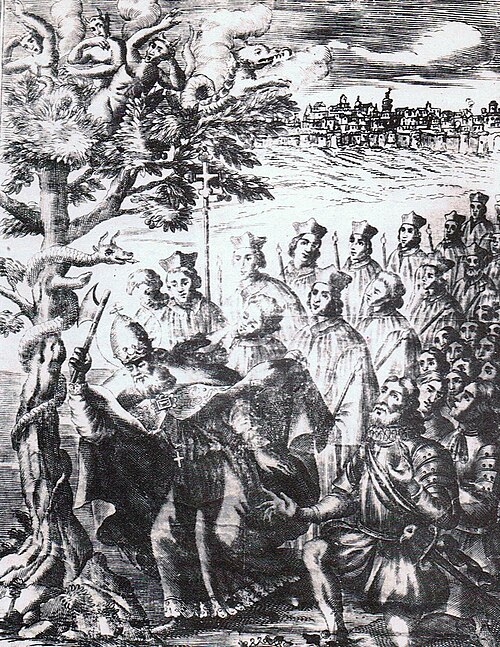
In those days the people of Benevento still kept some idolatrous superstitions, among them the veneration of a golden viper and of a local walnut tree. The Lombard prince, Romuald I, son of the Arian king Grimoald I, was himself involved in these practices. Barbatus preached regularly against them, but was not heeded. Later he warned the people of the city of the great trials they would soon suffer from the East Roman emperor Constans II and his army, which landed in the area and besieged Benevento. The people, in fear, renounced the practices that Barbatus had condemned. He then cut down the walnut tree the locals venerated and melted the viper into a chalice for the use of the church.
Barbatus also devised a practical resistance to Constans. In 1903 the foundations of the temple of Isis were discovered near the arch of Trajan in Benevento, with many fragments of fine sculptures, Egyptian and Greco-Roman, which belonged to it. They had been used as foundation for part of the city wall, rebuilt in 663 for fear of an attack by Constans, the temple having been demolished by order of Barbatus to provide the necessary material. The bishop of Benevento, Ildebrand, died during the siege, which ended, as Barbatus had foretold, with the defeat of Constans. After the withdrawal of the invaders Barbatus was made bishop on 10 March 663 and continued his struggle against superstition. In 673 Duke Romuald placed the grotto of Saint Michael at Gargano in the care of Barbatus.
The council and death
In 680 he took part in the council held by Pope Agatho, and in 681 in the sixth general council at Constantinople against the Monothelites. He died shortly after the end of the council, on 19 February 682, at about seventy years of age. The Roman Martyrology places him among the chief patrons of the city of Benevento. He is patron also of Cicciano, Castelvenere, Casalattico and Valle dell'Angelo. Since 1687 his relics rest beneath the high altar of the cathedral of Benevento.
Commemorated the same day February 19
 ArchippusApostle · Apostle of the SeventyFeb 19
 PhilemonApostle · Apostle of the SeventyFeb 19
 Beatus of LiébanaConfessor · Spanish monk and theologianFeb 19
 Quodvultdeus of CarthageConfessor · Bishop of CarthageFeb 19
 Philothei of AthensVenerable Martyr · Nun of AthensFeb 19
 Dositheus of GazaVenerable · Disciple of Dorotheus of GazaFeb 19
 Mansuetus of MilanSaint · Archbishop of MilanFeb 19
- Conon of PentuclaVenerable · Abbot of PentuclaFeb 19
- Sylvester of AlexandriaSaint · Patriarch of AlexandriaFeb 19
- Baoithin son of GuanaSaintFeb 19
- Daigh son of NenuaillSaintFeb 19
- Dionysios of SiatistaVenerable · of St Demetrius Skete (Vatopedi)Feb 19