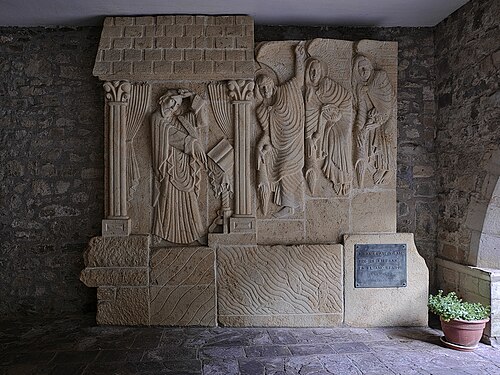
Confessor
Beatus of Liébana
Spanish monk and theologian
Spanish monk, author of a Commentary on the Apocalypse compiled from the views of earlier authorities.
- Feast
- February 19old style March 4
- Reposed
- 7988th century
- Place
- Monastery of Santo Toribio de Liébana
- Order
- Confessors
Life
Beatus of Liébana was a monk and theologian of the kingdom of Asturias, in Spain, in the eighth century, author of a Commentary on the Apocalypse. He is venerated as a saint chiefly in the Roman Catholic Church and in Spain, and his commemoration is on 19 February. Almost nothing is known of him apart from his work, and his book became famous for its richly illustrated manuscripts, which are inscribed in the Memory of the World Register.
The monk of Liébana
Beatus was a monk and probably an abbot of the monastery of Santo Toribio de Liébana, in Cantabria, part of the kingdom of Asturias, the only region of Spain that remained outside Muslim rule. He is thought to have been one of the many monastic refugees who moved north, to the Christian lands, after the Muslim conquest of the south and centre of the country. His contemporaries knew him well. He corresponded with the scholar Alcuin and enjoyed the trust of Queen Adosinda, daughter of Alfonso I of Asturias and wife of Silo. He was present when Adosinda took the monastic habit, in 785, the last sure record of his life. A so-called Life of Beatus has been shown to be a seventeenth century forgery without historical value.
The Commentary on the Apocalypse
His most important work is the Commentary on the Apocalypse, written in 776 and revised in 784 and in 786, dedicated to Etherius of Osma. It is a work of erudition, but without great originality, made up chiefly of extracts from Fathers of the Church, among them Augustine, Tyconius, Ambrose, Irenaeus, Jerome and Isidore of Seville. He relied most heavily on the lost commentary of Tyconius. Beatus saw in the Apocalypse a mirror of the history of the Church and expected the end of the world to be near, about the year 800.
The book was widely read in medieval Spain and survives in more than thirty manuscripts of the ninth to thirteenth centuries, many illustrated with brilliant miniatures, outstanding in Mozarabic art, among them the Morgan Beatus and the Saint-Sever Beatus. It seems that Beatus planned the book with illustrations from the start, and the first images, which have not survived, are attributed to him. In the second book there is a world map, with four continents instead of three and with paradise from which four rivers flow, showing the places where the apostles preached. Several hymns that entered the Mozarabic liturgy are also attributed to him, among them one in honour of the Apostle James. He also strengthened in Spain the conviction that James brought Christianity to the peninsula.
Against Adoptionism
Beatus was a determined opponent of Adoptionism, the teaching that Christ was the Son of God by adoption, upheld in Spain by Elipandus, bishop of Toledo, and Felix of Urgell. With Etherius he wrote in 786 the Book against Elipandus, fearing that such a teaching would divide the person of the Saviour and lose the reality of the Incarnation. In 794 Elipandus attacked him in a letter to the bishops of Gaul, calling him a false prophet for having announced the end of the world. Charlemagne gathered the Council of Frankfurt in the same year, which rejected Adoptionism.
He fell asleep about the year 798, in his monastery.
Commemorated the same day February 19
 ArchippusApostle · Apostle of the SeventyFeb 19
 PhilemonApostle · Apostle of the SeventyFeb 19
 Quodvultdeus of CarthageConfessor · Bishop of CarthageFeb 19
 Philothei of AthensVenerable Martyr · Nun of AthensFeb 19
 Dositheus of GazaVenerable · Disciple of Dorotheus of GazaFeb 19
 Mansuetus of MilanSaint · Archbishop of MilanFeb 19
 Barbatus of BeneventoSaint · Bishop of BeneventoFeb 19
- Conon of PentuclaVenerable · Abbot of PentuclaFeb 19
- Sylvester of AlexandriaSaint · Patriarch of AlexandriaFeb 19
- Baoithin son of GuanaSaintFeb 19
- Daigh son of NenuaillSaintFeb 19
- Dionysios of SiatistaVenerable · of St Demetrius Skete (Vatopedi)Feb 19