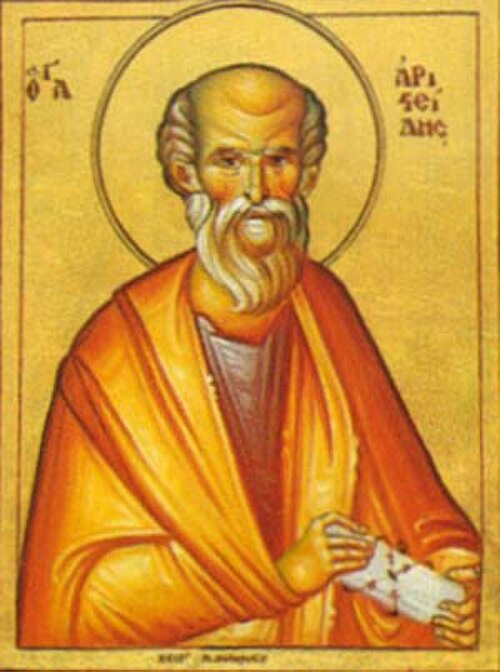
Martyr
Aristides of Athens
Christian apologist
Athenian philosopher turned Christian, author of an Apology in the second century.
Life
Saint Aristides of Athens was a philosopher who became a Christian and wrote, in the second century, the oldest complete Christian apology that has survived. The Orthodox Church keeps his memory on 13 September, and the Catholic Church on 31 August.
What is known of him
Very little is known of his life. The main witnesses are Eusebius of Caesarea and Saint Jerome, writing in the fourth century. Eusebius calls him a faithful follower of the Christian religion who left an Apology addressed to the emperor Hadrian, and says that many still kept it in his own day. Jerome adds that Aristides was a philosopher at Athens. Eusebius's Chronicle places the Apology in the year 125, when Hadrian was in Greece.
The Syriac version of the text gives a second heading, addressed to Antoninus Pius, who also bore the name Hadrianus. Because of this, scholars disagree: some date the work to about 124 or 125, others to about 140. Nothing is known for certain about the place or year of his death. The Orthodox menologia call him a martyr, but the sources available to us do not describe how he died.
The Apology
For centuries the work was believed lost. In 1878 the Mekhitarist fathers of Venice published an Armenian fragment from a tenth-century manuscript. In 1889 Rendel Harris found a complete Syriac translation at the monastery of Saint Catherine on Mount Sinai. J. A. Robinson then recognised that the Greek text lies, in a reworked form, inside the seventh-century Life of Barlaam and Joasaph, where it is given as a speech of the hermit Nachor before King Abenner. Greek fragments on papyrus were published in 1922.
Aristides begins from the order of the world, which shows that there is one God, eternal and perfect. He then divides humankind into four peoples: barbarians, Greeks (including the Egyptians and Chaldeans), Jews and Christians. He reproaches the first two for worshipping the elements, created things and gods who are shown with human vices. He grants the Jews the worship of one Creator, but says they go astray by serving angels and keeping observances. Christians, he says, know God through His Son Jesus Christ, born of a Virgin, crucified and risen.
The end of the Apology describes how Christians live: they do not bear false witness, they love one another and their enemies, they feed the hungry and clothe the naked, they ransom captives and bury the dead, and when one of them is poor they fast for two or three days in order to give him food. He asks the emperor to see this and to stop persecuting them.
Some have suggested that Aristides also wrote the Epistle to Diognetus, but this is only a suggestion.
Commemorated the same day August 31
 Aidan of LindisfarneSaint · Bishop of LindisfarneAug 31
 Gennadius of ConstantinopleSaint · Patriarch of ConstantinopleAug 31
 Paulinus of TrierSaint · Bishop of TrierAug 31
 WalaSaint · Adviser to CharlemagneAug 31
 CuthburhVenerable · First abbess of WimborneAug 31
 Martyrs of JasenovacHoly New Martyrs · Serbian new martyrsAug 31
- Macarie the ProtopsaltesVenerable · Hieromonk and protopsaltesAug 31
- 366 Martyrs of NicomediaHoly MartyrsAug 31
- Aedh of Cuil MaineSaint · DeaconAug 31
- Alexander LyubimovHieromartyrAug 31
- AndrewMartyrAug 31
- Barbolenus of BobbioVenerable · Abbot of BobbioAug 31