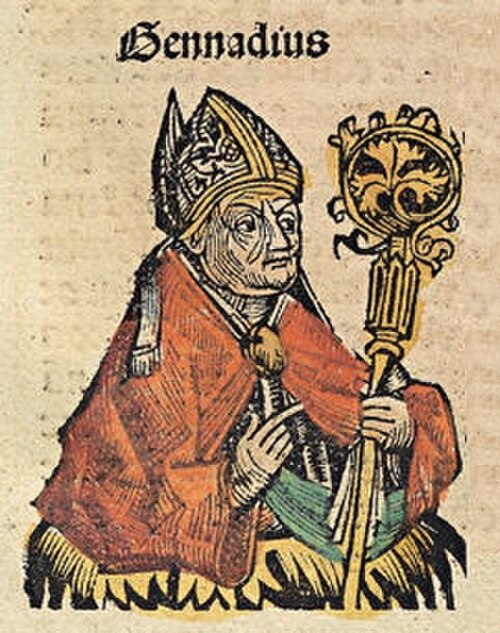
Saint
Gennadius of Constantinople
Patriarch of Constantinople
Patriarch of Constantinople from 458 to 471, a learned writer of the Antiochene school of exegesis.
Life
Saint Gennadius of Constantinople, hierarch, was patriarch of Constantinople from the year 458 until his repose in 471, and a learned writer of the school of Antioch, which interpreted Scripture according to its letter. He came from Antioch. He took particular care for the discipline of the Church and fought against simony and monophysitism, holding firmly to the decisions of the Council of Chalcedon. The Church commemorates him on 17 November in the Greek calendar, and in the Slavic tradition on 31 August.
Before the throne
Gennadius was a native of Antioch and, before he was chosen patriarch, he was a presbyter at Hagia Sophia in Constantinople. According to some sources he had first been abbot of a monastery in the city. In 431 and 432 he wrote against Saint Cyril of Alexandria and his twelve anathemas, in the spirit of the Antiochene tradition. Fragments of his writings were preserved by Facundus. He is believed to have been reconciled with Cyril afterwards, although it is not certain that Cyril's letter of 434 was addressed to him.
Ministry
In 458 he succeeded Patriarch Anatolius in the see of Constantinople. Supporters of Chalcedon long regarded him as the last Orthodox patriarch of the city before the time of Zeno's Henotikon. The chroniclers praise his gentleness, purity and sense of order.
When the monophysite Timothy Aelurus, driven from the see of Alexandria, asked to come to Constantinople, Pope Leo I wrote to Gennadius on 17 June 460 to stop him and to see that an Orthodox bishop was quickly consecrated for Alexandria. Timothy was sent into exile, and Timothy Salophakiolos was chosen in his place. Gennadius appointed Marcian, a former Novatianist who had joined the Great Church, as steward of the Church's goods, and he admitted no one to the clergy who did not know the Psalter by heart, as Theodore Lector writes.
In 458 or 459, at a council of about eighty bishops, many from the East and even from Egypt, he took measures against simony, the buying and selling of holy orders. The circular letter of that council, which adds the penalty of anathema to the decisions of Chalcedon, is the only one of his writings preserved complete. In his time the church of Saint John the Baptist was built by the consul Studius, where the Akoimetoi monks settled and from which the Stoudios monastery came to be.
The Life of Saint Daniel the Stylite tells that, at the request of the emperor Leo I, Gennadius ordained him priest. Daniel did not want to come down from his pillar and would not let the patriarch climb up, so most of the service was held from below. At the end the patriarch did go up to give him communion and to receive it from him.
According to the Spiritual Meadow of John Moschus, Gennadius reproved and punished a reader of the church of Saint Eleutherius, a man of evil conduct. When none of these means helped, the patriarch sent word to the martyr to correct him or take him from the world, and the next day the reader was found dead. Theodore Lector adds that a painter who dared to depict the Saviour in the form of Zeus had his hand withered, but was healed by the prayers of the patriarch.
Writings
Gennadius wrote commentaries on Genesis, Exodus, the Psalms, Daniel, the minor prophets and the epistles of Saint Paul, as well as homilies. Of these mostly fragments survive, included in collections of commentaries called catenae. The most important of the surviving writings is his commentary on the Epistle to the Romans.
His end
The sources tell his end differently. According to some sources he fell asleep in peace at Constantinople in 471. According to Cypriot tradition, he left the throne in 471, leaving the presbyter Acacius in his place, and went as a simple monk on pilgrimage to the Holy Places and then to Cyprus. Wandering near Paphos in search of the cell of Saint Hilarion, he died of the cold in the village of Moro Nero. He was buried there, and a church was built over his tomb in his name, whose ruins can still be seen. It is said that the villagers did not believe he was a patriarch and gave him no shelter that winter.
Commemorated the same day August 31
 Aristides of AthensMartyr · Christian apologistAug 31
 Aidan of LindisfarneSaint · Bishop of LindisfarneAug 31
 Paulinus of TrierSaint · Bishop of TrierAug 31
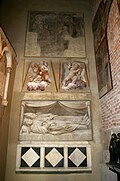 WalaSaint · Adviser to CharlemagneAug 31
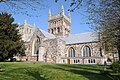 CuthburhVenerable · First abbess of WimborneAug 31
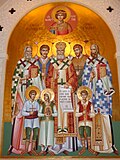 Martyrs of JasenovacHoly New Martyrs · Serbian new martyrsAug 31
- Macarie the ProtopsaltesVenerable · Hieromonk and protopsaltesAug 31
- 366 Martyrs of NicomediaHoly MartyrsAug 31
- Aedh of Cuil MaineSaint · DeaconAug 31
- Alexander LyubimovHieromartyrAug 31
- AndrewMartyrAug 31
- Barbolenus of BobbioVenerable · Abbot of BobbioAug 31