Saint
Wala
Adviser to Charlemagne
Adviser to Charlemagne, Louis the Pious and Lothair I, abbot at Corbie, who died in 836.
- Feast
- August 31old style September 13
- Reposed
- 8369th century
- Place
- Bobbio
Life
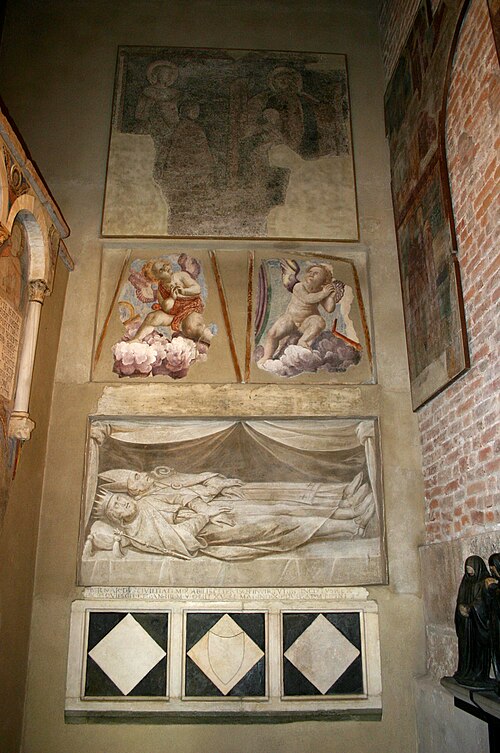
Saint Wala (Wala of Corbie or of Corvey) was a Carolingian noble, cousin of Charlemagne, adviser of the emperors Charlemagne, Louis the Pious and Lothair I, then monk and abbot at Corbie, Corvey and Bobbio. Born between 755 and 772 (sources give different dates), he died on 31 August 836 at Bobbio monastery in northern Italy. He is a saint of the pre-Schism West; he is commemorated on 31 August.
Family and youth
Wala was the son of Bernard, natural son of Charles Martel, and of a Saxon woman, so first cousin of Charlemagne and half-brother of Adalard the Younger, who was abbot of Corbie until 826. He also had a full brother, Bernarius, and two sisters, Gundrada and Theodrada, abbess of Notre-Dame of Soissons. He was brought up in the school of the royal palace, with Adalard, and both were known for honesty, honour and zeal. In youth he lost for a time his cousin's favour: in 792 it was supposed that he was involved in the conspiracy of Pepin the Hunchback, Charles's son, and he was banished from court and kept under the watch of magnates loyal to the king; but he regained favour. He is believed to have married Rothlindis, daughter of Count William of Toulouse, and was widowed before he became a monk. Under Charlemagne he rose to be second-in-command of the emperor and, like his brother-in-law Gerold in Bavaria, was charged with administering Saxony; in 811 he was count of the palace.
Under Louis the Pious
At Charlemagne's death Wala came to the new king, Louis the Pious, and gave homage, by the Frankish custom. But in 814, to remove any political disloyalty, Louis forced him to become a monk at Corbie. Almost all of Charlemagne's old advisers were removed from court, but in 821 Louis recalled Adalard from exile at Corbie and invited Wala to court; in 822, before the people, at Attigny, he did public penance for the way he had treated his father's advisers. Wala then went to court, where he met the old advisers. In 816 he and Adalard had been given the task of organizing the convent of Herford, recently passed under Louis at the Council of Aachen. In the 820s he became a determined opponent of royal and imperial control of church revenues. According to Paschasius Radbertus, he once said that the "army of clerics", that is the chaplains of the palace at Aachen, served only for personal gain and were not a legitimate church institution. At the death of King Bernard of Italy, in autumn 822, Wala, forty-nine by some reckonings, was called by the emperor to help his son Lothair I govern Italy and to serve as intermediary with the papacy.
Rebellions
Wala was a supporter of the unity of the Frankish empire and on several occasions supported Lothair, eldest son of Louis, in his rebellions against his father. In May 830 a short revolt of clergy and laity, with Louis's three elder sons, succeeded in shutting Empress Judith in a convent at Poitiers and sending her brothers to monasteries, and pressed the emperor to abdicate. The revolt was short-lived, and Wala was exiled first to a mountainous region near Lake Geneva, then to Noirmoutier, where his brother Adalard had also been exiled. In 833 he was recalled from exile and helped the three sons again, Lothair, Louis the German and Pepin, against their father, Empress Judith and her son Charles: the uprising began from Louis's decision to take Aquitaine from Pepin and give it to Charles, and Lothair took his father prisoner. Wala took part in the council of Compiègne in October 833, where the emperor was removed from the throne. When Louis returned to power, Wala fled to Italy with Lothair. In 836 his opposition was forgiven and he was allowed to return to Italy, because he persuaded Lothair to come and see the emperor. With Paschasius Radbertus he led Pope Gregory IV to sign the answer to the bishops, in which for the first time the aspiration of spiritual power to precedence over the secular was shown.
Monastic life
According to the "Life of Wala" by Paschasius Radbertus, Wala embraced the monastic life fully; he was content with ordinary clothes and shoes of the region and thought it unnecessary for a monk to dress better than those around. He sought to be loved rather than feared. After the emperor's return to favour in the 820s, he helped his brother Adalard found New Corvey in Saxony; he convinced Theodradus to give up his ancestral inheritance for New Corvey, and his military skill from his early days kept Saxon bandits away from the lands of the new monastery. After his service in Italy, in 825 he returned to Francia and, with the emperor's approval, went with Adalard to Saxony and formally organized the community. In Italy he also obtained for Corbie a copy of the Roman antiphonary. He had a special interest in the Danish mission of Ansgar, monk both of Corbie and of New Corvey. After Adalard's death in 826 he became abbot of Corbie. In 831 he left Corbie, and in 834 was abbot of Bobbio, in whose church he was buried.
His thought
Back at court in 821, Wala voiced his opinions on reform of Church and state. He tried to establish procedures to curb the squandering of wealth by Carolingian officials. In a letter of 826 to him and Archchaplain Hilduin, Bishop Agobard observed that Wala was always at court as one of Louis's most godly counsellors. Many sources show that Wala opposed the division of the empire among Louis's four sons and wanted its unity. He attributed the weakening of the empire to the turn toward the secular, to the depriving of the Church of its rights, while bishops busied themselves with affairs of state, but he held that the Church has the right to intervene in matters like the partition of the kingdom. In the Life of Wala Paschasius Radbertus shows him speaking in 829 of the greed and avarice of the chaplains of the court, of laymen placed over monasteries and of a "filthy disease within the Church" of corrupted clerics, some of whom had no spiritual authority and served for no reason other than profit.
Commemorated the same day August 31
 Aristides of AthensMartyr · Christian apologistAug 31
 Aidan of LindisfarneSaint · Bishop of LindisfarneAug 31
 Gennadius of ConstantinopleSaint · Patriarch of ConstantinopleAug 31
 Paulinus of TrierSaint · Bishop of TrierAug 31
 CuthburhVenerable · First abbess of WimborneAug 31
 Martyrs of JasenovacHoly New Martyrs · Serbian new martyrsAug 31
- Macarie the ProtopsaltesVenerable · Hieromonk and protopsaltesAug 31
- 366 Martyrs of NicomediaHoly MartyrsAug 31
- Aedh of Cuil MaineSaint · DeaconAug 31
- Alexander LyubimovHieromartyrAug 31
- AndrewMartyrAug 31
- Barbolenus of BobbioVenerable · Abbot of BobbioAug 31