Venerable
Macarie the Protopsaltes
Hieromonk and protopsaltes
Hieromonk and chief cantor, translator and theorist of psaltic music in Wallachia; died in 1836 at Viforâta.
- Feast
- August 31old style September 13
- Reposed
- 183619th century
- Place
- Viforâta monastery
- Order
- Venerables
Life
Saint Macarie the Protopsaltes (1763 - August 1836) was a Romanian hieromonk, protopsaltes, translator and theorist of psaltic music in Wallachia, regarded as one of the founders of Romanian psaltic music in modern notation. He had a major role in introducing and spreading the new method of psaltic notation in Romanian lands and in translating the Byzantine repertoire into Romanian. He was canonized by the Romanian Orthodox Church in 2023 and is commemorated on 31 August.
Origin and formation
He was born in 1763 in a family of lesser nobles of the Periețeanu line. He studied for a time at Odessa, where he learned Greek. After entering monastic life on Mount Athos, he was ordained hieromonk in Bucharest around 1785, becoming a servant of the princely Court and of the Metropolis of Ungro-Wallachia. He received his monastic name in honor of Archimandrite Macarie the Teacher, translator of some patristic works into Romanian, close to the spiritual tradition of Paisius Velichkovsky. In Bucharest he was a disciple of the protopsaltes Constantin Moldoveanul, from whom he learned the art of psaltic music and the techniques of Byzantine composition. In 1804 he was briefly preacher of the princely Court, but the next year he withdrew to study music at Iași with Petros Byzantios, former protopsaltes of the Patriarchate of Constantinople, brought to Moldavia by Metropolitan Veniamin Costachi. After his teacher's death, in 1808, Macarie returned to Bucharest and was appointed abbot of the Golgotha skete near Târgoviște.
The new method of psaltic notation
At the beginning of the nineteenth century the Ecumenical Patriarchate began the reform of the system of Byzantine musical notation. The new method, called Chrysanthine notation, was drawn up by Archimandrite Chrysanthos of Madytos, Gregorios the Lampadarios and Chourmouzios the Chartophylax. The princely courts of Bucharest and Iași supported financially the organization of schools of psaltic music, and Prince Ioan Caragea decided in 1816 to found a music school in Bucharest. Macarie was among the Romanian musicians who worked on it. In 1817, when the professor Petros of Ephesus came to Bucharest, he became his pupil, to learn the new notation. In 1818 he began the translation into Romanian of the Anastasimatarion of Petros Lampadarios of the Peloponnese, the first work translated in this notation.
Teaching and publishing
In 1819, at the enthronement of Metropolitan Dionysius Lupu, Macarie delivered the eulogy and was named head of the psaltic music schools of the Metropolis of Ungro-Wallachia. In 1820 he also became head of the metropolis's press for psaltic music in Romanian. Because of the political upheavals brought by the outbreak of the Greek revolution of 1821, printing was interrupted. He took refuge at Sibiu with Metropolitan Dionysius Lupu and tried to print some of the works there. After a failure, he went to Budapest, where he was supported by the philanthropist Atanasie Grabovsky, uncle of the future Metropolitan Andrei Șaguna. After opposition from some Greek clergy, he was called to Vienna by the great Macedo-Romanian financier and philanthropist Gheorghe Sina, who offered to pay for printing the works in Romanian.
In Vienna, in 1822, Macarie printed the first books of psaltic music in Romanian: the Anastasimatarion-Heirmologion of Petros Lampadarios of the Peloponnese, the Heirmologion of katavasiai, and the Theoretikon, the first manual of psaltic music in Romanian. In 1823 he returned to Bucharest with a large part of these volumes. After his return, Metropolitan Grigorie the Teacher named him ephor of the psaltic schools of the Metropolis of Ungro-Wallachia. The graduates of the first generation were sent to the great towns of Wallachia (Craiova, Buzău, Râmnicu Vâlcea, Câmpulung Muscel, Ploiești) in summer 1825. In 1828 he was called to Iași as music professor and named abbot of Bârnova monastery, but the outbreak of the Russo-Turkish war of 1828-1829 prevented the founding of a music school at the Metropolis of Moldavia.
Last years
In 1831 he withdrew to Neamț monastery, where until 1834 he worked on the completion of some musical compositions and translations, among them a large version of the Heirmologion Kalophonikon. In 1834, at the call of Metropolitan Grigorie the Teacher, he moved to Căldărușani monastery to prepare a new edition of the Lives of the Saints, finished in 1836. Here too he reprinted in 1835 the "Mirror of the Inner Man", after the edition of Neamț monastery. In 1835 he was called to Buzău by Bishop Chesarie of Buzău to print the book of the Funeral Service; at the same time he taught psaltic music at the newly founded seminary, and among his pupils was the future Metropolitan Iosif Naniescu. In August 1836 he suffered a stroke and was brought to Viforâta monastery near Târgoviște, where he died at the end of the same month, at the age of 73.
Canonization and works
On 25-26 October 2023 the Holy Synod of the Romanian Orthodox Church approved the canonization of Saint Macarie the Protopsaltes and his entry in the church calendar on 31 August; the decision included the approval of the liturgical texts (synaxarion, akathist and service) and of the official icon. An important part of his compositions and translations has been edited in our time at Petru Vodă monastery, by Sophia Publishing House: Paisian Anthologion (vol. I, 2005), Paisian Pentecostarion (2018, revised edition 2023), Paisian Kalophonikon (2023), Anastasimatarion. Paisian Vigil (2023) and Paisian Triodion, 1 (2024). He is regarded as one of the pioneers of modern Romanian psaltic music; our source breaks off here, at the start of the chapter on his importance.
Commemorated the same day August 31
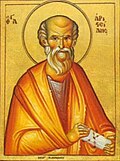 Aristides of AthensMartyr · Christian apologistAug 31
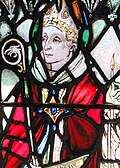 Aidan of LindisfarneSaint · Bishop of LindisfarneAug 31
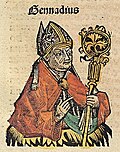 Gennadius of ConstantinopleSaint · Patriarch of ConstantinopleAug 31
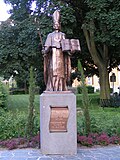 Paulinus of TrierSaint · Bishop of TrierAug 31
 WalaSaint · Adviser to CharlemagneAug 31
 CuthburhVenerable · First abbess of WimborneAug 31
 Martyrs of JasenovacHoly New Martyrs · Serbian new martyrsAug 31
- 366 Martyrs of NicomediaHoly MartyrsAug 31
- Aedh of Cuil MaineSaint · DeaconAug 31
- Alexander LyubimovHieromartyrAug 31
- AndrewMartyrAug 31
- Barbolenus of BobbioVenerable · Abbot of BobbioAug 31