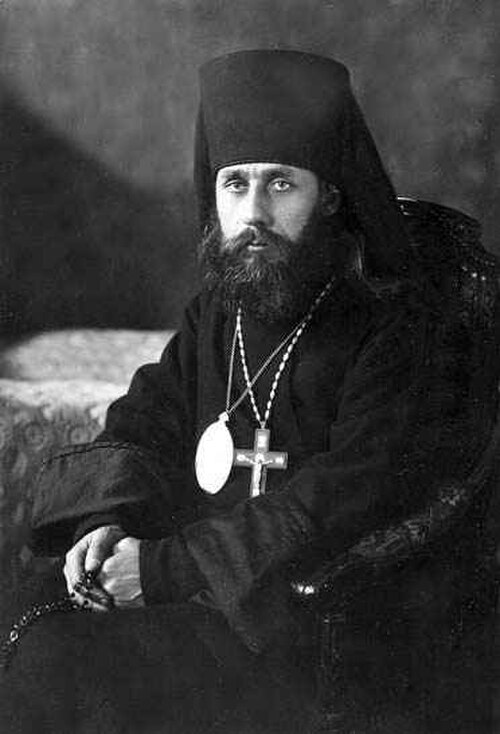
Hieromartyr
Arkady Ostalsky
Bishop of Bezhetsk
Bishop of Bezhetsk and vicar of the Kalinin diocese, executed on 29 December 1937 at the Butovo firing range.
- Feast
- December 16old style December 29
- Reposed
- 193720th century
- Place
- Butovo firing range
- Order
- Martyrs
Life
Saint Arkady Ostalsky, Hieromartyr, was Bishop of Bezhetsk, vicar of the Kalinin diocese, a preacher called "Chrysostom" by his contemporaries, who passed through prisons and the Solovki camp and was shot at the Butovo firing range near Moscow on 29 December 1937. He was born on 25 April (7 May) 1889 in the village of Skakovka in Volhynia. The Council of Bishops in 2000 numbered him among the New Martyrs of Russia. He is commemorated on 16 December.
Youth and priesthood
Born Arkady Iosifovich Ostalsky into a poor priest's family, of Iosif Venediktovich and Sofia Pavlovna, he was baptized on 16 May by his maternal grandfather, Fr Pavel Stefanovich. He spent his childhood at Skakovka, then at Zhitomir. From youth he dreamed of becoming a monk, but his parents insisted that he marry. He graduated in 1910 from the Volhynia seminary and was teacher at the parish school at Velikaya Tsvilya, assistant to the diocesan missionary and, in 1911, was ordained priest at the cathedral of Starokonstantinov, as assistant to the district missionary; he worked among sectarians. From 1914 he was a missionary in Galicia, from 1915 a military priest in an infantry regiment, and from 1917 he served at Zhitomir, at the church of Saint Seraphim of Sarov of the military hospital and then at the church of Saint Nicholas.
He preached much and was given the name "Chrysostom". In the civil war he founded at his church the Saint Nicholas brotherhood, which helped the needy and sick and buried the dead without relatives. He gave away all his goods to the needy: those close to him, knowing he had nothing, sewed him a fur coat, which he gave to a poor widow with two children sick with tuberculosis. With the brothers he made long pilgrimages on foot, among others to Kyiv.
First arrest
In 1922 he read in church Patriarch Tikhon's epistle against the confiscation of liturgical church objects and was arrested together with his father, who soon died in prison. He was sentenced to death, but at the request of the faithful the sentence was changed to five years' imprisonment. It is told that after the sentence he said: "I thank God for everything. For me death is gain." He served at Zhitomir and was released early, in 1924. His wife had meanwhile remarried, so a church divorce soon followed. In April 1924 he was tonsured a monk, with the blessing of Patriarch Tikhon, and raised to archimandrite. He went on serving and preaching much at Zhitomir.
Bishop
On 15 September 1926 he was named Bishop of Lubny, vicar of the Poltava diocese, and in October he was arrested and exiled to Kharkov. He fled exile, returned secretly to Lubny, served the Paschal service and, under threat of a new arrest, hid; he lived at New Athos in the Caucasus among monks. Knowing that he was sought and could be killed at any time, he carried his photograph in the lining of his boot, so that in case of death people would learn what became of him. Even so he kept in touch with the clergy of the Poltava diocese; one of his letters was distributed, without his knowledge, as an epistle to the flock at Lubny. He received Metropolitan Sergius's Declaration with criticism, but remained under his jurisdiction. In 1928 he fell gravely ill and moved to Kyiv, living illegally.
In May 1928 he came to Moscow and on 9 May presented himself to the secret police; he was arrested and accused of issuing an epistle to his flock of an "anti-Soviet" character (among other things, urging them to follow the example of the martyrs who "died for the freedom of the Church, for her holy traditions and even for books and vessels"). He refused to give the name of the priest to whom it had in fact been addressed. On 23 July 1928 he was sentenced to five years.
Solovki
He served his sentence in the Solovki camp, as a guard and at the hardest labour. One characterization said: "He does not obey camp regulations... has gathered around himself servants of the cult, agitating among them against the Renovationist current... Requires strict isolation and constant observation." He had authority among the clergy in the camp, held services and, in the hardest conditions, went on preaching, saying that "we must thank God that He has not yet taken from us the possibility of praying here, as before in the catacombs". In 1931 he was arrested in the camp, accused of "counter-revolutionary agitation, illegal meetings of an anti-Soviet organization under the guise of religious discussions". A witness said that "among the prisoners he enjoyed special popularity and every word of his was considered almost holy". He received five years from the secret police troika and was moved for a time to Sekirnaya Hill, a kind of internal prison with a very harsh regime.
A little freedom, and the end
In January 1937, after serving his sentence, he was released and secretly visited Kyiv and Zhitomir, meeting his spiritual children. In February he reached Moscow, where he was not allowed to live; Metropolitan Sergius named him Bishop of Bezhetsk, vicar of the Kalinin diocese, but the authorities did not let him go. For some months he lived in the village of Selishchi, with Archpriest Mikhail Dmitrov, whose nephews were exiled at Solovki. In May 1937 he went to the patriarchate and interceded for Archpriest Mikhail to receive the mitre; he brought it himself to Selishchi and placed it on his head. He was a friend of Archbishop Augustine Belyaev of Kaluga.
In September 1937, after Augustine's arrest, he tried to leave Kaluga but was arrested on the train, at the station. He was held in the Kaluga prison, then at Butyrka in Moscow. He did not admit guilt, saying at the interrogation: "After fifteen years of exile, I remain today in disagreement with Soviet power on the question of religion and the closing of churches." On 7 December an NKVD troika sentenced him to death and he was shot on 29 December 1937 at the range near Butovo. He was numbered among the New Martyrs and Confessors of Russia by the Council of Bishops in August 2000, for veneration throughout the Church.
Commemorated the same day December 16
 HaggaiProphet · The ProphetDec 16
 Adelaide of BurgundyRight-Believing · Holy Roman EmpressDec 16
 Ado of VienneSaint · Archbishop of VienneDec 16
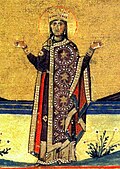 TheophanoRight-Believing · Empress, wife of Leo VIDec 16
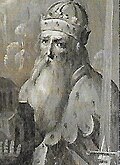 Eberhard of FriuliRight-Believing · Duke of FriuliDec 16
 Nicholas II ChrysobergesSaint · Patriarch of ConstantinopleDec 16
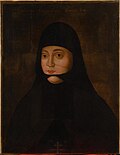 Sophia of SuzdalVenerable · Former Grand Princess of MoscowDec 16
 AlbinaMartyr · Virgin martyrDec 16
 Memnon of EphesusSaint · Metropolitan of EphesusDec 16
 Job of ManiavaVenerable · Founder of Maniava SketeDec 16
 Peter ZinovyevHieromartyr · PriestDec 16
- Irenion of GazaSaint · Bishop of GazaDec 16