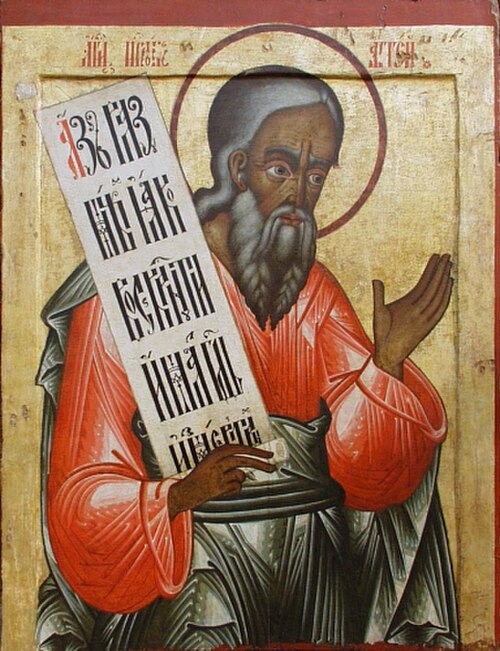
Prophet
Haggai
The Prophet
One of the twelve minor prophets, who urged the Jews to rebuild the Temple.
- Feast
- December 16old style December 29
- Born
- 550 BC5th century BC
- Order
- Prophets
Life
Saint Haggai the Prophet (in Romanian Agheu) is the tenth of the twelve minor prophets of the Old Testament and the first of the prophets after the return from the Babylonian captivity. He urged the people to rebuild the Temple in Jerusalem. His name means "my feasts." The Orthodox Church commemorates him on 16 December.
His time
Very little is known about Haggai's life. The book calls him simply "Haggai the prophet," without his father's name or place of origin. The synaxarion says that he came as a young man from Babylon to Jerusalem after the return from exile, and that he prophesied together with the Prophet Zechariah. Church tradition counts him of the tribe of Levi, of the line of Aaron. He is also mentioned in the Book of Ezra (5:1; 6:14), with Zechariah, as a supporter of the rebuilding of the Temple.
Those who had returned to their homeland found a city in ruins. They laid the foundation of the new Temple, but work stopped for many years because of the opposition of neighbours and hardship. The people thought first of their own houses, and the house of the Lord remained in ruins.
The prophecy
The Book of Haggai has only two chapters and contains four words of the Lord, spoken in the second year of King Darius (520 before Christ), between the sixth month and the ninth. They are addressed to Zerubbabel, governor of Judah, to the high priest Joshua and to the people. The first word rebukes those who lived in finely finished houses while the house of the Lord lay in ruins (Haggai 1:4). The prophet shows them that their want and their droughts come from forgetting the house of God. The people obeyed, and on the twenty-fourth day of the sixth month the work began, with the promise, "I am with you" (1:13).
The second word encouraged those who remembered the glory of Solomon's Temple and thought the new Temple of little account. Haggai announced that the glory of the latter house would be greater than the former, and that in that place the Lord would give peace (2:9). The Church has understood these words as announcing the coming of Christ into the Temple built after the captivity. The third word calls the people to purity and promises plenty once the work is begun. The fourth, addressed to Zerubbabel, announces the shaking of the heavens and the earth, and the Lord calls Zerubbabel His servant and makes him like a signet ring, that is, chosen (2:23). Christian commentators see here a prefiguring of Christ, who was born of the line of Zerubbabel.
The Temple was dedicated in 516 before Christ, in the sixth year of Darius (Ezra 6:15).
Veneration
According to tradition, Haggai was buried in Jerusalem with the priests, since he was of the line of Aaron. The Church commemorates him on 16 December, by the old calendar.
Commemorated the same day December 16
 Adelaide of BurgundyRight-Believing · Holy Roman EmpressDec 16
 Ado of VienneSaint · Archbishop of VienneDec 16
 TheophanoRight-Believing · Empress, wife of Leo VIDec 16
 Eberhard of FriuliRight-Believing · Duke of FriuliDec 16
 Nicholas II ChrysobergesSaint · Patriarch of ConstantinopleDec 16
 Sophia of SuzdalVenerable · Former Grand Princess of MoscowDec 16
 AlbinaMartyr · Virgin martyrDec 16
 Memnon of EphesusSaint · Metropolitan of EphesusDec 16
 Job of ManiavaVenerable · Founder of Maniava SketeDec 16
 Arkady OstalskyHieromartyr · Bishop of BezhetskDec 16
 Peter ZinovyevHieromartyr · PriestDec 16
- Irenion of GazaSaint · Bishop of GazaDec 16