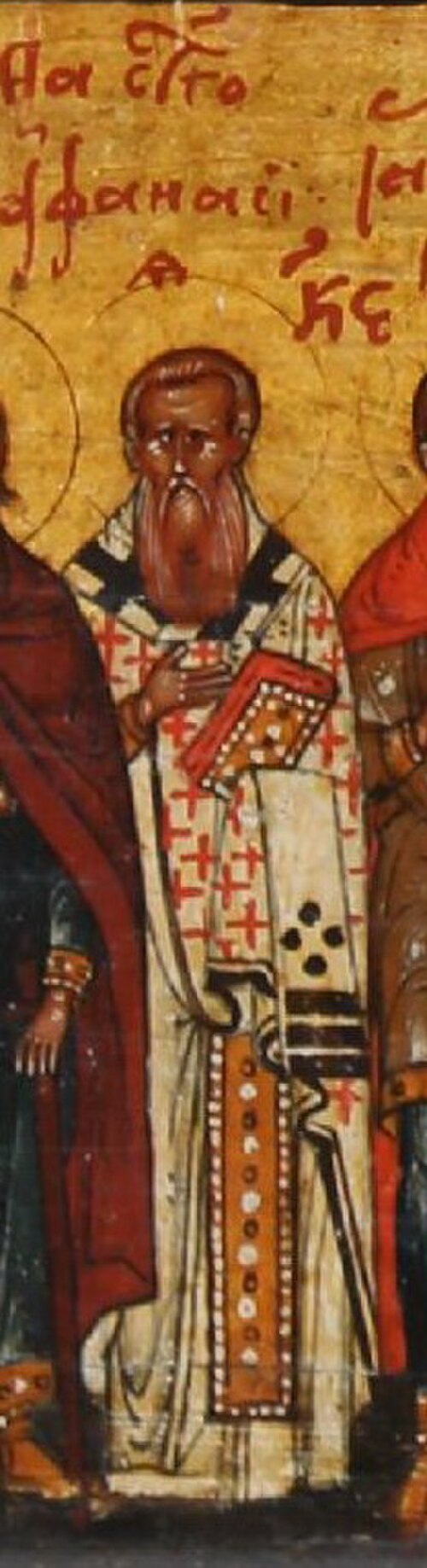
Saint
Athanasius I of Constantinople
Patriarch of Constantinople
Ecumenical Patriarch in 1289 to 1293 and 1303 to 1309, born in Adrianople, who died in 1310.
- Feast
- October 24old style November 6
- Reposed
- 131014th century
- Place
- Constantinople
- Order
- Hierarchs
Life
Saint Athanasius I, Patriarch of Constantinople, led the Church of Constantinople twice, from 1289 to 1293 and from 1303 until the end of 1309 or the beginning of 1310. Born at Adrianople between 1230 and 1235, he was a strict monk, a fighter against union with Rome and a reformer of church life. His contemporaries called him the new Chrysostom, and the Church honors him in October.
Monastic youth
His baptismal name was Alexios; his parents, according to the tradition of his life, were called George and Euphrosyne. While still young he became a monk at Thessalonica, receiving the name Acacius, and lived on Mount Ganos in Thrace and then on Mount Athos, where he dwelt in a cave near the Iviron monastery, still preserved today, and served as refectorian of the Esphigmenou monastery. Passing through Jerusalem and other holy places of Asia Minor, he came to Mount Galesios, where he stayed eight years; there he received the great schema, with the name Athanasius, and was ordained deacon and priest against his will.
In the time of Patriarch John Bekkos, a champion of union with Rome, he was persecuted for his steadfast opposition to it and was regarded by his contemporaries as a confessor. He had no great learning, but stood out for his asceticism, for the strictness of his conduct and views and for his opposition to union with the Church of Rome.
First patriarchate
Emperor Andronikos II Palaiologos proposed him as patriarch, and on 14 October 1289 he was elected. With the emperor's support he showed great love for the poor and fought corruption and food speculation in Constantinople. He tried to impose strict discipline on monks who wandered the provinces instead of staying in their monasteries and on bishops who lived in the capital instead of their dioceses, because of the Turkish invasions. This reform brought him into conflict with the patriarchs of Alexandria and Antioch, who were living in the capital. Some bishops returned to their dioceses, but his measures, together with his harsh temper, made him many enemies. In October 1293, the synod, without the emperor's consent, according to some sources, removed him from the throne, and he left the patriarchate and withdrew to a monastery.
Second patriarchate
In September 1303, after a terrifying earthquake, Emperor Andronikos recalled him. In June 1308 he ordained Peter as metropolitan of Kiev and all Russia. The party of clergy favorable to union forced him to retire in early 1310, or in September 1309. He withdrew to the Xerolophos monastery in Constantinople, where he died in extreme old age, in 1310 by most sources and later by others. There his veneration as a saint began. A rich correspondence of his survives, with the emperor, with hierarchs and with officials, a precious source for the history of the time.
Veneration
Saint Athanasius was glorified among the saints; the Church commemorates him on 24 October by the old calendar, and the Greek Church on 28 October.
Commemorated the same day October 24
 Elesbaan of AksumRight-Believing · King of AksumOct 24
 Arethas of NajranMartyr · Leader of the Christians of NajranOct 24
 Eberigisil of CologneSaint · Bishop of CologneOct 24
 Zosima VerkhovskyVenerable · Schemamonk and spiritual writerOct 24
 Alexei PorfiryevHieromartyr · ArchpriestOct 24
 Laurentius KnyazevHieromartyr · Bishop of BalakhnaOct 24
 Alexis NeidgardtMartyr · Member of the State CouncilOct 24
- Syncletica of NajranMartyrOct 24
- AcaciusHieromartyr · the PresbyterOct 24
- Arefa MitreninConfessorOct 24
- CadfarchVenerableOct 24
- CaetiSaintOct 24