Right-Believing
Elesbaan of Aksum
King of Aksum
King of Aksum, in present-day Ethiopia and Eritrea, from 514 to 542, venerated in the East.
- Feast
- October 24old style November 6
- Reposed
- 5406th century
- Place
- Kingdom of Aksum
Life
Saint Elesbaan, the right-believing king, called also Caleb or Ella Asbeha, was king of Aksum, in present-day Ethiopia and Eritrea, in the first half of the sixth century. He was honoured for his protection of the Christians of southern Arabia. He is commemorated on 27 October, and in some Orthodox calendars on 6 November.
His name
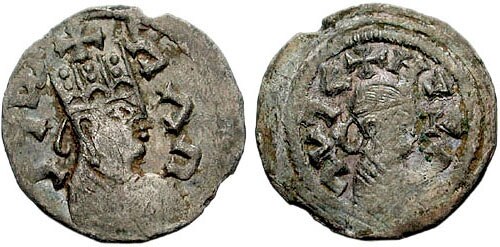
His baptismal name is Caleb, after the biblical figure, and his regnal name Ella Asbeha. On coins and on inscriptions left at Aksum he calls himself the son of Tazena. The Greek sources name him in various ways: Procopius writes Hellestheaeus, and others Elesboas or Elesbaan; hence the name under which he is known as a saint. Cardinal Caesar Baronius added him to the Roman Martyrology in the sixteenth century, for his protection of Christians.
The war in Yemen
In his time Aksum, a Christian ally of the Byzantine Empire, reached the height of its power. Around 520, at the request of the emperor Justin I, Caleb launched an expedition into Yemen against the Himyarite king Yusuf As’ar Yath’ar, called Dhu Nuwas, a convert to Judaism who was persecuting the Christian community of Najran. Procopius, John of Ephesus and other historians of the time relate this campaign. After fierce fighting, Caleb’s army defeated Yusuf and killed him, and Caleb set as viceroy of Himyar a Christian of the land, Sumyafa Ashwa. It is said that Najran was freed, and this is told in the life of Bishop Gregory of Himyar. Aksumite rule in western Yemen lasted until about 525, when Sumyafa Ashwa was deposed by Abraha, who made himself king. Procopius says that Caleb tried several times, without success, to recover his overseas lands.
His reign
His reign was also marked by the bringing into the kingdom of the Agaw tribes of Wag and Lasta; Cosmas Indicopleustes mentions a governor of the Agaw, entrusted by Caleb with guarding the caravan routes from the south. From the year 530 survives the record of a meeting between him and the Byzantine envoy and historian Nonnosus.
Retirement and veneration
Ethiopian tradition says that Caleb in the end left the throne, gave his crown to the church of the Holy Sepulchre in Jerusalem and withdrew to a monastery; by some accounts, around 540, in the monastery of Pantaleon, near Aksum, in favour of one of his sons. His sons, Gebre Meskel, Israel and Gebre Krestos, reigned after him. At Aksum are two ruined structures, one regarded as his tomb, the other as that of his son Gebre Meskel. The Orthodox Church honours him as a right-believing king.
Commemorated the same day October 24
 Athanasius I of ConstantinopleSaint · Patriarch of ConstantinopleOct 24
 Arethas of NajranMartyr · Leader of the Christians of NajranOct 24
 Eberigisil of CologneSaint · Bishop of CologneOct 24
 Zosima VerkhovskyVenerable · Schemamonk and spiritual writerOct 24
 Alexei PorfiryevHieromartyr · ArchpriestOct 24
 Laurentius KnyazevHieromartyr · Bishop of BalakhnaOct 24
 Alexis NeidgardtMartyr · Member of the State CouncilOct 24
- Syncletica of NajranMartyrOct 24
- AcaciusHieromartyr · the PresbyterOct 24
- Arefa MitreninConfessorOct 24
- CadfarchVenerableOct 24
- CaetiSaintOct 24