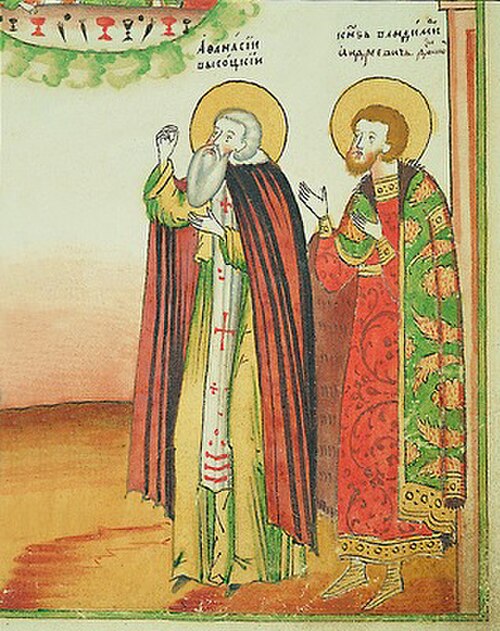
Venerable
Athanasius of Vysotsk
First abbot of Vysotsky Monastery
Disciple of Saint Sergius of Radonezh, first abbot of the Vysotsky Monastery in Serpukhov and a copyist of books.
- Feast
- September 12old style September 25
- Born
- 134014th century
- Place
- Constantinople
- Order
- Venerables
Life
Saint Athanasius of Vysotsk, called the Elder (born Andrei, about 1340 to after 1410), was a disciple of Saint Sergius of Radonezh, the first abbot of the Vysotsky monastery near Serpukhov and a copyist of books. He died at Constantinople. He is commemorated on 12 September, the day of the repose of his disciple and successor Athanasius the Younger, and in the Synaxis of the Saints of Radonezh and of Moscow. His veneration is local: since 1981 he has been commemorated in the Synaxis of the Saints of Radonezh, and the sources give no other canonization.
Beginnings
Few things are known with certainty about him. News comes mostly from the Lives of Saints Sergius and Nikon of Radonezh and from the chronicles; the "Word on the Life of our Venerable Father Athanasius of Vysotsk", written at the end of the seventeenth century, is full of implausible matters. According to the monastery's tradition, he was a priest's son from the Obonezhye of Novgorod the Great, called Andrei in the world, with parents Auxentius and Maria, born not later than the beginning of the 1340s. He was tonsured a monk at the monastery of the Holy Trinity of Saint Sergius and, according to the oldest redactions of the Life of Sergius, was his beloved disciple.
Abbot at Vysotsk
The chronicles mention him in 1374, when Saint Sergius made him abbot of the Vysotsky monastery of the Conception of the Mother of God, founded near Serpukhov at the initiative of Prince Vladimir Andreevich, the future hero of Kulikovo. The monastery, on the high bank of the river Nara, was dedicated to the Conception of the Mother of God by Righteous Anna, at the wish of its founder.
At Vysotsk a scriptorium was organized. With the abbot's blessing, the deacon Vunko copied for the monastery's use the "Pandects" of Nikon of the Black Mountain, and at the end the abbot added a series of texts: the Word of Isaac the Syrian, questions and answers of the Fathers on prayer, sobriety of mind and how the hesychast should sit in his cell, the teaching of Saint Symeon the New Theologian on prayer, and counsels of Saint Basil the Great to monks. When Sergius's future successor Nikon of Radonezh came to Sergius, Sergius sent him as a novice to Abbot Athanasius; Nikon received in his monastery tonsure and ordination as hieromonk, and later withdrew to the Holy Trinity Monastery.
With Metropolitan Cyprian at Constantinople
His acquaintance with Metropolitan Cyprian was apparently made in the first years of the latter's stay on Muscovite soil. The "Answers to Abbot Athanasius" written by Cyprian in 1381 to 1382 appear to have been addressed to him. When in 1382, after the invasion of Tokhtamysh, Cyprian was driven out of Moscow, Abbot Athanasius followed him to Kyiv, and a monk of the same name, known as Athanasius the Younger, became abbot at Vysotsk. He accompanied Cyprian also to Constantinople, where he bought a cell in a monastery and gave himself to stillness. When, in 1390, Cyprian returned to Russia, Athanasius refused to follow him, preferring to continue his struggle.
In 1392 the Russian monk Sergius wrote in the Studion monastery, with Athanasius's blessing, a collection of teachings and lives for the library of the Vysotsk monastery, with writings of Saint Maximus the Confessor, of Symeon the New Theologian, of Isaac the Syrian and other texts, among them some scientific ones. He also sent to Vysotsk seven icons of the Deisis tier, with a letter of blessing, a tier thought to have influenced the Zvenigorod Deisis of Andrei Rublev. In 1401, in a monastery of the Mother of God Peribleptos in Constantinople, a "sinful Athanasius" copied under the name "Eye of the Church" the typikon of the Lavra of Saint Sabbas, probably the abbot of Vysotsk. The typikon was then copied at the Holy Trinity, at Vysotsk and in other monasteries, but the original was lost. The monastery tradition that Athanasius was appointed abbot by the Patriarch of Constantinople is not true.
Repose and veneration
He died at Constantinople, probably after 1410. It cannot be said when his veneration began, which was evidently local. In the mid-1650s Simon Azarin entered his name in his menologion, without days of commemoration. In 1697 the "Word on his Life" was written, perhaps by Hieromonk Carion (Istomin). In 1981 he was entered, together with his successor Athanasius the Younger, in the Synaxis of the Saints of Radonezh.
Commemorated the same day September 12
 AutonomusHieromartyr · Bishop in BithyniaSep 12
 EanswytheVenerable · Princess and abbess of KentSep 12
- George of ChkondidiSaint · Archbishop of ChkondidiSep 12
 Gregory of KydoniesHieromartyr · Metropolitan of KydoniesSep 12
 Ambrosios of MoschonisiaHieromartyr · Metropolitan of MoschonisiaSep 12
- Dositheus of TbilisiHieromartyr · Archbishop of TbilisiSep 12
- Felix and CyprianHoly Hieromartyrs · Bishops of AfricaSep 12
- Daniel of ThassosSaintSep 12
- Serapion of CataniaHieromartyrSep 12
- Vassian of TiksnaVenerableSep 12
 Athanasius the Younger of VysotskVenerable · Abbot of Vysotsky MonasterySep 12
- Cornutus of IconiumHieromartyr · Bishop of IconiumSep 12