Venerable
Eanswythe
Princess and abbess of Kent
Anglo-Saxon princess of Kent said to have founded Folkestone Priory, one of the first in England.
- Feast
- September 12old style September 25
- Reposed
- 6407th century
- Place
- Folkestone
- Order
- Venerables
Life
Saint Eanswith, the Venerable (Eanswythe, Eanswide), was an Anglo-Saxon princess of the kingdom of Kent, daughter of King Eadbald, who, according to tradition, founded the monastery at Folkestone, one of the first convents for women in Britain. She refused a marriage, chose monastic life and died young. She is honoured in the Orthodox Church among the Saints of Britain and Ireland, with commemoration on 12 September. The remains attributed to her were examined scientifically in 2020. The sources do not agree on the years of her birth and death: she is dated about 614 to 630 for birth and 640 to 650 for death.
Family
Eanswith was a princess of the kingdom of Kent. Her father, Eadbald, ruled from 616 to 640. Her mother, Eadbald's second wife, Emma, probably a Frankish princess (by some, of Austrasia), bore him two more sons, Eormenred and Eorcenberht, who became kings. Eanswith's grandfather, Æthelberht of Kent, was the first of the kings of Anglo-Saxon England to receive Christian baptism.
The monastery at Folkestone
According to the Church's tradition, Eanswith, with her father's support, founded the Benedictine monastery of Folkestone, the first convent for women in England and one of the oldest on the territory of present-day Britain. The story says that, while the monastery was under construction, a pagan prince of a neighbouring kingdom came to Kent wishing to marry her. King Eadbald, whose sister, Æthelburh (Ethelburga), had two or three years before married the pagan King Edwin of Northumbria and brought her husband to Christianity, is said to have advised his daughter to accept the proposal, but she refused. Instead of marrying, Eanswith lived at the monastery with her companions in monastic life, perhaps guided by some of the monks who had come to England with Augustine in the Gregorian mission of 597. She became abbess of the newly built monastery and remained there until her death.
Of the circumstances of her death there is no certain information. The Lives say she fell asleep in peace, but at a young age. In 2020 the examination of the remains showed that Eanswith, if the remains were hers, was at death no more than 21. If she died in 640, she could have been a victim of the struggle for the throne of Kent between her brothers, in the year of her father's death, when Eormenred, the eldest, inherited the throne but was overthrown a few months later by Eorcenberht. Her death could then have been violent, but, since Eorcenberht was a Christian and his motives were political, she was venerated as a saint, not as a martyr.
The fate of the monastery and the relics
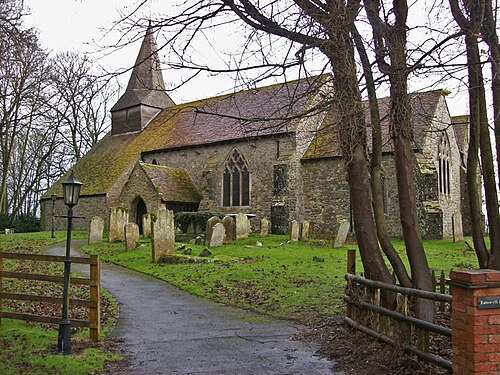
Unfortunately the monastery had been built on an unsuitable site, on the seashore, which was largely eroded by the waves. By the tenth century it could no longer be used for monastic life (by other data the monastery was first laid waste by the Danes). In 1095 it was moved for the first time farther from the shore, but not far enough. In 1137 William de Abrincis founded it a third time, on a site farther from the sea, with a church dedicated to the Mother of God and Saint Eanswith. In the next year, 1138, the saint's relics were moved to the new church. The date of the translation, 12 September, remained the day of her commemoration. At the Reformation the monastery was suppressed, and the monastery church became an Anglican parish church, Saint Mary and Saint Eanswythe at Folkestone.
In 1885, during restoration work in the church, human remains were discovered in a lead reliquary built into the north wall. The reliquary was identified as a vessel of the twelfth century, which led to the supposition that the remains might be the relics of Saint Eanswith, hidden at the Reformation. In 2017 a collaboration began between Kent historians and archaeologists of Canterbury Christ Church University and Folkestone Museum. In 2020 researchers examined the teeth and bones and determined they belonged to one person, probably a woman of 17 to 21, without signs of malnutrition, consistent with Eanswith's history. Radiocarbon dating, done at Queen's University Belfast, showed the remains to be from the mid-seventh century. It cannot be proven that they are Saint Eanswith's, but, if they are, they would be the oldest remains discovered of an English saint and of a relative of a British monarch. The bones were reinterred in the Folkestone church in November 2024.
Image and veneration
Eanswith is shown with the abbess's staff, a crown and a book, sometimes with two fish, which seem a recent attribute, linked to Folkestone's fishing port. Churches dedicated to her also include Saint Eanswith's at Brenzett, in Kent, and Saint Eanswythe's at Altona, in the state of Victoria, Australia. Her name is in the genealogies of some versions of the "Kentish Royal Legend". Goscelin of Saint-Bertin mentions her in the eleventh-century "Life of Saint Werburgh", and John of Tynemouth (a fourteenth-century chronicler) gives a detailed account in his "Sanctilogium". As with all the Kentish abbesses, Bede does not name Eanswith, so John must have had another source.
Commemorated the same day September 12
 AutonomusHieromartyr · Bishop in BithyniaSep 12
- George of ChkondidiSaint · Archbishop of ChkondidiSep 12
 Athanasius of VysotskVenerable · First abbot of Vysotsky MonasterySep 12
 Gregory of KydoniesHieromartyr · Metropolitan of KydoniesSep 12
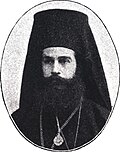 Ambrosios of MoschonisiaHieromartyr · Metropolitan of MoschonisiaSep 12
- Dositheus of TbilisiHieromartyr · Archbishop of TbilisiSep 12
- Felix and CyprianHoly Hieromartyrs · Bishops of AfricaSep 12
- Daniel of ThassosSaintSep 12
- Serapion of CataniaHieromartyrSep 12
- Vassian of TiksnaVenerableSep 12
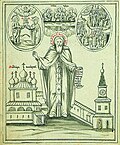 Athanasius the Younger of VysotskVenerable · Abbot of Vysotsky MonasterySep 12
- Cornutus of IconiumHieromartyr · Bishop of IconiumSep 12