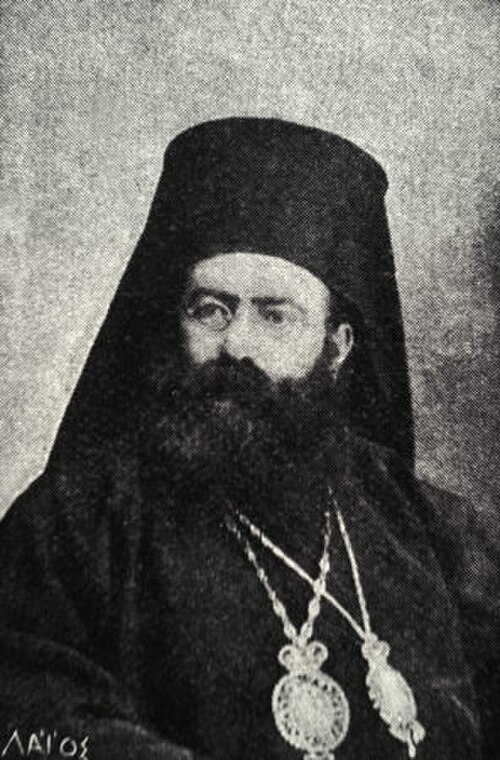
Hieromartyr
Gregory of Kydonies
Metropolitan of Kydonies
Metropolitan of Strumica, then of Kydonies in Asia Minor, who died a martyr in 1922.
- Feast
- September 12old style September 25
- Reposed
- 192220th century
- Place
- Ayvalık
- Order
- Martyrs
Life
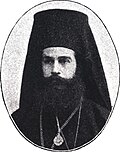
Holy Hieromartyr Gregory of Kydonies was a Greek hierarch of the Ecumenical Patriarchate, born in 1864 at Magnesia in Asia Minor. He was Metropolitan of Strumica in Macedonia and then the first and last Metropolitan of Kydonies (modern Ayvalık in Turkey).
The Church honours him as a shepherd who laid down his life for his sheep. In the autumn of 1922, after helping to save thousands of his faithful, he refused to leave his flock and was killed on 3 October 1922. He is commemorated among the New Martyrs of Asia Minor.
Early life and studies
Gregory was born in 1864 at Magnesia (modern Manisa) in the Ottoman Empire. His secular name was Anastasios Saatsoglou. He received his first schooling in his native town.
In 1882 he entered the Theological School of Halki, supported by Metropolitan Agathangelos of Ephesus. There he translated his Turkish surname into Greek as Orologas, meaning "watchmaker".
He was a brilliant student and completed his studies in 1889 with a dissertation showing that the holy Evangelists did not disagree about the Lord's last Passover. In his final year, following the old custom, he was ordained deacon and given the name Gregory. In 1891 he was ordained priest.
Ministry in Macedonia
From 1889 to 1892 he taught in several schools as a teacher and preacher of the Archdiocese of Constantinople. From 1892 to 1894 he was protosyngellos and preacher of the Metropolis of Thessaloniki, and in 1893 and 1894 he directed the Greek gymnasium in Thessaloniki.
From 1894 to 1901 he taught at the gymnasium of Serres and served as preacher and representative of the Monastery of Saint John the Forerunner near Serres. In 1901 and 1902 he was protosyngellos of the Metropolis of Drama, working alongside Metropolitan Chrysostomos (Kalafatis), the future martyr of Smyrna.
He was among the first preachers to use the spoken Greek of the people, the demotic, in his sermons. His ministry in Macedonia coincided with the sharpening school, church and later armed conflict between Greeks and Bulgarians, in which he stood on the side of the Patriarchate.
Metropolitan of Strumica
On 12 October 1902 he was elected Metropolitan of Strumica (Tiberioupolis and Strumica), and on 3 November he was consecrated in the patriarchal Cathedral of Saint George at the Phanar. The consecration was performed by Metropolitan Joachim of Ephesus together with Metropolitans Prokopios of Durrës, Nikodemos of Vodena, Nikephoros of Litica and Panaretos of Gallipoli.
At Strumica he faced not only the Ottoman authorities but also the Bulgarian revolutionary committees. In 1905 members of such a committee tried to kill him as he returned from a village; the metropolitan escaped, but four of his companions were wounded.
He remained at Strumica for six years. On 22 July 1908 (the Greek source says 22 June), under pressure from the Ottoman government, the Ecumenical Patriarchate was compelled to transfer him to another diocese.
Metropolitan of Kydonies
He was sent to the newly founded Metropolis of Kydonies, with its seat at Ayvalık on the Aegean coast of Asia Minor, which had been separated from the Metropolis of Ephesus in April 1908. He was enthroned on 8 September 1908 in the metropolitan church of the Dormition of the Mother of God at Ayvalık.
In his first years he supported the growth of schools and charitable institutions in the diocese. Yet these were among the most troubled years in the history of the Ottoman Empire.
In July and August 1909 the local authorities imposed martial law on the town, and many Orthodox Christians were persecuted and imprisoned. The metropolitan intervened on their behalf and secured the release of several prisoners, though many stayed in prison even after martial law was lifted.
Imprisonment during the war
During the First World War the persecution of Christians in Asia Minor grew to a vast scale. Metropolitan Gregory was accused of high treason and tried twice before the military tribunal in Smyrna.
Although the charges were never proven, he was imprisoned in September 1917. He was released only after the capitulation of the Ottoman Empire, on 16 October 1918, and returned to Ayvalık.
The Greek source says that after this first persecution he returned together with his people, determined to rebuild their town. The metropolitan worked to relieve the sufferings of a sorely tried population.
The Greco-Turkish War
In May 1919 the Greek army occupied the region with the approval of the Great Powers, and Ayvalık became part of the Smyrna occupation zone. The metropolitan stayed in his diocese, though he clashed several times with the Greek High Commissioner in Smyrna, Aristeidis Stergiadis.
In August 1922, after the defeat of the Greek army, the Greek civil and military authorities withdrew from the region. Before the Turkish troops reached Ayvalık, Gregory gathered the town's council of elders and urged them to evacuate the civilian population at once, fearing massacres. His advice was not followed.
Saving his flock
The first irregular Turkish troops entered the town at the end of August, and martial law was declared. In the following days all adult men were arrested and sent to labour battalions in the interior of Anatolia; many were killed on the road near the village of Freneli, and most never returned.
The metropolitan tried to protect the remaining Christians by appealing to the Turkish authorities, who did not hesitate to humiliate him. He then learned of the massacre on the Moschonisia islands, where about 6,000 people perished, among them Metropolitan Ambrosios.
He then secretly contacted the American Red Cross. With the consent of the Turkish authorities, Greek ships under the American flag came from the island of Lesbos and took away the women and children. In this way about 20,000 of the 35,000 Orthodox Christians of the diocese were saved.
Martyrdom
The metropolitan urged all the priests of the town to leave, but he himself refused to leave his diocese. On 30 September 1922, while the priests were gathered at the harbour ready to depart, the Turkish authorities arrested them and detained the metropolitan with them.
They were taken to the prison beside the town hospital and tortured. On 3 October 1922 the clergy were led out of the town and killed, together, according to the Greek source, with the town's notables and many other Christians.
Witnesses said that Metropolitan Gregory died of a heart attack as the soldiers were trying to bury him alive. Other accounts say he was being burned alive and died of heart failure as the torment began.
Glorification and veneration
Ten years later, in 1932, at the initiative of Metropolitan Iakovos of Mytilene, a statue of him was raised in Mytilene on Lesbos, where many of his flock had found refuge. Its inscription recalls the Lord's words about the good shepherd who lays down his life for the sheep (John 10:11).
In 1992 the Church of Greece numbered him among the saints, together with Metropolitans Chrysostomos of Smyrna, Ambrosios of Moschonisia, Prokopios of Iconium and Euthymios of Zela, and with the clergy and laity who perished in the catastrophe of Asia Minor. Many streets in Athens, Thessaloniki and other Greek towns, especially where refugees from Asia Minor settled, bear his name.
Holy Hieromartyr Gregory of Kydonies is commemorated with the other martyred hierarchs of Asia Minor on the Sunday before the Exaltation of the Holy Cross, between 7 and 13 September.
Commemorated the same day September 12
 AutonomusHieromartyr · Bishop in BithyniaSep 12
 EanswytheVenerable · Princess and abbess of KentSep 12
- George of ChkondidiSaint · Archbishop of ChkondidiSep 12
 Athanasius of VysotskVenerable · First abbot of Vysotsky MonasterySep 12
 Ambrosios of MoschonisiaHieromartyr · Metropolitan of MoschonisiaSep 12
- Dositheus of TbilisiHieromartyr · Archbishop of TbilisiSep 12
- Felix and CyprianHoly Hieromartyrs · Bishops of AfricaSep 12
- Daniel of ThassosSaintSep 12
- Serapion of CataniaHieromartyrSep 12
- Vassian of TiksnaVenerableSep 12
 Athanasius the Younger of VysotskVenerable · Abbot of Vysotsky MonasterySep 12
- Cornutus of IconiumHieromartyr · Bishop of IconiumSep 12