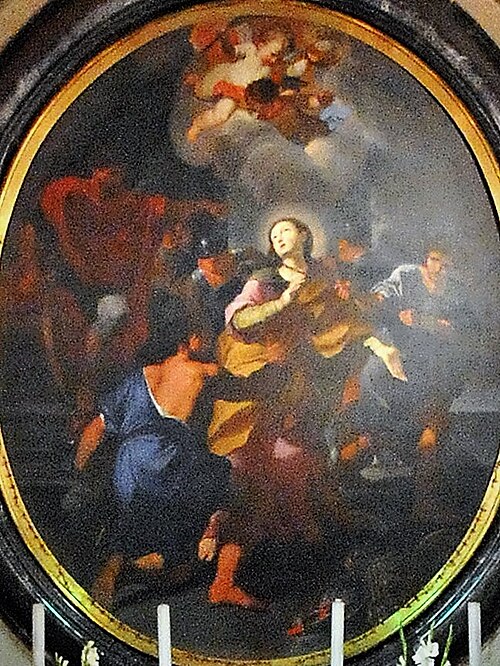
Martyr
Aurea of Ostia
Patron of Ostia
Martyr venerated as patron of Ostia; her name, Aurea or Chryse, means golden girl.
Life
Saint Aurea of Ostia, called Chryse in Greek, was a noble virgin who suffered for Christ in the third century. Her name, in Latin and in Greek, means “golden girl.” She is venerated as the patron of the city of Ostia.
Tradition says she suffered around the middle of the third century, in the reign of the emperor Claudius Gothicus or of Trebonianus Gallus. She is said to have been of royal or noble blood and, because she confessed Christ, was banished from Rome to Ostia. There she lived on an estate outside the city walls and kept in touch with the local Christians, among them Bishop Cyriacus of Ostia, who later suffered together with her.
Several miracles are linked with her name. When the Christian prisoner Censorinus was comforted by her in his cell, his chains came loose. Because of this miracle seventeen soldiers came to believe in Christ and were afterward beheaded near the Arch of Caracalla at Ostia. Another account speaks of the raising of a shoemaker's dead son. Her friends suffered with her, among them Hippolytus, Sabinus, the priest Maximus and the deacon Archelaus.
Ulpius Romulus put Aurea's friends to death and tortured her too. During her trial she confessed boldly that she was a Christian, and when she refused to sacrifice to the gods she was thrown into the sea in the harbour of Ostia with a stone tied round her neck.
She was buried on her own estate at Ostia, and the church of Santa Aurea grew up around her tomb; it was rebuilt in the fifteenth century. Tradition adds that Saint Monica was also buried in it. In 1981 a fragment of a Christian inscription reading “Chryse sleeps here” was found nearby, and in 1950 a marble column, perhaps of the fifth century, bearing the letters S.AVR.
In the Orthodox tradition she is venerated as Chryse, together with her companions. She is remembered on 24 August, and the synaxaria also mention her on other days, including 30 January and 20 May.
Commemorated the same day August 24
 Ouen of RouenSaint · Bishop of RouenAug 24
 Kosmas the AetolianVenerable Martyr · Missionary and teacher of the GreeksAug 24
 Peter of MoscowSaint · Metropolitan of Kyiv and MoscowAug 24
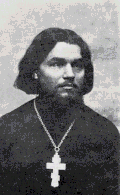 Maxim of GorliceHieromartyr · Priest of GorliceAug 24
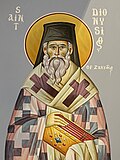 Dionysios of ZakynthosSaint · Archbishop of AeginaAug 24
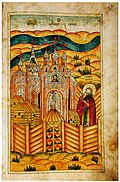 Arsenius of KomelVenerable · Founder of Arseniev Monastery at KomelAug 24
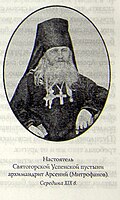 Arsenius of SviatohirskVenerable · Abbot of Sviatohirsk MonasteryAug 24
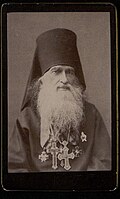 Herman of SviatohirskVenerable · Abbot of Sviatohirsk MonasteryAug 24
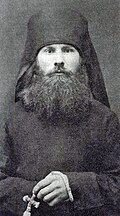 Seraphim ShakhmutHieromartyr · ArchimandriteAug 24
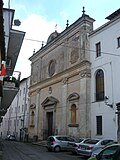 Ptolemaeus of NepiHoly Hieromartyrs · Bishop of NepiAug 24
- Serapion the WonderworkerVenerableAug 24
- AgofridusVenerableAug 24