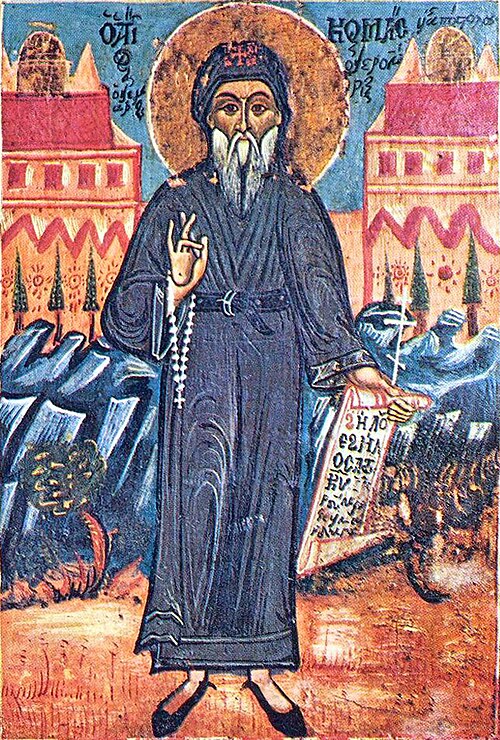
Venerable Martyr
Kosmas the Aetolian
Missionary and teacher of the Greeks
Monk and itinerant preacher, teacher of the Greek Christians under Ottoman rule, killed in 1779.
Life
Saint Kosmas the Aetolian (Patrokosmas, Father Kosmas), a venerable martyr, was a monk and itinerant preacher, teacher of the Greek Christians under Ottoman rule, hanged in 1779 at Kolkondas, in present-day Albania. The crowds called him the new apostle, and the Ecumenical Patriarchate numbered him among the saints on 20 April 1961, under Patriarch Athenagoras, with the title equal to the apostles. He is commemorated on 24 August, the day of his martyrdom.
Childhood and formation
He was born in 1714 in the village of Mega Dendron in Aetolia, near Thermo, in a family of weavers, and was given the name Constantine, Constas. Others think he was born in the neighbouring village. His family was poor, and in the mountain country there were hardly any churches or schools. According to the Russian account, until the age of twenty he did not know the alphabet. Eager for learning, he went first to the priest Ananias, then, in the village of Agia Paraskevi, to the teacher Theophanes, with whom he studied eight years and became his assistant, and then began to teach himself.
In 1749 (in other sources 1743) he went to the Athonite Academy on the Holy Mountain, where he studied theology and philosophy. He then lived about two years as a monk at the Philotheou Monastery, where he received the name Kosmas and was ordained hieromonk. The monastic environment, however, was not what he sought.
His preaching
In 1759 he left the monastery and went to Constantinople, where he received from Patriarch Seraphim II, himself from Delvino in what is now southern Albania, permission to preach the Word of God, at a time when more and more Christians were becoming Muslims. For sixteen years he travelled through Thrace, Macedonia, Thessaly, central Greece, the Aegean islands and the Ionian Islands under Venetian rule, and toward the end chiefly Epirus and Albania. Kosmas urged the faithful to found schools and to learn Greek, the language of the Church, so as to understand the Scriptures better. For him the school was a condition for strengthening Orthodoxy and education a way of catechesis. In sixteen years he founded, according to some sources, more than a hundred schools, according to others about two hundred; in a letter to his brother he said that he had founded only ten secondary schools and two hundred primary ones.
He addressed also speakers of Albanian and Aromanian and did not use the archaic language of the learned, but that of everyday. Thousands gathered at his sermons, so many that a church could not hold them. So he preached in the open field, drove a cross into the ground, stood on a bench and spoke for hours, and at the end took the bench with him and left the cross as a reminder. Many of these crosses survived for decades and some to this day. He was known for his complete disregard for money and said that he had no cassock other than the one he wore. He taught Christians not to work or trade on Sunday, but to go to church. His sermons sometimes refer harshly to the Jews, but in one of them he stated plainly that those who wrong Christians, Jews or Turks would be repaid for the injustice they did.
Martyrdom
His preaching found a response among Christians and among some Muslims, but it aroused against him the rich and powerful, the village notables tied to Ottoman power and some merchants. By moving the weekly market from Sunday to Saturday it brought losses to Jewish merchants, and some researchers believe that for this reason the Jews of Epirus had a part in his condemnation. The Venetians also suspected him, as spy reports preserved in the archives of Venice show. In a letter of 2 March 1779 he wrote to his brother that ten thousand Christians loved him and one not much, a thousand Turks loved him and one did not, a thousand Jews wished his death and only one was against.
Accused of being a Russian agent, he was seized by the Ottoman authorities and, on 24 August 1779, was executed by hanging at Kolkondas, near the mouth of the river Seman in present-day Albania, without formal charge and without trial, hence the many opinions, even today, about who wished him dead.
Veneration
In 1813 Ali Pasha, ruler of Epirus, built a church near the place of the execution, in which the saint's remains were placed. In 1984 they were moved from the Monastery of Saint Kosmas at Kolkondas to the Archaeological Museum of Fier; other relics are in the Metropolitan Cathedral of Athens. The saint is also greatly honoured by Orthodox Albanians for his message. Numerous popular religious texts are attributed to him, chiefly the five Didaches and the Prophecies, but no manuscript written by his own hand survives; they are believed to rest on his sermons but were written and copied mostly after his death.
Commemorated the same day August 24
 Ouen of RouenSaint · Bishop of RouenAug 24
 Peter of MoscowSaint · Metropolitan of Kyiv and MoscowAug 24
 Aurea of OstiaMartyr · Patron of OstiaAug 24
 Maxim of GorliceHieromartyr · Priest of GorliceAug 24
 Dionysios of ZakynthosSaint · Archbishop of AeginaAug 24
 Arsenius of KomelVenerable · Founder of Arseniev Monastery at KomelAug 24
 Arsenius of SviatohirskVenerable · Abbot of Sviatohirsk MonasteryAug 24
 Herman of SviatohirskVenerable · Abbot of Sviatohirsk MonasteryAug 24
 Seraphim ShakhmutHieromartyr · ArchimandriteAug 24
 Ptolemaeus of NepiHoly Hieromartyrs · Bishop of NepiAug 24
- Serapion the WonderworkerVenerableAug 24
- AgofridusVenerableAug 24