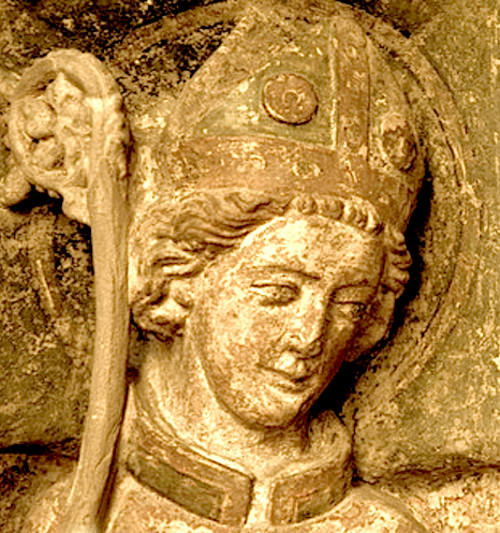
Hieromartyr
Aureus of Mainz
Bishop of Mainz
First named bishop of Mainz, who died around 436 or 451; commemorated on June 16.
Life
Saint Aureus of Mainz is the first bishop of Mainz known from the sources, remembered by tradition as a martyr, together with his sister Justina, in a raid by the Huns. He was born at an unknown date in the region between the Rhône and the Loire and died, according to tradition, around 436 or 451. He is commemorated on 16 June. His veneration is local: the Roman Catholic Church counts him a saint, and since 2006 the Russian Orthodox Church (Moscow Patriarchate) has numbered him among the saints venerated locally in its diocese of Berlin and Germany. This is not a canonization for the whole Orthodox Church.
What is known
His name stands first on the oldest list of the bishops of Mainz, preserved in a source of the tenth century. For his life we have only church sources and legends, and historians today cannot say with certainty that he lived as tradition describes. The earliest testimony comes from Rabanus Maurus, who in a text about the dedication of the abbey at Fulda mentions an altar of Saint Aureus in the south part of the church. In 843 the same Rabanus writes that Aureus and his sister Justina were killed on 16 June in a church during a raid of the Huns.
The sources give no year. Some later ones say 454, but this is unlikely, since the invasion of the Huns in Gaul was in 451. If the martyrdom belongs to the age of the great migrations, the years 451, 436, 406 to 407 or even 368 may be considered.
The link with Alban
In 406 to 407 Saint Alban was martyred at Mainz, according to tradition because he had preached against Arianism. The same tradition says that Aureus had earlier been driven out of the city by its people for opposing the Arians, and that in his absence Bishop Theonestus and his disciple Alban came from Italy. Aureus is said to have returned after 406 to the ruined city and taken up his ministry again. If his death were dated to 451, he would have been bishop for nearly fifty years, which raises difficulties for the date of the next bishop, Maximus, so the year 436 is thought more probable. His relics were buried in the basilica of Saint Alban, either immediately after his death or, according to another source, transferred there in 805.
Veneration
At Mainz, on the traditional site of his martyrdom and first burial in the Zahlbach quarter, a chapel of Saint Aureus was built, probably the earliest place of Christian worship in the city. It was ruined in the siege of Mainz in 1793, rebuilt, and destroyed again in the air raid of 1944. In 1022 relics were transferred to Heiligenstadt, where from the late Middle Ages Aureus and the deacon Justinus were honoured as patrons of the town. According to this other version of the legend, they were fleeing Attila, who caught up with them in the Eichsfeld, tortured them and beheaded them; they were buried there and miracles took place. He is also venerated at Oberursel-Bommersheim, and in the diocesan calendar of Mainz his day is 16 June.
Commemorated the same day June 16
 Tychon of AmathusSaint · Bishop of Amathus in CyprusJun 16
 Hermogenes of TobolskHieromartyr · Bishop of TobolskJun 16
 Tikhon of KalugaVenerable · Abbot near KalugaJun 16
 Moses of OptinaVenerable · Abbot and elder of OptinaJun 16
 Julitta of TarsusMartyrJun 16
 Tikhon of LukhVenerable · Founder of Nikolo-Tikhonov MonasteryJun 16
 CyricusMartyr · Child martyr of TarsusJun 16
 Tikhon of KarachevVenerable · Founder of Resurrection MonasteryJun 16
- Kaikhosro the GeorgianSaintJun 16
 Konstantin MinyatovMartyr · LawyerJun 16
- Actinea and GraecinaHoly MartyrsJun 16
- Athcain of Inbher ColpthaiSaintJun 16