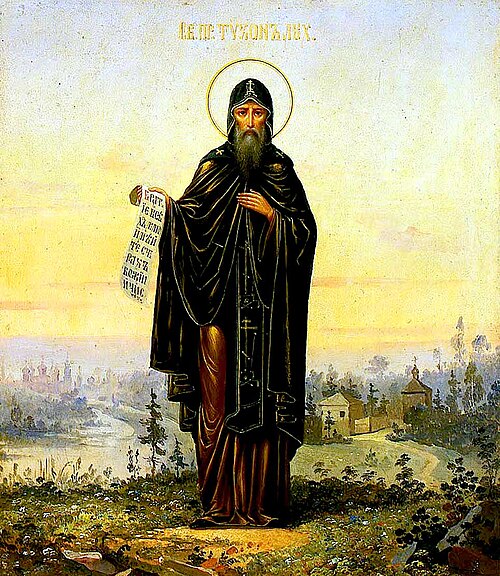
Venerable
Tikhon of Lukh
Founder of Nikolo-Tikhonov Monastery
Ascetic monk who loved poverty, founder of Nikolo-Tikhonov Monastery, who died in 1503.
- Feast
- June 16old style June 29
- Reposed
- 150316th century
- Place
- Nikolo-Tikhonov Monastery
- Order
- Venerables
Life
Saint Tikhon of Lukh, also called Tikhon of Kostroma, in the world Timothy, was a fifteenth-century ascetic monk and lover of poverty who founded the Nikolo-Tikhonov Monastery near the town of Lukh (today the village of Timiryazevo in Ivanovo region). He reposed in 1503, was glorified in 1570, and is venerated as a wonderworker and protector of the surrounding lands.
Until the nineteenth century his veneration spread across a wide area of the Upper Volga, from the Kostroma and Vetluga country to the neighbourhoods of Lukh, Vichuga and Nerekhta, along the roads he had walked in his wanderings.
Life in the world
Timothy was born in the first half of the fifteenth century to devout parents. Saint Dimitri of Rostov writes that Tikhon came from Little Russia, from lands then subject to the Grand Duchy of Lithuania, being neither Lithuanian nor Pole. His parents were well-to-do and gave him a good education, raising him in the Orthodox faith.
Reliable information concerns his mature years, when he lived in Vilna and had chosen military service. Even then he stood out among the soldiers as a literate, well-read man with an artistic gift.
In 1483 Timothy went to Moscow with the Orthodox Prince Fyodor Belsky, a great-grandson of Prince Algirdas, who fled there after a failed plot against Grand Duke Casimir IV of Lithuania. The Life says he left his homeland because many there were turning to the Latins and other errors, probably a reference to the Union of Florence. According to Saint Dimitri of Rostov, he could not endure the pressure of the Latins and moved to Moscow, where he began to lead a godly life.
Tonsure and wanderings
In Moscow he marvelled at the good order of church life. He gave his property to the poor and began visiting monasteries. He then entered a monastery as a novice, probably one in Moscow, and as a mature and learned man soon received monastic tonsure with the name Tikhon.
The scholar of his Life, Pyotr Ilinsky, wrote that life in the world and even the hardest monastic obediences seemed too little to him for the salvation of his soul. So Tikhon set out for the Kostroma lands in the north-east of the Muscovite principality. Ilinsky believed his departure may also have been connected with the fact that Prince Belsky had fallen into disgrace and been imprisoned at Galich.
For a long time Tikhon wandered through the Kostroma country. Wherever he stopped for solitude, people came for counsel and blessing, and, not wishing to break his silence, he moved on. He would humbly tell them to leave him so as not to be led astray, since he himself was a great sinner. His influence spread not through instruction but through the example of his ascetic life.
Traces among the people
The Vetluga chronicles say that Tikhon passed through Shanga, was at Kazhirovo and Nikola-Bystrykh, in the districts of Pyshug and Zavodskaya, where an annual feast in his honour was later established. Many folk traditions about his presence in various places survived at least until the mid-nineteenth century. In one village of the Vetluga district it was told that he had delivered the people from snakes.
Springs which, according to tradition, Tikhon found and cleared still exist in the villages of Izmailovo and Novlyanskoye (Tikhon's ravine), near Semigorye and Borshchevka, and in the town of Rodniki. Near Nerekhta a very old little church still stood around 1852, which the people called the church of Saint Tikhon of Lukh and said he had built. In the nineteenth century several villages of the region had churches or altars dedicated to him.
The hermitage near Lukh
Around 1493, with the permission of the local landowner, Tikhon settled at a place called Kopytovo, a short distance from Lukh, and built a cell there. The Life describes the place as very harsh: a great pine forest and endless sand, with impassable marshes on the other bank of the river, wholly unsuitable for farming.
Tikhon avoided people and spent his time in vigil and labour. He tilled a small patch of poor ground and carved various wooden objects, including dishes. He left them by the road, and the peasants left bread for him in exchange; gifts he would not touch. On the opposite bank of the Lukh, where his first cell had stood, a well dug by him was long preserved.
Despite his love of solitude, two monks, Photius and Gerasimus, came to him, and for their sake he moved three versts from Kopytovo to a more suitable place. Thaddeus and Philaret were also his disciples. All four were later venerated among the saints, and their names were preserved in the old synodikon of the monastery and on an ancient icon of Saint Tikhon. The ascetics lived by the work of their hands, and gradually a skete formed around Tikhon.
Throughout his years near Lukh, Tikhon suffered from a grave illness that made his body swell and tormented his legs. The Life says it was fearful to see, yet he never ceased from prayer and prostrations, day or night.
The Monastery of Saint Nicholas
By 1498 Prince Fyodor Belsky had been released and had received the lands of Lukh, Vichuga and Kineshma as the dowry of his wife Anna, niece of Grand Prince Ivan III. The old friendship between the soldier Timothy and the prince, as well as the fame of Tikhon's ascetic life, probably led Belsky to give the brethren a site near Kopytovo, at the confluence of the Vozopol and the Lukh.
There, in the words of Saint Dimitri of Rostov, Tikhon founded a skete, gathered many disciples and laboured in fasting and abstinence. The first building was a small wooden church dedicated to Saint Nicholas, and so the monastery was at first called the Monastery of Saint Nicholas.
Tikhon refused to be abbot and remained a simple rassophore monk until his death, never accepting the priesthood. He also avoided giving spiritual direction to monks and laypeople, repeating only that he was a sinful man. Yet he remained the spiritual guide of the brethren. He taught that poverty and labour are the straight road to salvation, and this precept remained the monastery's chief rule for many years; it acquired property only in the 1570s.
The Life relates that the elder, who could barely move his legs, would harness himself to the plough out of pity for his disciples and the animals, and ask the brothers to guide the plough behind him. Fearing glory, he tried to hide his labours from the local people, and whenever he felt himself watched he would leave his work and hide with his disciples.
Repose
According to Saint Dimitri of Rostov, Tikhon foreknew his departure, instructed his disciples in all that was profitable for their souls, and reposed in the Lord. He died on 16 June 1503, on the feast of his patron, Saint Tikhon of Amathus.
The brethren were so poor that they had nothing in which to bury him. Then, unexpectedly, a messenger arrived from Bishop Niphon of Suzdal, bringing a monastic habit for the departed and a coffin fastened with iron nails.
The work of his hands
For more than four hundred years the monastery kept as treasures objects probably made by Tikhon: two wooden ladles and a dish, worked with great care and precision. There was also a small casket in the shape of a church, bearing icons of the feasts and Gospel scenes, which could serve as a cell iconostasis or as a tabernacle; according to the Life it foreshadowed the building of a large stone church in the monastery.
Most precious of all was a Gospel book written, according to tradition, in Tikhon's own hand and dated by specialists to the fifteenth century. The ancient icon of the saint bore an inscription saying that he had worked on holy books in the wilderness and written out the Gospel. Ilinsky studied it closely and judged it very probably his work, praising its even script, close to print, and its ornaments. Many of these treasures and documents were lost in the Soviet period.
Miracles and glorification
Saint Dimitri of Rostov writes that many years after the saint's death his relics were uncovered and many healings came from them. They were found incorrupt under Hegumen Constantine around 1566, and from then on his memory was celebrated. According to tradition, the hegumen, who had raised the relics above ground, was struck blind, and after recovering his sight he placed them back in the earth.
In 1570 Tikhon was numbered among the saints, and the monastery came to be called Tikhon's Hermitage. In 1649 a Life was compiled describing seventy posthumous miracles; the account of them is three times longer than the biography and gives details about each person healed. In 1839 a new chased metal shrine was made for his relics.
Veneration
In the Soviet period the monastery was closed in the early 1920s, the shrine was destroyed and the relics were lost. In 1931 many of the monastery's icons were hacked with axes. According to tradition, when one unbeliever tried to cut the icon of Saint Tikhon, the axe bounced off without harming it, and the man fled in terror. The faithful hid the icon and later brought it back; known as the "Unhewn" icon, it is now the chief treasure of the monastery.
The Nikolo-Tikhonov Monastery was reopened in 1995. In 1996 it was decided to build a church dedicated to Saint Tikhon in the town of Volgorechensk in Kostroma region. The saint is commemorated on 16 June, the day of his repose, on the day of the uncovering of his relics, and in the Synaxes of the Saints of Kostroma and of the Ivanovo Metropolis.
Commemorated the same day June 16
 Tychon of AmathusSaint · Bishop of Amathus in CyprusJun 16
 Aureus of MainzHieromartyr · Bishop of MainzJun 16
 Hermogenes of TobolskHieromartyr · Bishop of TobolskJun 16
 Tikhon of KalugaVenerable · Abbot near KalugaJun 16
 Moses of OptinaVenerable · Abbot and elder of OptinaJun 16
 Julitta of TarsusMartyrJun 16
 CyricusMartyr · Child martyr of TarsusJun 16
 Tikhon of KarachevVenerable · Founder of Resurrection MonasteryJun 16
- Kaikhosro the GeorgianSaintJun 16
 Konstantin MinyatovMartyr · LawyerJun 16
- Actinea and GraecinaHoly MartyrsJun 16
- Athcain of Inbher ColpthaiSaintJun 16