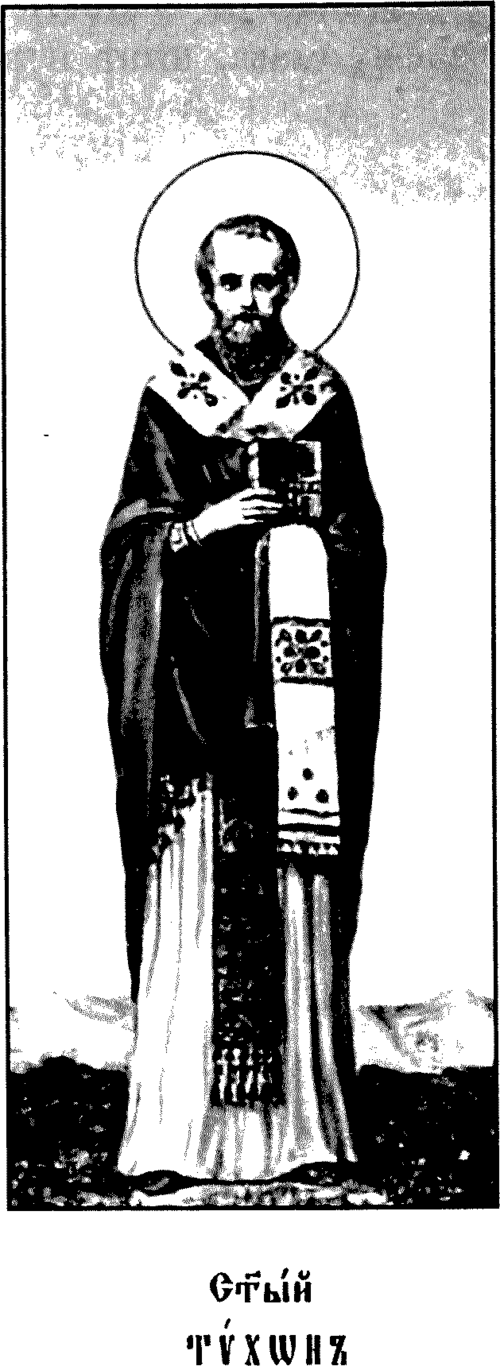
Saint
Tychon of Amathus
Bishop of Amathus in Cyprus
Bishop of Amathus in Cyprus in the early 5th century, venerated as a wonderworker.
Life
Saint Tychon the Hierarch, bishop of Amathus in Cyprus, was a pastor of the fifth century, venerated as a wonderworker. He fell asleep around the year 425, and the Church commemorates him on 16 June, by the old calendar.
Youth
He was born in Amathus, on the south coast of Cyprus, in the time of the emperors Arcadius and Honorius, to a poor family. His father was a baker. His parents brought him up in the true faith and taught him to read the holy Scriptures. He was received into the clergy and made a reader, and later Memnon, bishop of Amathus, ordained him deacon. Saint Tychon worked miracles from his youth. It is said that whenever his father left him alone in the shop, he gave the bread to the poor. When his father rebuked him, Tychon prayed to God and their granary was filled to the top.
Bishop
After the death of Memnon, Saint Tychon was chosen bishop of Amathus by the whole community of the faithful, for the purity of his life and his zeal for the true faith. In those days there were still many idolaters in Cyprus. The saint brought them to Christ with apostolic zeal, destroyed pagan shrines and raised churches in their place. He was merciful, the door of his house was open to all, he listened with love and fulfilled the requests of anyone who came to him, and he confessed his faith fearlessly before the pagans.
It is told of him that he planted a dry shoot of a vine, which turned green and bore fruit. For this he is held to be the patron of Amathus and of vine growers. It is also said that he turned a dry field green for desperate farmers. In his struggle against idolatry he broke the statue of the goddess Aphrodite when some of her worshippers, in a cult procession, passed before his church. Other accounts say that he entered a temple of Artemis and drove out a priestess named Anthousa, though some place this deed too in a temple of Aphrodite. In Amathus Aphrodite Amathusia was worshipped, while the cure for paganism was attributed to Artemis, so the text may be confused.
He foresaw the hour of his death, which came around the year 425. He lived in peace to the end and always strove to bring peace to those around him. Later he was regarded as a healer of the possessed.
Veneration
His life was written by John the Merciful, Patriarch of Alexandria, who was born in Amathus. The village of Agios Tychonas in Cyprus, near the ruins of Amathus, bears his name. In Russia he was venerated especially in the diocese of Voronezh, where three bishops in succession bore his name.
Commemorated the same day June 16
 Aureus of MainzHieromartyr · Bishop of MainzJun 16
 Hermogenes of TobolskHieromartyr · Bishop of TobolskJun 16
 Tikhon of KalugaVenerable · Abbot near KalugaJun 16
 Moses of OptinaVenerable · Abbot and elder of OptinaJun 16
 Julitta of TarsusMartyrJun 16
 Tikhon of LukhVenerable · Founder of Nikolo-Tikhonov MonasteryJun 16
 CyricusMartyr · Child martyr of TarsusJun 16
 Tikhon of KarachevVenerable · Founder of Resurrection MonasteryJun 16
- Kaikhosro the GeorgianSaintJun 16
 Konstantin MinyatovMartyr · LawyerJun 16
- Actinea and GraecinaHoly MartyrsJun 16
- Athcain of Inbher ColpthaiSaintJun 16