Venerable
Tikhon of Kaluga
Abbot near Kaluga
Russian abbot raised in Moscow who lived in an oak hollow near Kaluga and founded a monastery.
- Feast
- June 16old style June 29
- Reposed
- 149215th century
- Place
- Tikhon of Kaluga's ermitage
- Order
- Venerables
Life
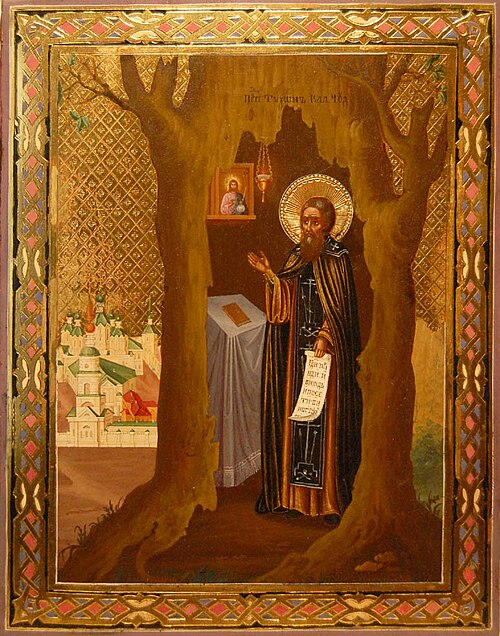
Saint Tikhon of Kaluga, also called Tikhon of Medyn, was a Russian hermit of the fifteenth century, the founder of the monastery of the Dormition of the Mother of God, now known as Tikhon's Hermitage. According to tradition he was born around 1400 at Kiev and fell asleep in the Lord on 16 June 1492 (29 June in the new calendar), at a great age. He blessed Grand Prince Ivan III before the Stand on the Ugra, and the Church honours him as a helper of the paralysed and of those tormented by evil spirits.
Youth and tonsure
Little certain is known of his life. He is said to have come from Kiev, "mother of Russian cities", and as a young man to have resolved to leave all worldly things. He left his parents' house and walked to the Chudov Monastery in Moscow, founded in 1365 by Saint Alexis of Moscow. There he was tonsured with the name Tikhon, after Saint Tikhon of Amathus. Some sources say only that he grew up in Moscow.
The hermit in the oak
Wishing a harder life spent with God alone in prayer, he left the monastery in the Kremlin for the wilderness. He settled in the deep forest on the right bank of the river Vepreika, 20 kilometres from Kaluga and 17 from Medyn (so he was first called Tikhon of Medyn). His dwelling was the hollow of a huge oak. The trunk of that oak was kept in the monastery until 1918, when the Soviet authorities demolished the chapel that held what remained of it. At the source of the Vepreika, where the skete of the "Life-Giving Spring" now stands, he dug a well of holy water. He lived on what the forest gave, berries and roots, and drank from his spring. Gradually people began to come to the old man, and some stayed and became his disciples. Two are named, Photius and Gerasimus. So a small monastic community gathered in the deep forest.
The prince and the monastery
That land belonged to Prince Yaroslav Vladimirovich, son of Vladimir the Brave (in another version, to his son Vasily Yaroslavich). Hunting in the forest, the prince saw a praying monk in an oak, with some people around him. He ordered the hermit to leave and, in anger, raised his whip against him. At that moment his hand turned to stone. The prince understood that this was God's punishment and that he stood before a great ascetic, and begged to be healed. Through the old man's prayers he was healed. This is the first recorded miracle of Saint Tikhon. The prince asked him to found a monastery on his lands and promised everything needed. On the bank of the Vepreika a church of the Dormition of the Mother of God was built and the monastery founded, with Tikhon as its first hegumen. It is said that he led the brothers with gentleness and humility and always took upon himself the hardest labours. Gifts of foresight, healing and wonderworking are recorded of him. Around the monastery a village grew, Tikhonova Sloboda (now the village of Lev Tolstoy).
The Icon Painters' Guide, under 10 April, describes him: a venerable man somewhat grey, with a beard like that of Blaise, in monastic vestments and in the schema. It is also told that in 1842 a peasant woman, Alexandra Zhalnova, paralysed for twelve years, who had never seen an icon of him, saw him on the eve of his commemoration coming to her: a short, thin old man with a small white beard, in a black mantle and a schemamonk's cowl with embroidered green crosses. He healed her and told her that his name was Tikhon the Venerable and that he lived 17 versts from Kaluga. This likeness matched the icons.
The Stand on the Ugra
In 1480 the events of the Stand on the Ugra took place near the monastery, which Russian historians say ended the Tatar-Mongol yoke. A few versts from the hermitage, in the village of Palaty on the bank of the Ugra, was the camp of Princes Ivan the Young and Andrei the Lesser, who led the Muscovite army. Before the confrontation with the army of Khan Akhmat of the Great Horde, Grand Prince Ivan III came to ask the hermit's blessing. This recalls what had happened a hundred years before, when Saint Sergius of Radonezh blessed Dmitry Donskoy, and Tikhon is called "the disciple of Sergius's disciples". During those days the brothers held processions, gave communion to the soldiers and buried the dead. The event is commemorated on 6 July, together with the Vladimir icon of the Mother of God.
Repose and veneration
He passed peacefully to the Lord, having received the great schema, in 1492, on 16 June in the old calendar (29 June in the new), and was buried in the Dormition church of the monastery. Veneration of him became established soon after, and he was numbered among the saints at the Council of 1551, under Metropolitan Macarius (by other accounts, at the Council of 1584). He helped especially the paralysed and those possessed by spirits. On icons he is shown praying in the oak, in schema habit.
His best-known disciple was Saint Nikephoros of Kaluga, who succeeded him as hegumen, founded the monastery "Saviour on the Ugra" at Vorotynsk and died in 1506 at Tikhon's Hermitage; he is commemorated locally together with his teacher, on 29 June.
The relics
The saint's relics were found in the sixteenth century and placed in a shrine in the Dormition church. In 1610, during the Polish invasion, the monastery was burned and the brothers fled into the forest. The saint's life was lost, and the relics were buried under the floor of the Three Hierarchs church. Today they lie under the floor of the underground church of Saint Tikhon in the Transfiguration cathedral, built on the site of the Three Hierarchs church.
Miracles
Miracles were wrought even in his lifetime, and especially many in the nineteenth century, and the monastery keeps a collection of them. Among those recorded are the deliverance of Kaluga from cholera in 1812, the healing of a landowner in 1842, the healing of a woman of a disease of her hands and feet and of skin sores in 1853, deliverance from drought in 1861 and many healings of people possessed. Many believers have also received healing from the wonderworking icon of Saint Tikhon.
Commemorated the same day June 16
 Tychon of AmathusSaint · Bishop of Amathus in CyprusJun 16
 Aureus of MainzHieromartyr · Bishop of MainzJun 16
 Hermogenes of TobolskHieromartyr · Bishop of TobolskJun 16
 Moses of OptinaVenerable · Abbot and elder of OptinaJun 16
 Julitta of TarsusMartyrJun 16
 Tikhon of LukhVenerable · Founder of Nikolo-Tikhonov MonasteryJun 16
 CyricusMartyr · Child martyr of TarsusJun 16
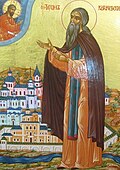 Tikhon of KarachevVenerable · Founder of Resurrection MonasteryJun 16
- Kaikhosro the GeorgianSaintJun 16
 Konstantin MinyatovMartyr · LawyerJun 16
- Actinea and GraecinaHoly MartyrsJun 16
- Athcain of Inbher ColpthaiSaintJun 16