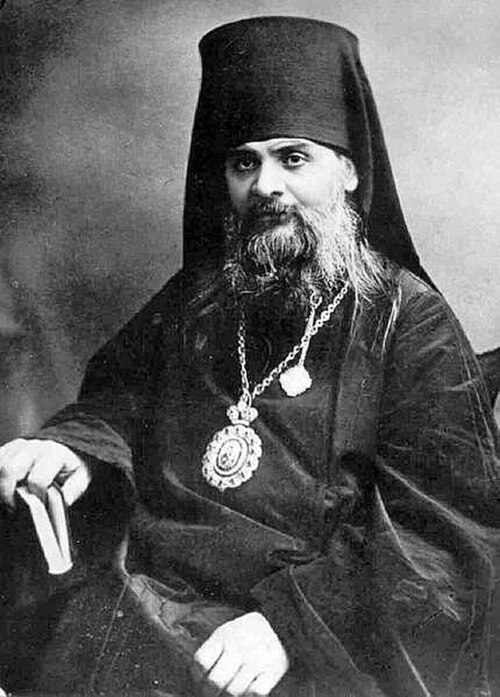
Hieromartyr
Hermogenes of Tobolsk
Bishop of Tobolsk
Bishop of Tobolsk from 1917, killed by the Bolsheviks in April 1918.
Life
Saint Hermogenes of Tobolsk was Bishop of Saratov and later of Tobolsk and Siberia, one of the best-known and most controversial Russian hierarchs of the early twentieth century. Born in 1858 in the south of the Russian Empire, he was drowned by the Bolsheviks in the river Tura on 29 June 1918. The Russian Church honours him among the new martyrs and confessors for his missionary zeal and for the death he suffered for the faith.
Family and years of searching
His name in the world was George Yefremovich Dolganov (or Dolganyov). He was born on 25 April (7 May, New Style) 1858 at Novaya Odessa in Kherson province. His father was a priest who later became a monk and was raised to the rank of archimandrite in the Transfiguration monastery in Saratov. From childhood George was deeply religious.
He completed the Odessa theological school and five classes of the Odessa seminary, and obtained his school-leaving certificate at the classical gymnasium in Ananiv. He studied medicine for two years at the University of Geneva and then graduated from the law faculty of Novorossiysk University (1889), where he also studied mathematics and philology.
He interrupted his studies several times, took various jobs, tried farming and travelled. He went through a severe spiritual crisis. Under the influence of Bishop Nicanor of Kherson he chose to serve the Church.
Monastic life and Tiflis
In 1890 he was tonsured a monk with the name Hermogenes and ordained a hierodeacon, and on 15 March 1892 a hieromonk. In 1893 he graduated from the Saint Petersburg Theological Academy as a candidate of theology.
From 1893 he was inspector and from 1898 rector of the Tiflis Theological Seminary, with the rank of archimandrite. He was also a member of the Georgian-Imeretian synodal office, chairman of the diocesan school council and editor of the Spiritual Herald of the Georgian Exarchate. From 1895 he censored the Russian texts of the journal The Pastor.
During his rectorship he expelled the young Joseph Dzhugashvili, the future Stalin, from the seminary. Russian sources give absences and poor marks as the reason, while others say the seminarian was reading forbidden books and lecturing his fellow students on Marxism.
Bishop in Saratov
On 14 January 1901 he became Bishop of Volsk, vicar of the diocese of Saratov. He launched wide missionary work, drawing in the laity as well, organized readings and talks outside the services and drew up programmes for Sunday schools.
On 21 March 1903 he became Bishop of Saratov and Tsaritsyn. He had been consecrated in the Kazan Cathedral in Saint Petersburg by several hierarchs, among them Metropolitans Anthony (Vadkovsky) of Saint Petersburg, Theognostus (Lebedev) of Kiev and Vladimir (Bogoyavlensky) of Moscow.
He urged his clergy to celebrate the services reverently, unhurriedly and strictly according to the typikon. He introduced congregational singing, encouraged processions and devoted great attention to combating sectarianism. In his time more than fifty churches were built in the diocese, four monasteries were founded, among them the Annunciation convent and the Holy Trinity monastery at Khvalynsk, and four hundred parish schools were opened. A later audit, however, found the diocesan finances in complete disorder and revealed unjust transfers of priests who were loved by their flocks.
A severe and controversial hierarch
During the revolution of 1905 he preached frequently against the revolution and showed himself a convinced and consistent monarchist. He led the Saratov branch of the Union of the Russian People, and in 1907, displeased that it admitted Old Believers, he founded an organization of his own. His diocesan paper sharply condemned the "rebels", and critics regarded him as an inspirer of violence, including attacks on the Jews of Saratov.
He harshly criticized the literary and theatrical trends of his day. He asked the Synod to ban Leonid Andreyev's play Anathema and to excommunicate a number of writers, he cancelled a memorial service for the actress Vera Komissarzhevskaya, and at the end of 1911 he opposed the proposal, supported by Saint Elizabeth Feodorovna, to restore the order of deaconesses.
From 1905 he knew Grigori Rasputin and for a time supported him, but later turned against him. On 16 December 1911, together with Hieromonk Iliodor (Trufanov) and others, he denounced Rasputin, forced him to kiss the cross and made him promise to leave the imperial palace.
On 3 January 1912 the emperor removed him from the Synod and ordered him to return to his diocese. The bishop refused and gave newspaper interviews criticizing members of the Synod, and on 17 January he was removed from his diocese as well and sent to the Zhirovichi monastery. In August 1915 he was transferred to the monastery of Saint Nicholas at Ugresha near Moscow.
Bishop of Tobolsk
On 8 March 1917 he was appointed Bishop of Tobolsk and Siberia as a "victim of the old regime". He kept his monarchist convictions and urged his flock to stay faithful to the faith of their fathers and not to bow before the idols of revolution and unbelief. He strongly criticized the decree separating Church and state.
In 1917 he was an ex officio member of the Local Council of the Russian Church and took part in its first session. In Tobolsk he was near the exiled imperial family and, according to some sources, sought to keep in contact with them.
Arrest and martyrdom
On 15 April 1918 a great procession with the cross was held in Tobolsk, after which the bishop was placed under house arrest. He was then taken to Yekaterinburg, arriving on 18 April, and imprisoned. In prison he read the New Testament and the lives of the saints, prayed and sang church hymns.
The Tobolsk diocesan assembly sent a delegation to Yekaterinburg to ask for his release on bail. Its members were the bishop's brother, Archpriest Ephraim Dolganyov, the priest Michael Makarov and the lawyer Constantine Minyatov. The delegation paid the bail of ten thousand roubles (the authorities had first demanded a hundred thousand), but the bishop was not released, and the delegates themselves were arrested and soon shot.
In June 1918 the bishop and several other prisoners, among them Father Peter Karelin of the village of Kamenskoye, were taken to Tyumen and put aboard the steamer Yermak. They were first made to work on fortifications near the village of Pokrovskoye and then transferred to the steamer Oka, which was bound for Tobolsk.
On the way the Bolshevik commander Pavel Khokhryakov ordered all the hostages to be killed. The others were shot on the bank, while Bishop Hermogenes and Father Peter Karelin were drowned in the river Tura near the village of Karbany on 29 June 1918, and so received the crown of martyrdom.
Relics and glorification
The bishop's body was found on 3 July, and the next day peasants of the village of Usolskoye buried it. A month later, on 2 August, his remains were moved to a crypt in the chapel of Saint John Chrysostom in the Cathedral of Saint Sophia and the Dormition in Tobolsk. The crypt and the relics were rediscovered in 2005 during restoration work on the cathedral.
In 1981 the Russian Church Outside of Russia glorified the new martyrs of Russia, and Bishop Hermogenes was afterwards numbered among them with a commemoration on 16 June. In August 2000 the Jubilee Council of Bishops of the Russian Orthodox Church entered his name in the Synaxis of the New Martyrs and Confessors of Russia, together with those who suffered on his account: the hieromartyrs Ephraim Dolganyov, Michael Makarov and Peter Karelin and the martyr Constantine Minyatov.
His writings include articles for young theologians, a report on the missionary brotherhood in Tiflis, an open letter to the Russian people and a commentary on the Book of Revelation. In 2017 the Holy Synod included him in the Synaxis of the Fathers of the Council of 1917-1918, commemorated on 18 November (5 November, Old Style).
His relics rest in the cathedral at Tobolsk. Saint Hermogenes is commemorated on 29 June (16 June, Old Style), as well as in the Synaxes of the Saints of Moscow and of Saratov.
Commemorated the same day June 16
 Tychon of AmathusSaint · Bishop of Amathus in CyprusJun 16
 Aureus of MainzHieromartyr · Bishop of MainzJun 16
 Tikhon of KalugaVenerable · Abbot near KalugaJun 16
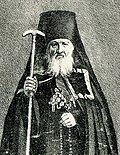 Moses of OptinaVenerable · Abbot and elder of OptinaJun 16
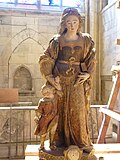 Julitta of TarsusMartyrJun 16
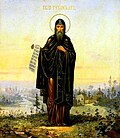 Tikhon of LukhVenerable · Founder of Nikolo-Tikhonov MonasteryJun 16
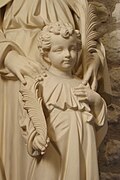 CyricusMartyr · Child martyr of TarsusJun 16
 Tikhon of KarachevVenerable · Founder of Resurrection MonasteryJun 16
- Kaikhosro the GeorgianSaintJun 16
 Konstantin MinyatovMartyr · LawyerJun 16
- Actinea and GraecinaHoly MartyrsJun 16
- Athcain of Inbher ColpthaiSaintJun 16