Venerable
Axius of Solovki
A Russian monk who labored in the Kashkaran hermitage at Solovki.
- Feast
- August 9old style August 22
- Era
- 15th century
- Order
- Venerables
Life
The Venerable Axius of Solovki (Asterius) and Kashkarantsy was a hermit who struggled on the Terek shore of the White Sea, in the fifteenth century or, by another hypothesis, in the seventeenth. He is commemorated on 11 July, in the synaxis of the saints of Novgorod, on 22 August, in the synaxis of the saints of Solovki, and on 28 December, in the synaxis of the saints of Kola. The name "Axius" is not found in the calendar of the Orthodox Church, and his true name has been lost.
The hermit of Kashkarantsy
To the Terek shore of the White Sea, to the headland of Kashkarantsy, the fishermen and seal hunters of Great Novgorod had come from of old, but only for the season. All knew the hermit who had lived there for many years and called him "the monk Axius". Each who came for the hunt considered it his duty to visit the elder and ask for his holy prayers for success in the hard work at sea.
According to tradition, one spring a crowd of people gathered there for the hunt on the ice, and among them scurvy suddenly spread, of which many died, while those who lived were gripped hard by it. The elder Axius supported the sick with prayer, heard their confessions and saw off the dying. One day he fell ill himself and soon reposed peacefully in the Lord, deeply grieving the hunters, for all their hope had been in his prayers. Each hunter thought it necessary to take leave of the departed hermit. Then everyone noticed that any sick person who came to the coffin went away from it healthy. So the illness ceased along the whole coast.
The burial and the wonder
After mourning him, the hunters decided to carry the body of the monk Axius to the Solovki monastery, for the funeral service and burial. The Pomor boat with the saint's body set out by night, with a fair wind, from the headland of Kashkarantsy, to reach Solovki by morning. According to tradition, the sailors went all night under full sail and at dawn saw that they were still within sight of Kashkarantsy. For the sailors of the north this was an unheard-of wonder. They understood the event as God's command that the body be buried right there, and the body of Axius was buried at Kashkarantsy. The grave was greatly honoured by all the fishermen who came there, especially after they saw that scurvy no longer appeared at all in those places.
Hypotheses about his life
About that time monks of the Solovki monastery began to appear at Kashkarantsy, taking over the places of the glorious deeds of the disciples of Saint Euthymius of Karelia, and that part of the shore was officially assigned to the monastery. According to documents, in 1470 Martha, the widow of the Novgorod posadnik Isaac Boretsky, bequeathed to the father founder Zosimas of Solovki the fishing grounds from the Kashkarantsy stream to Krasnaya Shchelyeka, her estate of Kashkarantsy headland and the Tochilny stream.
By one hypothesis, Axius was one of the few disciples of Saint Euthymius of Karelia who survived the devastation of 1419 of the Nicholas monastery in Karelia and its sketes on the Kola peninsula; he would be called of Solovki only because he ended his life on the shore later assigned to the monastery, though he had not been tonsured at Solovki. All this, however, is only supposition. By another version, the events belong to the middle of the seventeenth century, to the uprising called the "Solovki Sitting" (1668 to 1676), when the siege by the tsar's troops cut the archipelago off from the mainland, and the return of the boat with the body to Kashkarantsy would have a natural explanation, later clothed in the garb of a life. When the monastery was taken, in 1676, hardly any monks remained in it; twenty-eight rebels were put to death and the rest sent to the prisons of Kola and Pustozersk.
Veneration
The Solovki monastery set up on its estates "courts" with elder managers of the fisheries, called "vitamans". Such vitamans struggled at Kashkarantsy one after another: the venerable Avxentius, Axius and Tarasius. Crosses were set over their graves, and the place was greatly honoured by the Pomors. In 1815 the dean of the Kola cathedral, Father John Dyakonov, reported to Archbishop Parthenius of Arkhangelsk that the faithful served memorial services at their graves and that this veneration had begun with their burial. It was believed that for success in the northern fishing one should pray at the graves of the Kashkarantsy monks, and in thanks give something to the monks of the Kashkarantsy skete for the repose of these saints of God. Since the local veneration was established, scurvy has wholly vanished from the Terek shore. Their chief merit, however, was their power over the unclean spirits of those places and the ending, at their prayers, of terrifying night visions. Now over the grave of the three saints of Kashkarantsy stands the church of the Tikhvin Icon of the Mother of God.
Commemorated the same day August 9
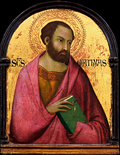 MatthiasApostle · Apostle chosen in place of JudasAug 9
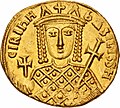 Irene of AthensRight-Believing · Byzantine EmpressAug 9
 Sava of OhridSaint · Disciple of Saints Cyril and MethodiusAug 9
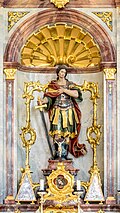 Romanus OstiariusMartyr · Doorkeeper of the church in RomeAug 9
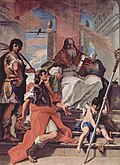 Firmus and RusticusMartyr · Martyrs of VeronaAug 9
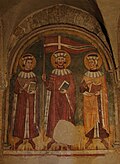 Secundianus, Marcellianus and VerianusHoly Martyrs · Martyrs of ItalyAug 9
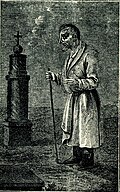 Anthony MonkinFool-for-ChristAug 9
- Jacob of SolovkiVenerable · Abbot of Solovki MonasteryAug 9
- Marcellus of VologdaSaint · Archbishop of VologdaAug 9
- Adrian of SolovkiVenerable · HermitAug 9
- Alexis of ConstantinopleMartyrAug 9
- Alexis of SolovkiVenerable · HermitAug 9