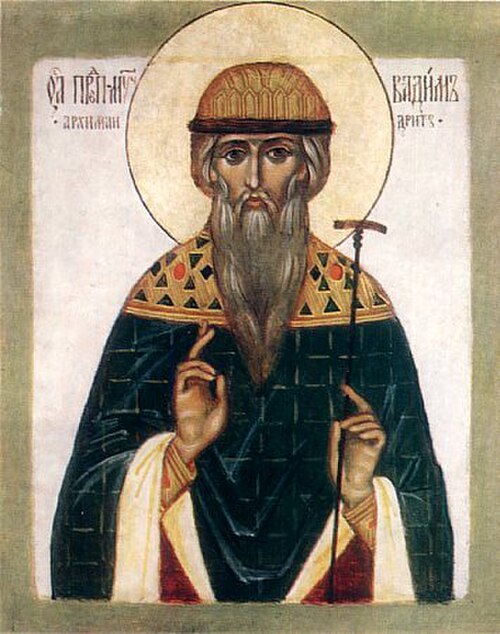
Venerable Martyr
Bademus of Persia
Abbot and martyr of Persia
Wealthy nobleman of Bethlapeta in Persia, founder of a monastery, who was put to death for his faith in 376.
Life
The Holy Venerable Martyr Bademus (Vadim) was a rich and noble citizen of Bethlapeta in Persia, who founded a monastery nearby and became its abbot. He was imprisoned with his disciples in the persecution of the Persian king Shapur II and received martyrdom in the year 376. He is commemorated on 9 April (22 April by the new calendar); Russian sources give 10 April as the day of death.
According to his life, he was born in the fourth century in Bethlapeta (Beth Lapat), was enlightened by Christian teaching from his youth, left his rich and noble parents, left home and settled in a small monastery outside the city. Soon his labours were noticed and he was ordained a priest. For a time he withdrew alone to a desolate mountain and prayed there in complete solitude, once being granted to see the Glory of God, then returned to the monastery and taught and preached there until his death.
Shapur II (309 to 379) persecuted Christians cruelly; Saints Symeon, Isaac and many others suffered in his persecution. More than 270 victims of Shapur are counted as martyrs, and their memory is kept on the day of Saint Bademus. In the thirty-sixth year of the persecution, Bademus was thrown into prison with seven of his disciples. The saint spent four months in chains, beaten daily, forced to renounce Christ and bow down to the sun and fire (the god Atar), and his disciples, seeing this, remained just as firm in the faith. At the same time another Christian was imprisoned, the nobleman Nersan, prince (or former head) of Aria, who first refused Zoroastrianism but, at the sight of the tortures, gave in and promised to convert. To test his sincerity, Shapur ordered Bademus brought to Nersan's cell, which was a chamber in the royal palace, and ordered Nersan to kill him with his own hand, promising to restore his princely rights and dignities, according to the Serbian source along with all the property of Bademus's monastery. Nersan accepted. A sword was put in his hand, but he was seized with terror and stood still until he could not lift his arm. With trembling hands he struck at the sides of Bademus, his blows weak from fear, shame and remorse. The wounds were so many that the witnesses admired his unshakable patience. The saint rebuked him: "Unhappy Nersan, how far do you carry your apostasy? With joy I go to meet death, but I would wish to fall by some other hand than yours; why must you be my executioner?" Nersan needed four strokes to cut off his head. Shortly afterwards, troubled by his conscience, he killed himself by throwing himself on a sword.
The saint's body was cast out of the city by the Persians, but was taken and buried in secret by Christians. His disciples were freed from their chains in 379, after the death of King Shapur, having remained in prison four more years, according to other sources five.
Commemorated the same day April 9
- Maximus of AlexandriaSaint · Patriarch of AlexandriaApr 9
 Acacius of AmidaSaint · Bishop of AmidaApr 9
 Raphael, Nicholas and Irene of LesbosHoly Venerable MartyrsApr 9
 Aedesius of AlexandriaMartyr · Brother of Saint AmphianApr 9
 Eupsychius of CaesareaMartyr · Martyr of Caesarea in CappadociaApr 9
- ClementinaMartyrApr 9
- Theodore of CrowlandVenerable Martyr · Abbot of CrowlandApr 9
- Abdies of PersiaMartyrApr 9
- AedhachSaintApr 9
- Bat Emas of PersiaMartyrApr 9
- BroganSaintApr 9
 Casilda of ToledoVenerableApr 9