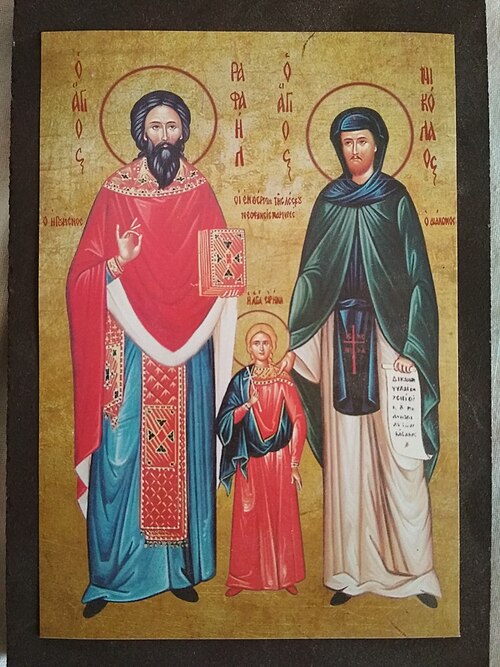
Holy Venerable Martyrs
Raphael, Nicholas and Irene of Lesbos
By tradition they lived on Lesbos in the fifteenth century and were killed by Turkish raiders in April 1463.
Life
The Holy Venerable Martyrs Raphael, Nicholas and Irene are honoured as new martyrs of the island of Lesbos, where, according to tradition, they were killed by the Turks in Bright Week of 1463, ten years after the fall of Constantinople. Raphael was abbot of a monastery on the hill of Karyes near the village of Thermi, Nicholas his deacon, and Irene the twelve-year-old daughter of the village headman. Their relics were found in 1959-1960, and the monastery built on the place of their martyrdom is today one of the great pilgrimage sites of Orthodoxy.
Almost everything known of their lives comes from the visions and revelations that, according to the people of Lesbos, they received in dreams and while awake after the relics were found, above all from Saint Raphael. Excavations at the site of the martyrdom confirmed much of what was revealed. The life below follows this tradition.
The life of Saint Raphael
According to these revelations, Saint Raphael was born in 1410 in the village of Perachori on the island of Ithaca, and in the world he was named George Laskaris (or Laskaridis). His parents, Dionysios and Maria, gave him a Christian upbringing. At thirteen he went to Mystras at the urging of his brother-in-law, and there he studied Greek and Western philosophy as well as medicine, which he greatly enjoyed.
He then entered the Byzantine army, where he rose to high rank. At about thirty-five he chose the path of God's service. He was led to it by a devout and much-respected priest, Father John: at Christmas this priest gave communion to the soldiers and preached the word of God to them, and George was deeply moved; at Theophany he left his post and followed the call.
He was tonsured a monk with the name Raphael and then ordained priest. He served as parish priest and preacher in Athens at the church of Saint Demetrius the Myrrh-streamer on the hill of Philopappos, below the Acropolis, later known as Loumbardiaris. Later he was raised to the rank of protosyncellus and archimandrite of the Ecumenical Patriarchate, and shortly before the fall of Constantinople he was sent by the patriarch on a mission to Morlaix in France.
His disciple Nicholas
In France he met the young Nicholas from Thessaloniki, the son of a wealthy notary, whom his parents had sent to study medicine. Moved by the word of the Gospel, Nicholas followed Father Raphael back to Greece and embraced monastic life, being tonsured a monk and then ordained deacon. From then on they were never parted, except when each preached in a different place. In 1450 they went together to Macedonia.
Refuge on Lesbos
When Constantinople fell in 1453, Raphael and Nicholas were in Thrace, where the Turks were persecuting Christians and ravaging the land. They fled with other refugees from the port of Alexandroupolis and reached Lesbos on 14 March 1454, an island then considered safe. Lesbos was still under Genoese rule and, enjoying privileges from the sultan and a lenient ruler, had become a refuge for many Christians.
They were directed to the Monastery of the Nativity of the Mother of God on the hill of Karyes, near the baths of Thermi, and settled there. According to local tradition, a women's monastery had once stood there, sacked by pirates in 1235. There the abbess Olympias, who came from the Peloponnese, and her sister Euphrosyne had struggled and faced the raiders; Olympias died then, on 11 May 1235. In the monastery the Holy Martyr Paraskevi was honoured alongside the Mother of God.
Raphael found only a few monks there, among them Reuben and Akindynos, and soon became abbot. Until the autumn of 1462 the island was at peace. The monastery became the most important on Lesbos, and others were dependent on it. The abbot and Deacon Nicholas, both skilled in medicine, cared for the sick who came to them, and the monastery also served as a school for the children of the area.
The conquest of the island
In September 1462 Sultan Mehmed II the Conqueror besieged Lesbos, and after a seventeen-day siege the island fell on 17 September 1462. For about six months the monastery remained untouched. But on Good Friday, 5 April 1463, after an uprising of the people of Thermi, the Turks came to the monastery looking for the rebels. Sheltering there were the headman of Thermi, Basil, with his wife Maria, their twelve-year-old daughter Irene and their niece Helen, the village schoolteacher Theodore and other villagers.
Martyrdom
On Tuesday of Bright Week, 9 April 1463, wishing to force Irene's parents to reveal where the rebels were hiding, the Turks cut off the girl's right hand and then burned her alive in a large clay jar. After her they killed her parents, the teacher Theodore and those who were with them.
On the same day Abbot Raphael and Deacon Nicholas received the crown of martyrdom. According to what the saint revealed, the Turks tortured him for a long time: they beat him with clubs, struck him with spears, dragged him along the ground by his beard and hanged him from a walnut tree, beating him for a day and a night. All the while he told them that by God's will he would endure everything to his last breath, and from this he drew his strength. They took him down and dragged him over stones, which he reddened with his blood, then hanged him again from the walnut tree, head downward, for another day. At the end they sawed through his jaw and beheaded him.
Deacon Nicholas was tied to a tree beside his spiritual father. Seeing the sufferings of his teacher, he died after the first blows. Then the Turks set fire to the monastery.
A forgotten commemoration
The martyrs were buried in secret. Later a chapel was built on the site of the monastery, and the Christians of the area came there with candles, generation after generation, on Tuesday of Bright Week, though the reason for the custom had been forgotten. In time the place became an olive grove, where a few ruins of the old monastery remained, and some women of the village kept the commemoration there. It was also said that after the memorial service a figure was sometimes seen walking among the trees.
The finding of the relics
In 1959 the family of Angelos Rallis, who owned the land, decided to build a small church in place of the old one. On 3 July 1959, while digging the foundations, the workers found a grave two metres deep containing the relics of Saint Raphael. The head lay on a rounded stone beside the body, the hands were crossed on the breast, and the jawbone was missing from the skull; it was found later.
On the night after the relics were found the saint appeared in dreams to a priest and to other local people, first to Vasiliki, wife of Angelos Rallis, and then to other devout women of the village, as a tall, stern figure in priestly vestments. He told them that he had suffered at the hands of the Turks on 9 April 1463 and that the remains were his, and he recounted the martyrdom of those who had suffered with him.
Through further visions Saint Raphael then showed where Saints Nicholas and Irene were buried. The relics of Saint Nicholas were found on 13 June 1960. The relics of Saint Irene were also uncovered, together with the clay jar in which she had been burned, the remains of her parents, of the teacher Theodore and of the Venerable Martyr Olympias, abbess of the former monastery, and of others. After the finding of the relics many local people testified that the saints appeared to them in dreams and while awake, helping them, healing them of illnesses and telling them of their lives; most often Saint Raphael appeared alone.
The monastery and veneration
On 12 September 1963 a women's monastery dedicated to Saint Raphael was founded on the place of the martyrdom. It stands in the north-east of the island, on the hill of Karyes, 12 kilometres from Mytilene and 3 kilometres from Thermi. There are kept the relics of Saints Raphael, Nicholas and Irene, Saint Irene's clay jar, the stone on which Saint Raphael's head was found and the relics of Saint Olympias. The monastery has become a great place of pilgrimage, visited by the faithful from the whole Orthodox world.
In 1962 the Church of Greece numbered them among the saints, and on 11 September 1970 they were canonised by the Holy Synod of the Ecumenical Patriarchate. They are commemorated on 9 April and, above all, on Tuesday of Bright Week, the day of their martyrdom.
Commemorated the same day April 9
- Maximus of AlexandriaSaint · Patriarch of AlexandriaApr 9
 Acacius of AmidaSaint · Bishop of AmidaApr 9
 Bademus of PersiaVenerable Martyr · Abbot and martyr of PersiaApr 9
 Aedesius of AlexandriaMartyr · Brother of Saint AmphianApr 9
 Eupsychius of CaesareaMartyr · Martyr of Caesarea in CappadociaApr 9
- ClementinaMartyrApr 9
- Theodore of CrowlandVenerable Martyr · Abbot of CrowlandApr 9
- Abdies of PersiaMartyrApr 9
- AedhachSaintApr 9
- Bat Emas of PersiaMartyrApr 9
- BroganSaintApr 9
 Casilda of ToledoVenerableApr 9