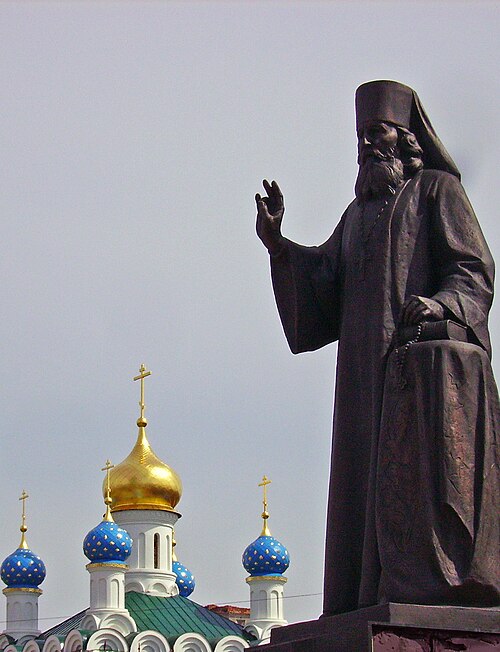
Venerable
Barnabas of Gethsemane
Hieromonk of Gethsemane Skete
Born into a serf family, hieromonk at Gethsemane Skete of the Trinity Lavra, who died in 1906.
- Feast
- February 17old style March 2
- Reposed
- 190620th century
- Place
- Sergiyev Posad
- Order
- Venerables
Life
Venerable Barnabas of Gethsemane (in the world Vasily Ilyich Merkulov, 1831 to 1906) was a hieromonk and spiritual father of the Gethsemane Skete beside the Trinity-Saint Sergius Lavra in Sergiev Posad. Born in serfdom, he became an elder sought out by thousands of pilgrims and the confessor of Tsar Nicholas II. He also founded the Iveron convent at Vyksa. The Russian Church numbered him among the saints in 1995.
Childhood and calling
Vasily was born on 24 January 1831 in the village of Prudishchi, in the Tula region, to Ilya and Darya Merkulov, serf peasants. At baptism he received the name of Saint Basil the Great. From childhood he went to services with his elders and tried to learn the prayers by heart. His pious parents sent him to the psalm-readers' school, where he learned the Book of Hours and the Psalter.
In 1840 the Merkulov family was sold to another landowner, from the village of Naro-Fominsk in Moscow province. The new owner, Prince Shcherbatov, ordered the teenager to be taught metalwork. In the time free from his craft Vasily went to the nearby Zosima Hermitage, where he met the hermit monk Gerontius, who soon became his spiritual guide.
In the autumn of 1850, aged nineteen, he went with his mother to the Trinity-Saint Sergius Lavra. When after the service he touched the relics of Saint Sergius, he felt a joy beyond explanation. A year later he went there with Gerontius, who had decided to end his life beside the relics of Saint Sergius of Radonezh. On 23 December 1857 he became a novice of the Gethsemane Skete. For several years he worked in the locksmith's obedience, then was put in charge of the candle desk and received a blessing to read the Apostle and the readings from the Prologue in church.
Gethsemane Skete
The skete lived by the rule of the Sarov Hermitage. Great influence on the future elder was exercised by the monk Daniil (Shimovsky). On 17 February 1856 Vasily received his certificate of release from serfdom. Only after almost ten years, on 20 November 1866, after the death of Elder Daniil, did he receive monastic tonsure, with the name Barnabas. In 1871 he was ordained hierodeacon, on 10 January 1872 hieromonk, and after some time the abbot of the Lavra, Anthony (Medvedev), appointed him confessor of the people at the Caves of the Gethsemane Skete. In 1890 he became confessor of the whole skete.
The convent at Vyksa
At the end of 1863 Vasily went for the first time to the village of Vyksa (now a town), in Nizhny Novgorod province, to look for the site of a future monastery. A verst from the village he chose a secluded spot and prayed there long and warmly, then bowed in all four directions, dug a cross into the place of the future community and set a broken branch where the holy altar would be. Soon, as he wished, the place was blessed by the bringing there of the wonder-working Oranky icon of the Mother of God. So in 1863 Barnabas became the founder of the Iveron convent at Vyksa. In 1913 the question of naming it the Barnabas convent was raised, but war and revolution stopped the plan.
The elder of the people
From the time he was named confessor of the people he became known among the faithful. Pilgrims from many corners of Russia came for his blessing. Contemporaries left testimonies of his gift of perceiving hidden things. He received between 500 and 1,000 people a day. In January 1905 Emperor Nicholas II confessed to him with his family, and the elder blessed him to accept a martyr's death.
In January 1906 he fell ill with acute catarrh of the respiratory tract and his sight weakened. On 17 February 1906 he fell asleep in the Lord while hearing confessions in the Dormition church of the Lavra's almshouse in Sergiev Posad.
Relics and glorification
The saint's body was moved in 1923 to the Ascension cemetery of Sergiev Posad, in 1934 to the Saint Nicholas cemetery and in 1968 to the Zagorsk cemetery. In 1989, at the Bishops' Council, the question of canonization was raised. After studying the materials, Metropolitan Juvenaly, head of the canonization commission, reported to Patriarch Alexy II that the elder could be canonized. On 30 September 1994 the Patriarch sent a letter to the abbot of the Lavra, Archimandrite Theognost, saying that the commission unanimously found it possible to number Hieromonk Barnabas among the locally venerated saints of the Moscow diocese, in the synaxis of the saints of Radonezh. In 1995, on the day of the synaxis of the saints of Radonezh, the Patriarch performed the canonization in the Dormition Cathedral of the Moscow Kremlin.
The venerable one's relics rest in the rebuilt church of the Chernigov Icon of the Mother of God, in the Chernigov Skete of the Lavra, in a side altar that bears his name, beside the part of Saint Elijah. He is commemorated on 17 February (old style) and on 6 July (old style), in the synaxis of the saints of Radonezh.
Commemorated the same day February 17
 Mesrop MashtotsSaint · Creator of the Armenian alphabetFeb 17
 MarcianRight-Believing · Byzantine EmperorFeb 17
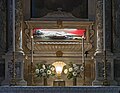 Theodore the RecruitGreat Martyr · of AmaseaFeb 17
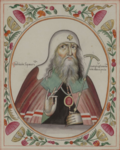 Hermogenes of MoscowHieromartyr · Patriarch of MoscowFeb 17
 MariamneApostle · Sister of the Apostle PhilipFeb 17
 Theodore the SilentVenerable · Monk of the Kiev CavesFeb 17
- Theodore of ByzantiumNew MartyrFeb 17
- Michael MavroeidisNew MartyrFeb 17
- Theodore AvalianiSaintFeb 17
- Finan of LindisfarneSaint · Bishop of LindisfarneFeb 17
- Agathangelos of FlorinaNew MartyrFeb 17
- Auxibius of SoliSaint · Bishop of SoliFeb 17