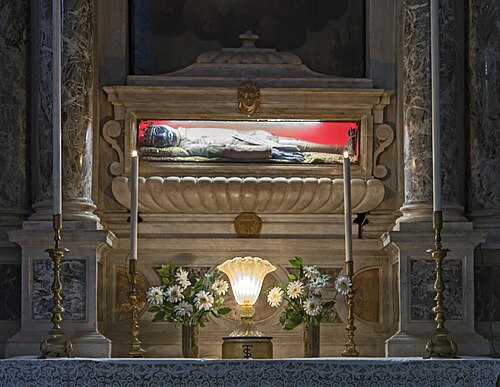
Great Martyr
Theodore the Recruit
of Amasea
Young soldier of Amasea, killed for his faith in Christ in the persecution of Diocletian, around 306.
- Feast
- February 17old style March 2
- Reposed
- 3064th century
- Place
- Amasya
- Order
- Great Martyrs
Life
Saint Theodore the Recruit, called Tiron in Greek, was a young soldier at Amasea in Pontus, put to death for confessing Christ in the persecution of Diocletian, around the year 306. The Church honours him as a Great Martyr and keeps his memory on 17 February. He is also remembered on the first Saturday of Great Lent, in memory of the miracle of the kollyva, and he is one of the best loved soldier saints.
The martyr of Amasea
The name Tiron means a new recruit. According to the Life, Theodore had only lately joined the army and served in a cohort that was quartered at Amasea for the winter, under the commander Brincus. When the soldiers were ordered to sacrifice to the gods, Theodore confessed aloud that Jesus Christ is God and that idols are made by human hands. The commander, taking pity on his youth, gave him some days to think it over, and Theodore spent them in prayer.
In this time the temple of the pagan goddess, whom the Life calls the mother of the gods, Rhea or Cybele, burned down, and Theodore was accused of setting the fire. He confessed that he had done it. He was thrown into prison to be starved, and there the Lord Jesus Christ appeared to him and comforted him. Brought before the governor Publius, he again confessed his faith boldly. He was tortured and condemned to be burned alive.
Theodore climbed on to a great pyre, made the sign of the Cross and glorified God as the fire was lit. According to the Life, written by a man who claimed to have seen it himself, the Holy Spirit cooled the flames, and Theodore gave up his soul into the hands of God while the onlookers saw it rise to heaven. His body was unharmed by the fire. This happened about the year 306, under the emperor Galerius. The earlier date of 287, found in a Western collection of saints' lives, is not accepted by later tradition.
The kollyva
Fifty years later, in the reign of the emperor Julian the Apostate (361 to 363), the Christians of Constantinople were tested again. Julian ordered the city prefect to sprinkle all the food in the markets with the blood of idol sacrifices during the first week of Great Lent. Saint Theodore appeared in a dream to Archbishop Eudoxius and told him to warn the Christians not to buy anything in the market, but to eat boiled wheat with honey, the kollyva.
In memory of this, the Church keeps the first Saturday of Great Lent as his feast. On the Friday evening, after the Liturgy of the Presanctified Gifts, the Canon to the Great Martyr Theodore, composed by Saint John of Damascus, is sung, and the kollyva is blessed and given to the faithful. This observance is traditionally traced to Patriarch Nectarius of Constantinople (381 to 397). The story of the kollyva is a tradition and cannot be checked from earlier sources.
Veneration
His veneration is old. In the winter of 381 Gregory of Nyssa preached a panegyric on him at his shrine, and the cult spread quickly. His body was buried at Euchaita, not far from Amasea, which became a famous place of pilgrimage and was also called Theodoropolis. According to a tradition recorded much later, a woman of Euchaita named Eusebia moved his relics there as he had wished. His relics were later brought to Constantinople, to a church that bore his name, while Gaeta in Italy claims his head and Brindisi claims his body. Venice honoured him before Saint Mark. Western sources keep his day on 9 November.
The dragon legend that is told of Theodore, and of Saint George after him, is much later than the martyrdom. In icons he is shown as a soldier, sometimes with a dragon, and sometimes with Saint Theodore Stratelates, whose own feast is on 8 February. Some scholars think Stratelates is a duplicate figure of the Recruit. The Orthodox Church prays to Theodore the Recruit for the finding of lost or stolen things. In Chișinău, in Moldova, the monastery called Ciuflea is dedicated to him.
Commemorated the same day February 17
 Mesrop MashtotsSaint · Creator of the Armenian alphabetFeb 17
 MarcianRight-Believing · Byzantine EmperorFeb 17
 Hermogenes of MoscowHieromartyr · Patriarch of MoscowFeb 17
 MariamneApostle · Sister of the Apostle PhilipFeb 17
 Barnabas of GethsemaneVenerable · Hieromonk of Gethsemane SketeFeb 17
 Theodore the SilentVenerable · Monk of the Kiev CavesFeb 17
- Theodore of ByzantiumNew MartyrFeb 17
- Michael MavroeidisNew MartyrFeb 17
- Theodore AvalianiSaintFeb 17
- Finan of LindisfarneSaint · Bishop of LindisfarneFeb 17
- Agathangelos of FlorinaNew MartyrFeb 17
- Auxibius of SoliSaint · Bishop of SoliFeb 17