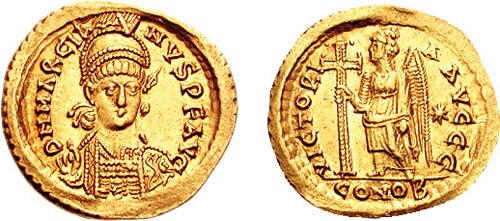
Right-Believing
Marcian
Byzantine Emperor
Emperor of the East from 450 to 457, who convened the Fourth Ecumenical Council at Chalcedon.
- Feast
- February 17old style March 2
- Reposed
- 4575th century
- Place
- Constantinople
Life
The Holy Emperor Marcian reigned over the Roman East from 450 to 457. His name is tied to the Fourth Ecumenical Council, at Chalcedon, in 451, which he convened together with his wife, Saint Pulcheria. The Orthodox Church commemorates him on 17 February, beside her.
Early life
He was born around 392 in Thrace or Illyria, into a family of no distinction, the son of a soldier. He enlisted young at Philippopolis in Thrace, and in the Persian war of 421 and 422 he was probably a tribune, but fell ill in Lycia and took no part in the fighting. He then served fifteen years as domesticus, a kind of personal assistant, to the commanders Ardabur and Aspar. In the 430s he went with Aspar to Africa, where he was captured by the Vandals.
Tradition says that King Gaiseric released him and predicted that he would become emperor. Modern historians think this story, written during his reign, is probably propaganda. After that Marcian is not mentioned until the death of Emperor Theodosius II.
Rise to the throne
Theodosius II died on 28 July 450 after a riding accident, with no sons and no designated heir. According to the life in the synaxarion, he had told Saint Pulcheria, from a revelation received at Ephesus in the church of Saint John the Theologian, that the sceptre would pass to the soldier Marcian. Historians regard this tale of a deathbed bequest as the creation of Marcian's supporters. The commander Aspar, who held great influence through the army, put him forward. After a month of talks, Pulcheria, sister of Theodosius, agreed to marry him, on condition that he respect her virginity, vowed in 413, and abandon the religious policy of Theodosius. Marcian was proclaimed on 25 August 450, and Pulcheria herself placed the diadem on him. She remained a virgin in the marriage.
Reign
Marcian at once changed the policy toward the Huns. He cancelled the treaties with Attila and stopped the tribute, saying, as it is told, that he had gold for friends and iron for enemies. Attila then turned on the West, into Gaul and later Italy. In 452, while Attila raided Italy, Marcian crossed the Danube and defeated the Huns in their own land. After Attila died in 453 his empire fell apart, and Marcian made alliances with the freed peoples, especially the Ostrogoths, and let them settle in Pannonia, Thrace and Illyria.
At home he forgave old debts to the state, tried to stop the sale of court offices, and left the treasury full. Wikipedia speaks of a surplus of seven million solidi, the Russian synaxarion of a hundred thousand pounds of gold. He was a man of faith. He walked on foot in the great processions, which led the patriarch to give up his litter, and he built a church for the venerable Bassian while that ascetic was still alive.
The Council of Chalcedon
In 451 Marcian convened the Fourth Ecumenical Council, at Chalcedon, to end the troubles stirred by the Robber Council of Ephesus in 449, which had exiled Patriarch Flavian. The council condemned the Monophysite teaching of Eutyches and Dioscorus of Alexandria and confessed Christ as perfect God and perfect man, in one Person and in two natures. It also gave canons for the order of the Church. Afterwards the emperor backed its decisions with the power of the state: he sent troops to Alexandria and took away the privileges of the Alexandrians inclined to Monophysitism, and in 453 he sent soldiers to quiet the rebellious Monophysite monks in Palestine.
Because of this decision many Churches of Syria and Egypt separated from the Church of the empire, and the Oriental Orthodox Churches still do not accept Chalcedon.
Repose
Marcian reposed in January 457 at Constantinople. The sources give 25, 26 or 27 January. The cause was gangrene of the legs, after a long religious procession. He was buried in the church of the Holy Apostles, beside Saint Pulcheria, who had fallen asleep in peace on 10 September 453. With him the Theodosian dynasty ended. After his death Aspar passed over Marcian's son-in-law Anthemius and had Leo I elected emperor.
The Orthodox Church honours him as a right-believing emperor on 17 February, with Pulcheria; he is not in the modern Russian calendar. The day is the same in the Greek and Romanian calendars.
Commemorated the same day February 17
 Mesrop MashtotsSaint · Creator of the Armenian alphabetFeb 17
 Theodore the RecruitGreat Martyr · of AmaseaFeb 17
 Hermogenes of MoscowHieromartyr · Patriarch of MoscowFeb 17
 MariamneApostle · Sister of the Apostle PhilipFeb 17
 Barnabas of GethsemaneVenerable · Hieromonk of Gethsemane SketeFeb 17
 Theodore the SilentVenerable · Monk of the Kiev CavesFeb 17
- Theodore of ByzantiumNew MartyrFeb 17
- Michael MavroeidisNew MartyrFeb 17
- Theodore AvalianiSaintFeb 17
- Finan of LindisfarneSaint · Bishop of LindisfarneFeb 17
- Agathangelos of FlorinaNew MartyrFeb 17
- Auxibius of SoliSaint · Bishop of SoliFeb 17