Hieromartyr
Basil Maksimov
Cleric martyred for the faith of Christ in 1937, during the Soviet persecution.
- Feast
- September 10old style September 23
- Reposed
- 193720th century
- Order
- Martyrs
Life
Holy Hieromartyr Basil Maksimov, a priest, was born on 28 January 1887 in the village of Babka, Pavlovsk district, Voronezh province, in the family of the peasant Nikita Maksimov. The family lived in poverty, and the father fell ill and went blind. The boy was pious and obedient and the local priest blessed him to serve in the altar. One feast day a visiting bishop was drawn to the devout boy gifted with music, took him along to Shadrinsk and placed him in the theological school. He was fourteen. At Shadrinsk he met his future wife, Julia, who studied at the music school, daughter of the priest Alexander Konev. In 1914 he was ordained priest for a church in Shadrinsk, then moved to Petropavlovsk. In 1923 he moved to Moscow region and was appointed to the church of the Great Martyr Nikita in the village of Kabanovo, Orekhovo-Zuevo district. For his faultless service he was made archpriest, received the mitre and was appointed dean.
He served often and at each service gave a sermon, carefully prepared from his large library. He knew that his sermons reached the hearts of the parishioners and therefore displeased the civil authorities, but he regarded the enlightenment of his flock as his duty. The people valued and trusted him, and he took the Holy Mysteries to the home of those who could not come to church. On 10 June 1927 his wife Julia died at only thirty-two, of blood poisoning, after scratching a pimple. The father was left with three children, Maria, Nina and a boy, Nicholas, not yet two. Prayer at her grave kept him awake at night, and his health faltered. At the end of the 1920s, after a fire, he gave the large church house to the families who had lost their homes and moved into the little cottage by the church, where Euphemia Vishnyakova, the watchman's daughter, took care of the children. In 1934 he wrote to a niece that taxes of 360 rubles had come, but that people were helping him, that the fast brought the faithful and gave him labour and joy. Ill with tuberculosis in 1935, he was saved by the love of his parishioners, who surrounded him with gifts, and he recovered completely.
In 1937, as news of arrests came, the authorities proposed that he leave the church and even become a theatre actor, for his strong voice, but he refused and prepared for arrest, burning his wife's diary. In the night of 22 to 23 August 1937 NKVD agents entered the house. Before leaving he asked leave to pray at his wife's grave and was given it. Taken to the prison in Orekhovo-Zuevo, he was questioned about agitation against the Stakhanovite movement and the collective farms and about the gatherings at one believer's home. He admitted only that some conversations might have taken place, but said that in his sermons he had never touched political questions. He was sentenced to death and shot on 23 September 1937 at the Butovo firing range. His books were distributed: the secular ones, mostly Russian classics, to a parishioner, the spiritual ones to the church singer, and through these a young man was enlightened and later ordained a priest.
He is commemorated on 23 September, on 29 May (a movable date) in the Synaxis of the New Martyrs of Butovo, and on 5 September (a movable date) in the Synaxis of the Saints of Moscow, all in the new style.
Commemorated the same day September 10
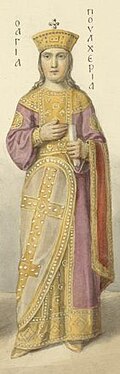 PulcheriaRight-Believing · Empress of ByzantiumSep 10
 Aubert of AvranchesSaint · Bishop of AvranchesSep 10
 Salvius of AlbiSaint · Bishop of AlbiSep 10
 Menodora, Metrodora and NymphodoraHoly Martyrs · Virgin martyrsSep 10
 Benjamin of the Kiev CavesVenerable · Monk of the Kiev CavesSep 10
 Palladius PopovHieromartyr · Priest of IzhmaSep 10
 Victor of ChalcedonMartyr · SoldierSep 10
 Tatiana GrimblitMartyr · NurseSep 10
 Juvenaly MaslovskyHieromartyr · Archbishop of RyazanSep 10
- Sophia of SicilyMartyrSep 10
 Varus ShmarinHieromartyr · Bishop of LipetskSep 10
 Sosthenes of ChalcedonSaintSep 10