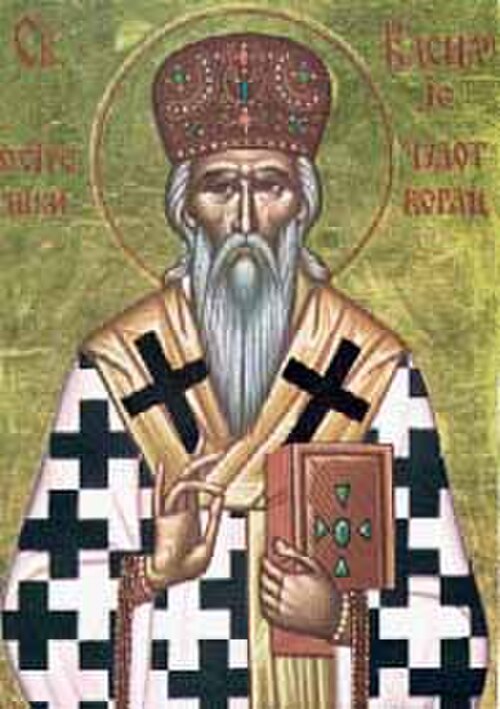
Saint
Basil of Ostrog
Bishop of Zahumlje
Serbian bishop of Zahumlje, whose relics rest at Ostrog Monastery; he died in 1671.
Life
Saint Basil of Ostrog, also called Basil the Wonderworker, was Bishop of Zahumlje in the seventeenth century and is one of the best loved saints of the Serbian people and of Montenegro. He passed to the Lord on 29 April 1671 in Ostrog Monastery, where his relics rest. He is commemorated in the Serbian Church on 29 April, which is 12 May in the new calendar.
Childhood and schooling
He was born Stojan Jovanović, on 28 December 1610 according to tradition, in the village of Mrkonjići on the plain of Popovo near Trebinje, in Herzegovina under Ottoman rule. His parents, Petar and Ana, were pious peasants. Later accounts say that, tending flocks on the hills of Herzegovina, he shared his food with the poor.
Out of fear of the Ottoman blood tax, his parents sent him at about twelve to the hidden monastery of Zavala, where his paternal uncle, the hieromonk Serafim, was abbot. There he learned church letters and came to know the Scriptures well. Later he was sent to the monastery of Tvrdoš near Trebinje for higher study. There he was tonsured with the name Basil, after Saint Basil the Great, and then received the orders of deacon and priest.
The bishop
After a journey to Montenegro, to the monastery of Cetinje, he was made archimandrite of Tvrdoš. The sources also speak of journeys to Mount Athos, to Wallachia and to Little Russia, from which he returned with gifts for the suffering people of Herzegovina. On his way back he stopped at Peć, the seat of the Serbian patriarchs, and Patriarch Paisije Janjevac ordained him bishop. This took place in 1638 (according to others his election was in 1639), with the title Metropolitan of Zahumlje. The title of Skenderija was added later.
His ministry was always in danger. He was persecuted by the Ottomans and slandered also by Catholic missionaries, in the time of Uniate pressure from Dubrovnik, and in 1641 a false Uniate bishop, Savatije, drove him from his seat at Trebinje. According to some sources he retired from the episcopal office in 1649. Without a throne, he travelled through villages and towns, served the liturgy, consoled the fearful and strengthened them in the faith of their fathers.
Ostrog
When the Ottomans destroyed Tvrdoš, he meant to leave for Athos, but the people of Bjelopavlići stopped him, promising that each would give him a measure of wheat. He stayed, struggling first in a cave at Pješivci and then in the cave at Ostrog. On the rock above he founded the monastery. He renewed the church of the Presentation of the Mother of God and built the church of the Elevation of the Cross. He spent the last fifteen years of his life in the cave cell of Upper Ostrog. He fell asleep in the Lord on 29 April 1671. According to tradition, a grapevine grew out of the rock beside his cell.
Veneration
His tomb in the cave church soon became a place of pilgrimage, not only for Orthodox Christians but also for Catholics and Muslims, drawn by reports of miracles through the saint's intercession. Today Ostrog is one of the great pilgrimage sites of the Balkans, especially at Pentecost. In Montenegro he is counted among the greatest saints. The Orthodox theological faculty in East Sarajevo bears his name.
Commemorated the same day April 29
 Torpes of PisaMartyr · Martyr of PisaApr 29
 Memnon the WonderworkerVenerable · Abbot in Egypt and wonderworkerApr 29
 Amphilochius of PochayivVenerable · Monk of the Pochayiv LavraApr 29
 Nectarius of OptinaVenerable · Elder of OptinaApr 29
 John Kaloktenes the NewSaint · Metropolitan of ThebesApr 29
- Three Hundred Laz MartyrsHoly New MartyrsApr 29
 EndelientaVenerable · Hermit of CornwallApr 29
 Nine Martyrs of CyzicusHoly Martyrs · Martyrs of CyzicusApr 29
- Sopater of BereaApostle · of BereaApr 29
- AemilianusMartyr · Martyr of CirtaApr 29
- Agapius and CompanionsHoly MartyrsApr 29
- Agapius and SecundinusHoly HieromartyrsApr 29