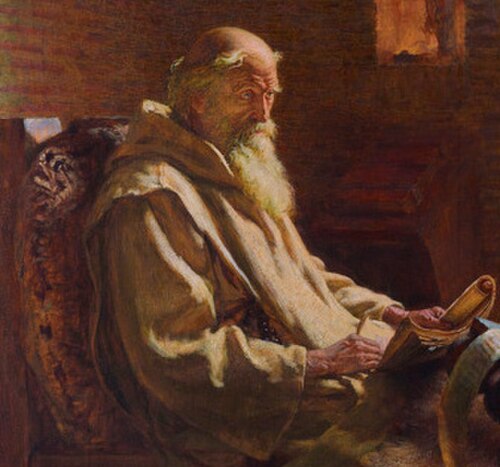
Venerable
Bede the Venerable
Monk and historian
English monk and scholar, author of the Ecclesiastical History of the English People.
- Feast
- May 27old style June 9
- Reposed
- 7358th century
- Place
- Jarrow
- Order
- Venerables
Life
Saint Bede the Venerable, the venerable father, was a monk of Northumbria in northern England, learned in the Scriptures, historian of the Church and one of the most important scholars of the first English centuries. He lived almost his whole life in one monastery, wrote more than sixty books, and is called the father of English history. The Orthodox Church commemorates him on 27 May.
Childhood in the monastery
He was born in 672 or 673 on lands belonging to the twin monasteries of Wearmouth and Jarrow in Northumbria. Almost everything known of his life comes from the last chapter of his Ecclesiastical History. At seven he was sent to be educated at the monastery of Saint Peter at Wearmouth under Saint Benedict Biscop, and then under Saint Ceolfrith, with whom he probably moved to the monastery of Saint Paul at Jarrow, founded in 682. In 686 a plague carried off nearly all the monks; the Life of Ceolfrith mentions only the abbot and a boy raised by him, who is thought to have been Bede.
The monastery's library, partly brought from the continent by Benedict Biscop, was rich. It made his scholarly work possible.
Priest and scholar
At about nineteen he was ordained deacon by Bishop John of Hexham, earlier than the canonical age, and at about thirty priest, by the same bishop. The OCA synaxarion calls this bishop Saint John of Beverley. Bede loved the church services. He believed that since the angels are present at the prayers of the monks, he too must be there.
He began to write around 701, with school works on metre and figures of speech. He wrote commentaries on Scripture, lives of saints, a martyrology, hymns and poems, letters, and works on reckoning time and the date of Pascha. His best-known work, the Ecclesiastical History of the English People, was finished around 731. It tells of the beginnings of Christianity in Britain, the mission sent by Pope Gregory the Great through Augustine of Canterbury, and the spread of the faith in Northumbria. Bede relies on old documents, the traditions of his ancestors and what he knew himself. The OCA synaxarion notes that he is not a neutral historian, since he stands on the side of Rome in the dispute with Celtic Christianity, but he remains fair and thorough. His books reveal a world of piety close to that of Orthodoxy: Christians fasted on Wednesdays and Fridays and kept a forty day fast before the Nativity. In 708 some monks at Hexham accused him of heresy over the calculation of the age of the world in De Temporibus, but nothing came of it.
Repose
In 735 he fell ill. For almost two weeks before Pascha he was short of breath but almost without pain. He kept teaching his students and sang Psalms for the rest of the day, while working on an Anglo-Saxon translation of the Gospel of John. His disciple Cuthbert, who described his end in a letter, says that on the Tuesday before the Ascension his breathing grew worse. On Wednesday he dictated until evening, and at the ninth hour he distributed to the priests of the monastery a few of his possessions: pepper, linen and incense. In the evening the young Wilbert told him that one sentence remained. After he had dictated it, Bede asked to be raised so that he could see the church where he used to pray. He said "Glory to the Father, and to the Son, and to the Holy Spirit" and gave up his soul. The sources differ on the day: the OCA synaxarion gives 25 May, Wikipedia 26 May, the day of the Ascension, 735.
Relics and veneration
He was buried at Jarrow. According to the OCA synaxarion, his body was first laid in the south porch of the church and later moved near the altar. In 1020 it was translated to Durham Cathedral, into the same tomb as Saint Cuthbert, and in 1370 into a shrine of its own. The shrine was destroyed in the Reformation, but Bede was reburied in the cathedral, in the Galilee chapel. His cult was widespread in England by the fourteenth century. Dante names him as the only Englishman in the Paradiso. The Orthodox Church commemorates him on 27 May, since 26 May is assigned to Saint Augustine of Canterbury.
Commemorated the same day May 27
 Cyprian of MoscowSaint · Metropolitan of Kiev and all RusMay 27
 John the RussianConfessor · Slave of the Turks in CappadociaMay 27
 Therapont of BelozerskVenerable · Founder of Ferapontov MonasteryMay 27
 MelangellVenerable · Hermit and abbess of PowysMay 27
 Julius the VeteranMartyrMay 27
- Basil of KhakhuliVenerable · Georgian monkMay 27
- Mikel ParekheliSaintMay 27
- Therapon of SerdicaSaint · Bishop of SerdicaMay 27
- AlypiusMartyrMay 27
- Averikios of PrečistaVenerable MartyrMay 27
 Bruno of WürzburgSaint · Bishop of WürzburgMay 27
- Cillin of Tigh TalainSaintMay 27