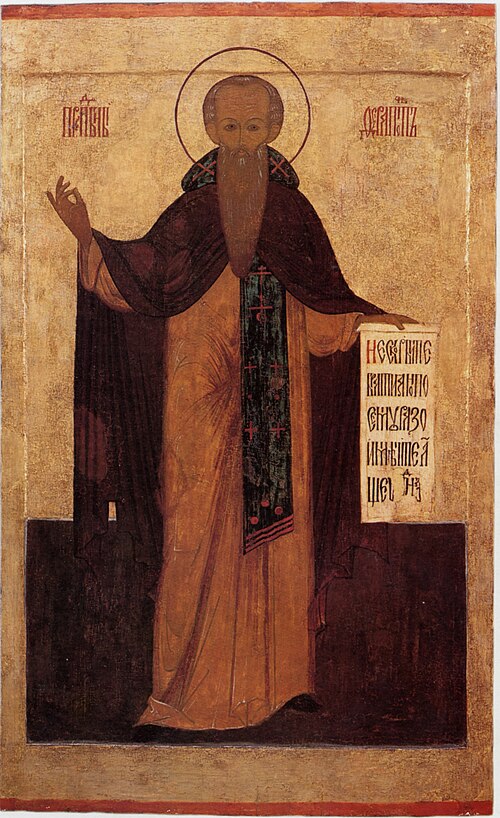
Venerable
Therapont of Belozersk
Founder of Ferapontov Monastery
Russian monk, born Feodor Poskochin, founder of Ferapontov Monastery in northern Russia; died in 1426.
- Feast
- May 27old style June 9
- Reposed
- 142615th century
- Place
- Mozhaysk
- Order
- Venerables
Life
Saint Therapont of Belozersk, also called Therapont of Mozhaysk (in the world Feodor Poskochin), was a Russian monk, founder of the Ferapontov Monastery in northern Russia and of the Luzhetsky Monastery at Mozhaysk. He lived almost ninety years and was honoured as a wonderworker.
Beginnings
He was born at Volokolamsk in the 1330s (some sources give 1331, others 1337), into a noble family, the Poskochins. From childhood he was devout and loved the monastic life. At about forty he entered the Simonov Monastery in Moscow, where he was tonsured by its abbot of that time, Saint Theodore of Rostov. There he met Cyril, the future Saint Cyril of White Lake, and often heard the teaching of Saint Sergius of Radonezh, who visited the monastery.
Once he was sent by the monastery to the region of the White Lake (Beloozero) in the north, where the severity of the land attracted him. According to tradition, Cyril meanwhile received a revelation that he must go to Beloozero, and the two asked the abbot's blessing. Between 1390 and 1397 they went north and settled in a cell near Lake Siverskoye, on the spot where the Kirillo-Belozersky Monastery would rise. After a year Therapont left alone, fifteen versts away, between lakes Paskoye and Borodava. He cleared the ground, made himself a hut and lived in stillness and silence. Robbers often attacked and robbed him.
The Ferapontov Monastery
Soon other lovers of solitary prayer gathered around him. When their number grew, Therapont founded in 1398 the monastery that bears his name. At first there were no more than fifteen monks. A wooden church of the Nativity of the Mother of God was built first, and under his leadership the monks built cells, copied books and painted the church. The common rule was strictly kept. Therapont refused to be abbot but lived in the monastery for ten years. The monastery and he became known beyond the Beloozero region. The cathedral of the monastery holds the sixteenth-century frescoes of Dionysius, famous throughout Russia.
Mozhaysk
At that time Beloozero belonged to the lands of Prince Andrew of Mozhaysk, a son of Dmitry Donskoy, who was one of the great benefactors of the monastery. In 1408 the prince sent gifts to the monastery and a letter calling Therapont to Mozhaysk. After much persuasion Therapont agreed to be abbot of a new monastery that the prince wished to build in his town. The Luzhetsky Monastery, on the bank of the Moskva river, was founded in 1408, and in 1420 its stone cathedral of the Nativity of the Mother of God was built. Although he never stopped wishing to return to Beloozero, the prince would not let him go, and Therapont remained at Luzhetsky until his death. He reposed on 27 May 1426, in the ninetieth year of his life.
Veneration
He was numbered among the saints in 1547 (other sources say 1549). His relics lie in the cathedral of the Nativity of the Mother of God at the Luzhetsky Monastery. Near the monastery, in the village of Isavitsy, there is a spring of healing water, "Saint Therapont's Well", discovered by the saint according to tradition. He is commemorated on 27 May, the day of his repose, and on 27 December, the day his relics were found.
Commemorated the same day May 27
 Bede the VenerableVenerable · Monk and historianMay 27
 Cyprian of MoscowSaint · Metropolitan of Kiev and all RusMay 27
 John the RussianConfessor · Slave of the Turks in CappadociaMay 27
 MelangellVenerable · Hermit and abbess of PowysMay 27
 Julius the VeteranMartyrMay 27
- Basil of KhakhuliVenerable · Georgian monkMay 27
- Mikel ParekheliSaintMay 27
- Therapon of SerdicaSaint · Bishop of SerdicaMay 27
- AlypiusMartyrMay 27
- Averikios of PrečistaVenerable MartyrMay 27
 Bruno of WürzburgSaint · Bishop of WürzburgMay 27
- Cillin of Tigh TalainSaintMay 27