Venerable
Melangell
Hermit and abbess of Powys
Welsh hermit and abbess of Powys, 7th or 8th century, remembered as patron of hares.
- Feast
- May 27old style June 9
- Reposed
- 7007th century
- Place
- Kingdom of Powys
- Order
- Venerables
Life
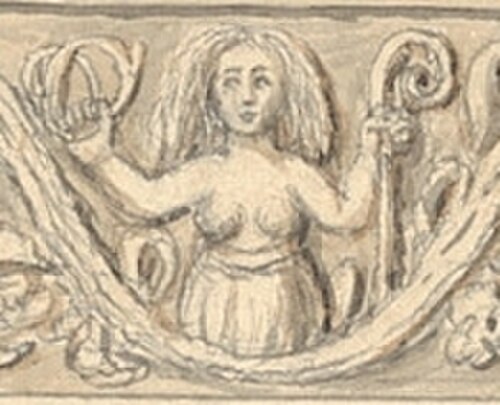
Venerable Saint Melangell (Monacella) was a hermit and abbess of Powys in Wales, who lived, by all signs, in the seventh or eighth century. She is venerated as patron of hares. She is commemorated on 27 May (Russian Church) and 31 January (in the Welsh tradition). Her veneration is medieval, tied to the shrine at Pennant Melangell, and does not result from an act of canonization recorded in our sources.
Her life according to tradition
The main account of her is the Historia Divae Monacellae, written in the fifteenth century, preserved in late manuscripts. Her chronology is unknown. The Historia gives the year 604, but the date is suspect, since it probably comes from Bede's History, considered unreliable, and another source gives 590. According to the Historia, Melangell was the daughter of a king of Ireland (in another version, Scotland) and fled an arranged marriage. She lived in the wilderness of Powys as a virgin consecrated to God for fifteen years, until she was found by a prince, Brochwel Ysgithrog.
One day, in the year 604, when he was hunting near Pennant (today Pennant Melangell), the prince's dogs chased a hare and led him to a beautiful virgin praying devoutly, with the hare lying hidden under the hem of her clothes. The prince urged on the dogs, but they drew back and fled. Hearing her story, he gave her the land, granting perpetual asylum to the people and animals of the area. Melangell lived there another thirty-seven years, founded a community of nuns and was its abbess, while the hares and wild animals behaved toward her as if tamed. According to some versions she continued her solitary life and slept on bare stone. After her death a certain Elise tried to attack the virgins, but came suddenly to a wretched end. The story puts great emphasis on her virginity, as the essence of her holiness.
Veneration
Melangell and Saint Winefride are the only Welsh women saints with Latin lives. Her cult probably flourished locally for many centuries before the Historia was written: the Romanesque shrine and the church built over her grave show that by the twelfth century the cult was established at Pennant Melangell, and the grave was venerated even before the Norman conquest. The settlement was probably an eighth-century foundation. Behind the altar of the church is a small chamber, the cell-y-bedd, which housed the original shrine. After the Reformation the shrine was dismantled, the sculpted stones were reused in walls, and in 1958 the shrine was reconstructed, moved in 1991 to the chancel. From the Middle Ages until the last century the locals did not kill hares in the parish, and the hares were called Saint Monacella's lambs; whoever cried to a hare pursued by dogs, "God and Saint Monacella be with thee," believed it would escape. Archaeologists link the veneration of hares to ancient Celtic religion.
Commemorated the same day May 27
 Bede the VenerableVenerable · Monk and historianMay 27
 Cyprian of MoscowSaint · Metropolitan of Kiev and all RusMay 27
 John the RussianConfessor · Slave of the Turks in CappadociaMay 27
 Therapont of BelozerskVenerable · Founder of Ferapontov MonasteryMay 27
 Julius the VeteranMartyrMay 27
- Basil of KhakhuliVenerable · Georgian monkMay 27
- Mikel ParekheliSaintMay 27
- Therapon of SerdicaSaint · Bishop of SerdicaMay 27
- AlypiusMartyrMay 27
- Averikios of PrečistaVenerable MartyrMay 27
 Bruno of WürzburgSaint · Bishop of WürzburgMay 27
- Cillin of Tigh TalainSaintMay 27