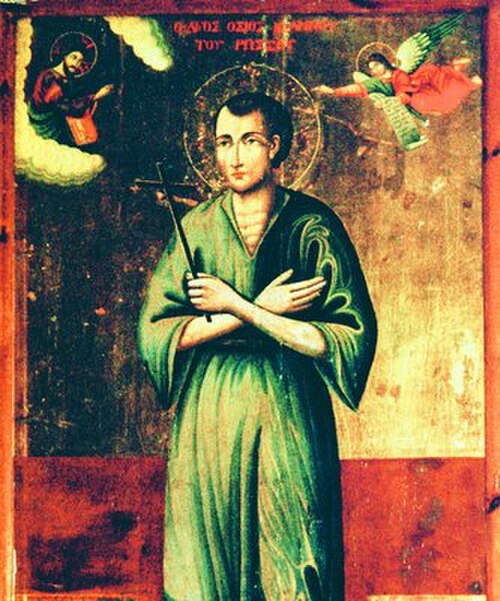
Confessor
John the Russian
Slave of the Turks in Cappadocia
Russian prisoner of war, slave to a Turkish agha and respected even by him for his humility; died in 1730.
- Feast
- May 27old style June 9
- Reposed
- 173018th century
- Place
- Ürgüp
- Order
- Confessors
Life
Saint John the Russian was a Russian slave, a prisoner of war, who lived in Cappadocia and died at Ürgüp on 27 May (9 June by the civil calendar) 1730. His master, a Turkish agha, came to respect him for his humility, steadfastness in faith and kindness. His relics are incorrupt and wonderworking, and tradition says he helps especially sick children and those who suffer from cancer. The Church remembers him on 27 May.
He was born around 1690 in the Hetmanate, into a Cossack family. He was recruited into the army of Peter the Great and took part in the Russo-Turkish war of 1710 to 1711. In the fighting he was captured by the Tatars, allies of the Turks, probably in the fight for Azov, taken to Constantinople and sold as a slave to a Turkish officer, the head of cavalry, called "Agha" in his Life, perhaps only a rank. The agha took him to his home village, Ürgüp (Prokopion), in Cappadocia. John refused to accept Islam, and for this he was humiliated and tormented by the Turks, who called him "giaour", unbeliever. In time the Turks, seeing his steadfast faith, meekness and diligence, ceased to mock him, and his master and household respected him. He worked as a groom and lived in the stable, out of love for God. Other slaves mocked him for his zeal in work, but he took no offence and sought to help and comfort them in their need. For his kindness the agha grew fond of him and offered him a free life in a house of his own. John refused, saying: "My patron is the Lord, and no one is above Him. He ordained that I live as a slave in a foreign land. It seems that is needed for my salvation." By day he worked, kept a strict fast and prayed, and by night he went secretly to the cave church of Saint George, where he read the prayers of the All-Night Vigil in the narthex. Every Saturday he received communion.
Soon the agha grew rich and became one of the most prominent men in Ürgüp, which he linked to the fact that a righteous man lived in his house. Grown rich, the agha decided to make the pilgrimage to Mecca. In his absence his wife gave a banquet. When pilau, the master's favourite dish, was served, she said to John, who was waiting at table: "How glad your master would be to eat this pilau with us." John asked her to give him the dish, promising to send it to Mecca. All laughed, thinking he wished to eat it himself or give it to the poor. When the agha returned he told that in Mecca he had found in his locked room a plate of steaming pilau, with his name engraved on it, like all the plates in his house. The news spread, and all, even Muslims, began to call John a wali, a saint. But John lived on in work and prayer. Before his death he fell gravely ill and, unable to rise, asked the priest to give him communion. The priest, afraid to be seen entering a Muslim house, hid the Holy Communion inside an apple. John fell asleep soon after. He was buried in the church of Saint George at Prokopion, now Ürgüp, and was venerated as a saint. The agha called the priests to the burial, and all the Christians of Prokopion came to venerate him. Three and a half years later, around 1733, his incorrupt relics were moved into the church.
When the Greeks were expelled from Turkey in 1924, the people took his relics to their new home on the island of Euboea, where they rest in the church of Saint John the Russian at Prokopi. His right hand is at the Russian monastery of Saint Panteleimon on Athos. With the blessing of Patriarch Alexy II, in 2003 and 2004 a small wooden chapel of Saint John the Russian was built in Moscow, in the Kuntsevo district, then a stone church, consecrated in 2016. In Novosibirsk the lower side chapel of the church of Our Lady of the Sign is dedicated to him.
Commemorated the same day May 27
 Bede the VenerableVenerable · Monk and historianMay 27
 Cyprian of MoscowSaint · Metropolitan of Kiev and all RusMay 27
 Therapont of BelozerskVenerable · Founder of Ferapontov MonasteryMay 27
 MelangellVenerable · Hermit and abbess of PowysMay 27
 Julius the VeteranMartyrMay 27
- Basil of KhakhuliVenerable · Georgian monkMay 27
- Mikel ParekheliSaintMay 27
- Therapon of SerdicaSaint · Bishop of SerdicaMay 27
- AlypiusMartyrMay 27
- Averikios of PrečistaVenerable MartyrMay 27
 Bruno of WürzburgSaint · Bishop of WürzburgMay 27
- Cillin of Tigh TalainSaintMay 27