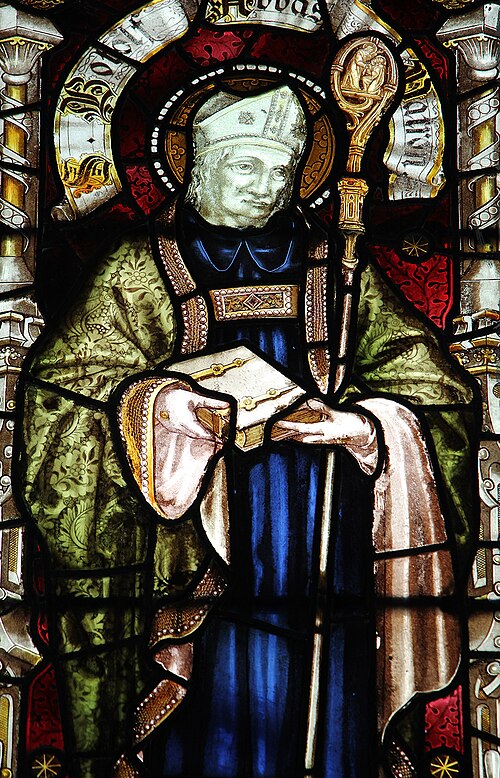
Venerable
Botolph of Thorney
English abbot
English abbot who died around 680, regarded as patron of boundaries, travelers and trade.
- Feast
- June 4old style June 17
- Reposed
- 6707th century
- Place
- England
- Order
- Venerables
Life
Saint Botolph was an English abbot of the seventh century, who died around 680, regarded as patron of boundaries, travellers, trade and some farming work. He is commemorated on 17 June in England and on 25 June in Scotland.
Little is known of him, apart from doubtful details in an account written four hundred years after his death by the eleventh-century monk Folcard. He was born in the early seventh century to noble Christian Saxon parents. He and his brother Adulph were educated by Saint Fursey at Cnobheresburg monastery, then were sent to study on the Continent, where they became Benedictines. Adulph stayed there and is said to have become a bishop. Botolph, returning to England, found favour with a "king of the southern Angles", whose sisters he had known in Germany, and was allowed to choose a tract of desolate land for a monastery. The Anglo-Saxon Chronicle records: "The Middle Angles, under earldorman Peada, received the true faith. King Anna was killed and Botolph began to build the church at Ikanho." He founded the monastery of Icanho, "ox hill", now Iken, at the mouth of the river Alde in Suffolk, where a church still stands on top of an isolated hill. At the time it was a tidal island nearly surrounded by water, but Botolph attracted other monks and hermits, and together they turned marsh and scrub into pasture and farmland. He also worked as an itinerant missionary in East Anglia, Kent and Sussex. The Life of Saint Ceolfrith, written at the time of Bede by an unknown author, mentions an abbot Botolph in East Anglia, "a man of remarkable life and learning, full of the grace of the Holy Spirit", whom Ceolfrith visited around 670.
He is thought to have been first buried at Icanho, but in 970 King Edgar allowed his relics to be moved to Burgh near Woodbridge, to prevent their destruction by invading Danes. They stayed there some fifty years, then were moved, on Cnut's instruction, to their own tomb at Bury St Edmunds Abbey. Later they were moved again, with those of his brother Adulph, to Thorney Abbey, his head going to Ely and various parts to other houses, among them Westminster. According to the Oxford Dictionary of Saints, 64 ancient English churches were dedicated to him, perhaps as many as 71, mostly in East Anglia. Saint Botolph's church in Boston, Lincolnshire, called "the Stump", is among the most famous, and the town of Boston, "Botolph's town", gave its name to Boston, Massachusetts. Four London churches near the gates of the city wall bear his name: Billingsgate, Aldersgate, Bishopsgate, where the poet John Keats was baptized, and Aldgate; it is believed they were places where arriving travellers gave thanks and departing ones prayed for a good journey. In Denmark the church of Sankt Budolfi in Aalborg is now the cathedral of the diocese.
Commemorated the same day June 4
 Mary of BethanyRighteous · Sister of LazarusJun 4
 Optatus of MilevisSaint · Bishop of MilevisJun 4
 Metrophanes of ByzantiumSaint · Bishop of ByzantiumJun 4
 Petroc of CornwallVenerable · British prince and missionaryJun 4
 Sophia of SlutskRight-Believing · Princess of SlutskJun 4
 Sophia of ThraceVenerable · Mother of ThraceJun 4
 George BogićHieromartyr · Protopresbyter at NašiceJun 4
 Methodius of PeshnoshaVenerable · Founder of Peshnosha MonasteryJun 4
- Clateus of BresciaHieromartyr · Bishop of BresciaJun 4
- Frontasius, Severinus, Severianus and SilanusHoly MartyrsJun 4
- 90 Hieromartyrs of Montenegro and the LittoralHoly HieromartyrsJun 4
- Aldegrin of ClunyVenerableJun 4