Venerable
Petroc of Cornwall
British prince and missionary
British prince, probably born in South Wales, who ministered mainly in Devon and Cornwall.
- Feast
- June 4old style June 17
- Reposed
- 5646th century
- Place
- Padstow
- Order
- Venerables
Life
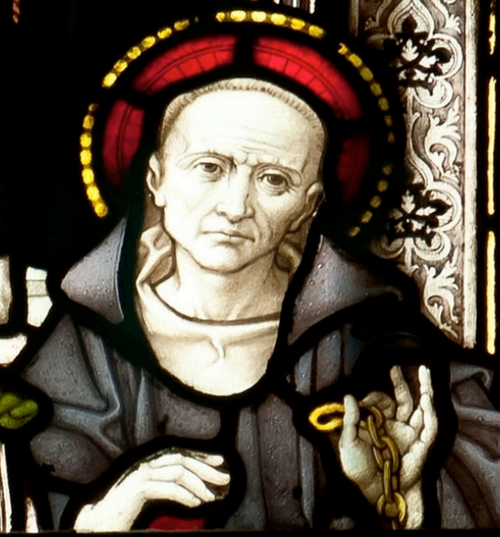
Saint Petroc of Cornwall (Petrock) was a British prince, monk and missionary, one of the most venerated saints of Cornwall and Devon. His feast is on 4 June, and he is included in the Synaxis of the Saints of the British Isles and Ireland. The sources count him probably born in South Wales and fallen asleep around 564, after a very long life.
Family and training
The earliest Life of him says he was the younger son of a Welsh chieftain whose name it does not give; the twelfth-century version, called the Gotha Life and written at Bodmin, shows him as the son of Glywys, king of Glywysing, brother of Gwynllyw and uncle of Saint Cadoc. He studied in Ireland, where he is said later to have been the teacher of Saint Kevin of Glendalough. He made a pilgrimage to Rome and, on returning, wind and tide brought him to Trebetherick, in Cornwall, where he stayed.
His work in Dumnonia
Petroc founded a monastery and a school at Lanwethinoc (the church of Wethinoc, an earlier holy man), at the mouth of the river Camel on the north Cornish coast. The place came to be called Petrocs-Stow, the Place of Petroc, now Padstow. The hermit Guron had settled earlier at Bodmin, but left for the coast when Petroc arrived; at the western entrance to the churchyard of Saint Petroc's in Bodmin Saint Guron's Well is still found. All the sources show that Petroc later retired from Padstow to Bodmin.
He laboured throughout the kingdom of Dumnonia, which included Devon, Cornwall, Somerset and Dorset, and he served also in Brittany. He founded churches at Little Petherick and in many places in Britain, Wales and Brittany. According to tradition, he brought Constantine of Cornwall to the faith by saving a stag that Constantine was hunting; Constantine afterwards founded a hermitage at the place now called Constantine Bay. After thirty years of labour, the legend says, he went again to Rome, by way of Brittany. He is believed to have fallen asleep at a house of the Rovel family, probably a farm now called Treravel, near Little Petherick; in other traditions, his remains ended up in the bay of Hailemouth, near Padstow.
Humility and veneration
Humility is the virtue most bound to his name. A story often repeated says that, returning from his pilgrimage to Rome and Jerusalem, as he set foot on British soil under heavy rain, he told his companions confidently that the sky would clear by morning. But the rain lasted many days, and Petroc, ashamed of his presumption, is said to have set out on another pilgrimage, of penance, reaching as far as India, according to the legend, where he tamed a wolf. For this reason he is often painted with a wolf and, like other British saints, also with a stag.
Padstow was the first great centre of his veneration; in the later ninth century his relics were moved to the monastery at Bodmin, which became by the eleventh century one of the wealthiest foundations in Cornwall. In 936 King Athelstan annexed Cornwall and granted Padstow the right of sanctuary, a privilege held in the region by only two other churches. In 1177 a Breton stole the relics from Bodmin and gave them to the abbey of Saint-Meen, but King Henry II had them brought back. They were cast out during the English Reformation, yet the ivory casket in which they lay is still kept in Saint Petroc's church in Bodmin. Exeter Cathedral also had relics of him, probably given by King Athelstan.
With Saint Piran and Saint Michael he is one of the patrons of Cornwall; Thomas Fuller called him the captain of the Cornish saints. In Devon there are about seventeen ancient dedications to him (plus Timberscombe, over the border in Somerset), among them one within the old Roman walls of Exeter, and the villages of Petrockstowe and Newton St Petroc; in Wales, St Petrox near Pembroke, Ferwig and Llanbedrog; in Brittany his cult spread by the end of the tenth century, and Saint-Perreux bears his name. The cross of Saint Petroc is on the flag of Devon.
Commemorated the same day June 4
 Mary of BethanyRighteous · Sister of LazarusJun 4
 Optatus of MilevisSaint · Bishop of MilevisJun 4
 Metrophanes of ByzantiumSaint · Bishop of ByzantiumJun 4
 Botolph of ThorneyVenerable · English abbotJun 4
 Sophia of SlutskRight-Believing · Princess of SlutskJun 4
 Sophia of ThraceVenerable · Mother of ThraceJun 4
 George BogićHieromartyr · Protopresbyter at NašiceJun 4
 Methodius of PeshnoshaVenerable · Founder of Peshnosha MonasteryJun 4
- Clateus of BresciaHieromartyr · Bishop of BresciaJun 4
- Frontasius, Severinus, Severianus and SilanusHoly MartyrsJun 4
- 90 Hieromartyrs of Montenegro and the LittoralHoly HieromartyrsJun 4
- Aldegrin of ClunyVenerableJun 4