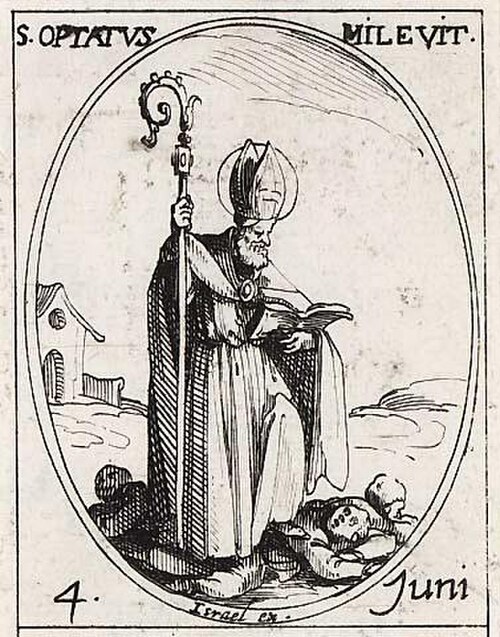
Saint
Optatus of Milevis
Bishop of Milevis
Bishop of Milevis in Numidia, remembered for his writings against Donatism.
Life
Saint Optatus of Milevis was bishop of Milevis in Numidia (today Mila, in Algeria) in the second half of the fourth century, known above all for his writings against Donatism. Little is known of his life, but Jerome, Augustine and Fulgentius testify to his importance for the Church of his time. He died around 387 to 390. He is commemorated on 4 June.
Life
He is believed to have come to Christianity as an adult, as a former pagan rhetorician. Saint Augustine counts him among those who came out of Egypt with a booty of gold, silver and garments, that is, who brought into the Church the learning of the pagans, along with Cyprian, Lactantius, Victorinus and Hilary. He was bishop of Milevis, but it is not known exactly when.
The work against the Donatists
His writing, untitled in antiquity, is an answer to Parmenian, successor of Donatus in the see of Carthage. According to Jerome it was written in six books in the time of Valens and Valentinian, between 364 and 375; seven books are now known, the seventh being added in a second edition, in which Optatus made additions to the episcopal lists. The first edition appeared around 366 to 370, and the second around 385 to 390. The work is important for the history of the beginnings and development of the Donatist dispute and for the documents gathered in it; it is regarded as the first collection of charges against the Donatists.
In the dispute Optatus showed himself mild toward schism, milder than many of the Fathers. He distinguishes schismatics from heretics: the first have rejected unity, but have right doctrine and true sacraments, so Parmenian ought not to have threatened them with eternal damnation. The Donatists and the Christians agreed that the Church must be one; the question was where this Church is. Optatus argues that it cannot be only in a corner of Africa, but is the catholica, the Church spread throughout the world. Parmenian had counted six properties of the Church, of which Optatus accepts five and argues that the first, the episcopal chair, belongs to the Christians, and therefore all the others as well. To show who holds the Church in unity, he began from the succession in the episcopal sees, above all that of Rome.
Against the teaching inherited by the Donatists from Cyprian, that baptism administered outside the Church is not valid, Optatus held, especially in the fifth book, that the sacraments are holy in themselves, not through men, which anticipated Augustine's argument. In baptism there must be the Holy Trinity, the believer and the minister, and their importance is in that order, the last being the least important. He rebuked the Donatists for breaking and scraping the altars of God, the place where the Body and Blood of Christ were set. In the seventh book he asked that returning Donatists be received into the Church, out of love and for the sake of unity.
Commemorated the same day June 4
 Mary of BethanyRighteous · Sister of LazarusJun 4
 Metrophanes of ByzantiumSaint · Bishop of ByzantiumJun 4
 Petroc of CornwallVenerable · British prince and missionaryJun 4
 Botolph of ThorneyVenerable · English abbotJun 4
 Sophia of SlutskRight-Believing · Princess of SlutskJun 4
 Sophia of ThraceVenerable · Mother of ThraceJun 4
 George BogićHieromartyr · Protopresbyter at NašiceJun 4
 Methodius of PeshnoshaVenerable · Founder of Peshnosha MonasteryJun 4
- Clateus of BresciaHieromartyr · Bishop of BresciaJun 4
- Frontasius, Severinus, Severianus and SilanusHoly MartyrsJun 4
- 90 Hieromartyrs of Montenegro and the LittoralHoly HieromartyrsJun 4
- Aldegrin of ClunyVenerableJun 4