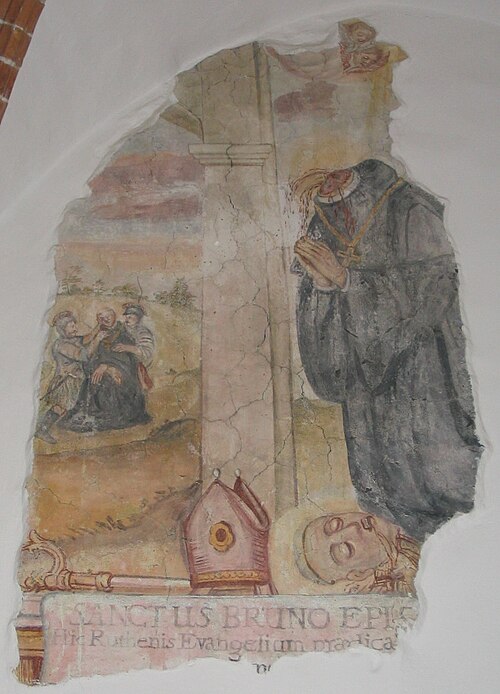
Hieromartyr
Bruno of Querfurt
Missionary Archbishop
Monk and missionary bishop in the eastern lands of Germany, killed by pagans in 1009.
Life
Bruno of Querfurt was a monk, missionary bishop and martyr, who preached the Gospel in Hungary, among the Pechenegs and among the Prussians, and was killed by pagans in 1009. He is venerated as the Second Apostle of the Prussians. He is commemorated on 9 March.
Youth
He was born around 970-974 into a noble family of Querfurt, in present-day Saxony. He studied at the cathedral school of Magdeburg, was made a canon, and while still young entered the service of the emperor Otto III, who took him among his chaplains. The path of a career at court and in the Church lay open before him, but, perhaps moved by the martyrdom of Saint Adalbert of Prague, he went to Rome and entered the monastery of Saint Boniface and Saint Alexius on the Aventine Hill, where he seems to have taken the name Boniface. Later he lived in the monastery near Ravenna that Otto had founded and was trained in asceticism under the guidance of Saint Romuald.
The missionary
In 1003 Pope Sylvester II set him at the head of a mission among the pagan peoples of Eastern Europe. He was consecrated a missionary archbishop, without a fixed see, in February 1004 by Archbishop Tagino of Magdeburg. Because a war between the emperor Henry II and Duke Boleslaus of Poland closed the road to Poland, he went to Hungary, in the footsteps of Saint Adalbert. His attempt to bring Duke Ahtum of Banat, who belonged to the Patriarchate of Constantinople, under the bishop of Rome stirred up great opposition, above all from the local monks. Bruno left after finishing his Life of Adalbert of Prague, a work that tells how the Hungarians were brought to Christianity.
The Pechenegs and Rus’
He then came to Kiev, where Grand Prince Vladimir allowed him to preach among the Pechenegs, a Turkic people living between the Danube and the Don. He stayed among them five months and baptized some thirty adults, then helped to bring about a peace treaty. In 1008 he reached Poland, from where he sent letters to the German king. He also wrote the Life of the Five Brothers, for the monks killed in Poland in 1003.
Martyrdom
Towards the end of 1008 Bruno set out with eighteen companions to preach among the Prussians. He is said to have baptized there first a local chief, Netimer. Soon afterwards, on 14 February or 9 March 1009, near the frontier between Prussia, Kyivan Rus’ and Lithuania, he was beheaded, and his companions were killed with him. News of his death was recorded in the Annals of Quedlinburg, which contain the earliest known mention of Lithuania. Both the Roman Catholic and the Orthodox Church honour him as a martyr, and his writings remain a precious witness to his age.
Commemorated the same day March 9
 Forty Martyrs of SebasteHoly Martyrs · Soldiers of the Twelfth LegionMar 9
 Pacian of BarcelonaSaint · Bishop of BarcelonaMar 9
 Caesarius of NazianzusSaint · Brother of Gregory the TheologianMar 9
- Urpasianus of NicomediaMartyrMar 9
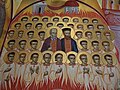 The 42 Martyrs of MomišićiHoly New MartyrsMar 9
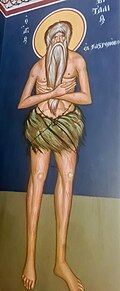 Vitalis of CastronovoVenerable · Hermit and abbot in southern ItalyMar 9
- Aetius of SebasteMartyrMar 9
- Aglaius of SebasteMartyrMar 9
- Alexander of SebasteMartyrMar 9
- Alexandra SamoylovaVenerable MartyrMar 9
- Alexis SmirnovHieromartyrMar 9
- AngiasSaintMar 9