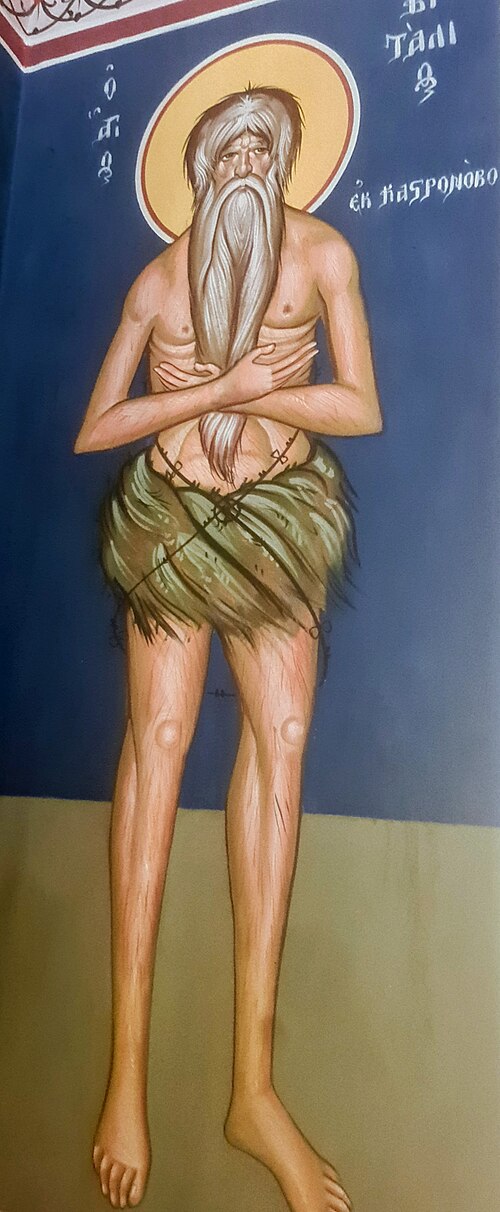
Venerable
Vitalis of Castronovo
Hermit and abbot in southern Italy
Byzantine Sicilian hermit of the 10th century who founded several monasteries in Basilicata and Calabria.
- Feast
- March 9old style March 22
- Reposed
- 99410th century
- Place
- Rapolla
- Order
- Venerables
Life
Saint Vitalis of Castronovo (Vitale) the venerable was a Greek-speaking Byzantine hermit, recluse, ascetic and abbot from Sicily in the tenth century, who founded several monasteries in Basilicata and Calabria in the south of Italy, then Greek-speaking lands of the Byzantine Empire. He died on 9 March 994 on Monte Vulture and is commemorated on 9 March. He is the principal patron of the cities of Castronovo in Sicily and Armento in Italy.
Beginnings
He was born in the small town of Castronovo di Sicilia, in the tenth century, to a wealthy Byzantine family, of pious Greek-speaking parents, Sergius and Chrysoniki. He was baptized in the then mother church of Maria Santissima dell'Udienza in Castronovo and educated in the faith by ecclesiastical tutors of the Greek rite: in that island environment, during Arab domination, Christians enjoyed a certain autonomy in religious affairs. Uninterested in studies, he developed a spiritual inclination that led him around 950 to become a monk. He joined the Basilian monastery of Saint Philip of Agira, in the province of Enna, on the slopes of Etna, a breeding ground for many famous ascetics of Calabria and Sicily of the ninth and tenth centuries. There he received the angelic schema after a life of asceticism and progress in virtue for fifteen years.
Five years after his tonsure he made a pilgrimage with some brothers to the holy places in Rome. On the way, near Terracina, a poisonous snake bit him, but he miraculously survived by making the sign of the cross on the wound. On the way back he decided to stop in the wilderness of Calabria and lived two years as a hermit on a hill near Santa Severina. He then returned to another Basilian monastery in Sicily, near the one at Agira, where he stayed twelve years. After that he withdrew to a hermitage in the wilderness of Calabria, on the mountain of Lipirachi (now Monte Lipiricchio near Reggio di Calabria), continuing his ascetic struggles. Near Cassano he met the ascetic Anthony, who lived very strictly in a cave (abbot of the monastery of Locri), and stayed with him for a short time. He later went to live in a secluded place in the region of Capo Spulico, overlooking the sea, but its isolation made it a haven for criminals. At Pietra Roseti, on the border with Lucania, Vitalis chased the criminals out of a decaying house and turned the place into a monastic community, bringing back peace and cordiality; the residents of Roseto gratefully built a church of Saint Basil. A miracle is recorded from this time: he prayed for the crops threatened by a flood, which in the end yielded good fruit. He then moved to the "Mercurion" and the "Latinianon" in Lucania, organized local monastic communities and began to travel through the region, founding monasteries in various places and comforting monks distressed by the recurring Arab invasions.
Asceticism and miracles
During those years he changed his hermitage several times (Mount Rapparo, Sant'Angelo d'Asprono, Mount San Giuliano), each new location attracting new disciples for whom he founded monasteries, until at last he settled in the monastery of Saint Elias at Carbone near Basilicata. After several years he went to a cave between the mountains of Torri and Armento in Basilicata. There, day and night, he prayed and ascended to great spiritual heights. Even the wild beasts of the mountain approached him gently to receive his blessing. His familiarity with animals became proverbial, as a Sicilian folk song from Castronovo shows: "Holy Vitalis, slice of bread, and the rest he gives to the dogs." There he was visited by Saint Luke of Demenna in Sicily, with whom he prayed and discussed spiritual matters. On various occasions he turned to God, with success, asking him to remedy needs of varying seriousness.
Together with two other holy monks, he also travelled to Bari, where he was received in 979 by the Catapan Basil. The biographer reports that the miraculous events of his life continued: the governor of the Byzantine province of Bari summoned him, given his fame. Vitalis went to him, heard his confession and, during his stay, worked a miracle at Bari, preventing a violent storm from causing damage. In 979 he returned to Calabria and restored (damaged by the Saracens) the convent and church of Saints Adrian and Natalia at San Demetrio Corone. When the monastery was attacked by the Saracens, his brothers fled in fear, but Vitalis stayed to face them. When one of the Muslims was about to kill him, he was struck by lightning, dropped his scimitar and collapsed in sudden pain. Vitalis saw to it that his attacker was healed and, warned, the attackers withdrew from those lands. This became a great reference for the faithful, who saw the imprint of holiness in his actions. Those who turned to him sincerely were welcomed and directed to the help of divine grace (a man who was granted children, for instance), and those who had fallen into error had the chance to amend and be freed from punishment (the liar who had mispronounced the name of God, for instance). With the help of his nephew Blessed Elias of Castronovo, he built the church of Torri on Monte Torretta di Pietragalla (1587 metres high) and founded the monastery on Monte Vulture at Rapolla, both in Basilicata.
His repose
The fame of the miracles God worked through His servant drew great crowds to the monastery, interrupting the quiet of contemplation. So he left with his nephew and disciple Elias, who had long since left Sicily, to live by the river at Rapolla. There, in a solitary place, he resumed his customary penances: he passed nights sometimes immersed in frozen ponds, sometimes praying in the mountains. His last abode was in the region of Rapolla, where he built a monastery on Monte Vulture (a volcano of 1,326 metres), gathering a multitude of monks around him. He died in his monastery on Monte Vulture on 9 March 994, after appointing a new abbot.
His Life was written in Greek by a contemporary Basilian monk and translated into Latin a century later, for liturgical use in 1194, and dedicated to Robert, bishop of Tricarico. His remains were first buried in the church of the monastery on Monte Vulture, then in 1024 moved to another monastery (Guardia Perticara, whose abbot was his nephew Elias), then to Torri on Monte Torretta (to protect them from Muslim attacks) and then to Armento, by order of the feudal lord of the territory, next to those of Saint Luke of Demenna. Both were then placed in the cathedral of Tricarico. Finally the relics of Saint Vitalis were returned to Armento, where they are kept in a reliquary bearing the inscription "SANCTI VITALIS RELIQUIAE". The village of Castronuovo di Sant'Andrea, in the province of Potenza, owes its foundation and name to Saint Vitalis, who remembered his native city. The Abbey of Saint Michael at Monticchio, near Rapolla, is the place where he lived and died; the large cave on Monte Vulture, above the small lake, was inhabited by Greek monks.
Commemorated the same day March 9
 Forty Martyrs of SebasteHoly Martyrs · Soldiers of the Twelfth LegionMar 9
 Bruno of QuerfurtHieromartyr · Missionary ArchbishopMar 9
 Pacian of BarcelonaSaint · Bishop of BarcelonaMar 9
 Caesarius of NazianzusSaint · Brother of Gregory the TheologianMar 9
- Urpasianus of NicomediaMartyrMar 9
 The 42 Martyrs of MomišićiHoly New MartyrsMar 9
- Aetius of SebasteMartyrMar 9
- Aglaius of SebasteMartyrMar 9
- Alexander of SebasteMartyrMar 9
- Alexandra SamoylovaVenerable MartyrMar 9
- Alexis SmirnovHieromartyrMar 9
- AngiasSaintMar 9