Holy Martyrs
Forty Martyrs of Sebaste
Soldiers of the Twelfth Legion
Forty Christian soldiers, killed in 320 on a frozen lake near Sebaste for confessing Christ.
Life
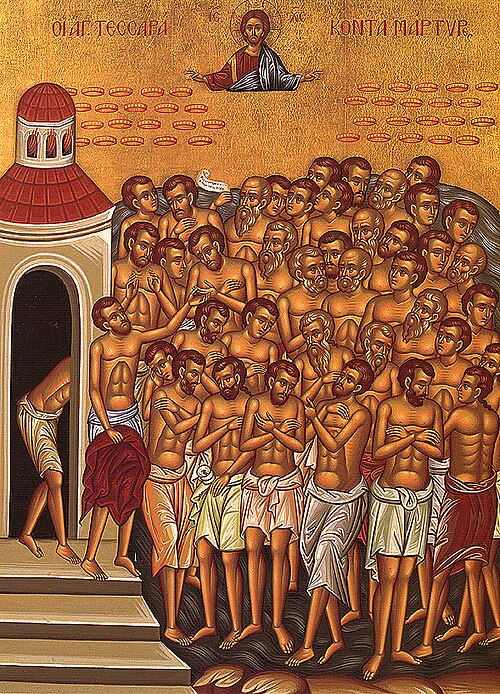
The Forty Holy Martyrs of Sebaste were Christian soldiers of the Twelfth Legion, called “Fulminata”, who received martyrdom in 320 on a frozen lake near Sebaste in Lesser Armenia (today Sivas, Turkey), in the persecution of Licinius. The Church celebrates them on 9 March, in Great Lent.
The confession
The oldest account of them is the homily of Saint Basil the Great, preached on their feast day; so the feast is older than Basil, who praised them fifty or sixty years after their death. The soldiers came from Cappadocia. Licinius, who after 316 was persecuting the Christians of the East, had the official Agricolaus order them to sacrifice to the gods, but they refused and confessed themselves Christians. Three of them, Kyrion, Candidus and Domnus, were especially learned in the Scriptures. When Agricolaus spoke of their honour as soldiers, Candidus answered, according to tradition, that they render to Caesar what is Caesar’s but cannot deny Christ. They were imprisoned, stoned and tempted with gifts.
The frozen lake
On a night of bitter frost they were led out naked onto a lake near the city to die of cold. On the shore a bath had been heated for anyone who would renounce the faith. They are said to have encouraged one another: “Bitter is the winter, but sweet is paradise.” One of them could bear it no longer, left the lake and ran to the bath, but died at its threshold (according to some sources his name was Meliton). The guard Aglaius, who was watching the martyrs, saw then a light from heaven and crowns coming down on the heads of those who remained. He undressed, confessed himself a Christian and entered the lake, receiving the fortieth crown. In the morning the martyrs, still alive, were taken out of the lake, their shins were broken and they were burned; the ashes were thrown into a river. According to the account, after three days they appeared to Bishop Peter of Sebaste, who by night gathered their shining relics from the water and buried them with honour.
Their names, from the Menaion of the Orthodox Church, are: Kyrion, Candidus, Domnus, Isychius, Heraclius, Smaragdus, Eunoicus, Valens, Vivianus, Claudius, Priscus, Theodulus, Eutychius, John, Xanthias, Helianus, Sisinius, Angias, Aetius, Flavius, Acacius, Ecdicius, Lysimachus, Alexander, Elias, Gorgonius, Theophilus, Domitian, Gaius, Leontius, Athanasius, Cyril, Sacerdon, Nicholas, Valerius, Philoctimon, Severian, Chudion, Meliton and Aglaius.
Veneration
The relics were distributed among many cities. At Caesarea in Cappadocia a church was built in which Basil preached his homily. Saint Gregory of Nyssa had a special devotion to them: two of his discourses in their praise survive, and he buried his parents beside their relics. Saint Ephrem the Syrian also praised them. The historian Sozomen, an eyewitness, tells how the relics were found at Constantinople, in the shrine of Saint Thyrsus, through the care of Empress Pulcheria.
Their veneration spread across the East. The Monastery of the Forty Saints at Sarandë in Albania, from the sixth century, gave the city its Greek name (Hagioi Saranda). Churches are dedicated to them at Xeropotamou on Athos, at Veliko Tarnovo (thirteenth century), and at Aleppo and Homs. The Bulgarian tsar Ivan Asen II attributed his victory at Klokotnitsa, in 1230, to their protection and built or renewed in their honour the church at Tarnovo. Their feast at Štip was inscribed in 2013 on the list of intangible heritage of North Macedonia.
Their feast falls in Great Lent so that the number forty, of the martyrs and of the days of the fast, may be an example of perseverance to the end. On the day the strictness of the fast is eased and the Liturgy of the Presanctified Gifts is served, and among the people pastries in the shape of birds are baked, to welcome spring. A prayer mentioning them is also placed in the wedding service, so that the couple may know that spiritual crowns await them too.
Commemorated the same day March 9
 Bruno of QuerfurtHieromartyr · Missionary ArchbishopMar 9
 Pacian of BarcelonaSaint · Bishop of BarcelonaMar 9
 Caesarius of NazianzusSaint · Brother of Gregory the TheologianMar 9
- Urpasianus of NicomediaMartyrMar 9
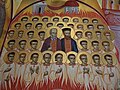 The 42 Martyrs of MomišićiHoly New MartyrsMar 9
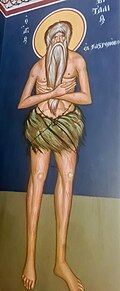 Vitalis of CastronovoVenerable · Hermit and abbot in southern ItalyMar 9
- Aetius of SebasteMartyrMar 9
- Aglaius of SebasteMartyrMar 9
- Alexander of SebasteMartyrMar 9
- Alexandra SamoylovaVenerable MartyrMar 9
- Alexis SmirnovHieromartyrMar 9
- AngiasSaintMar 9