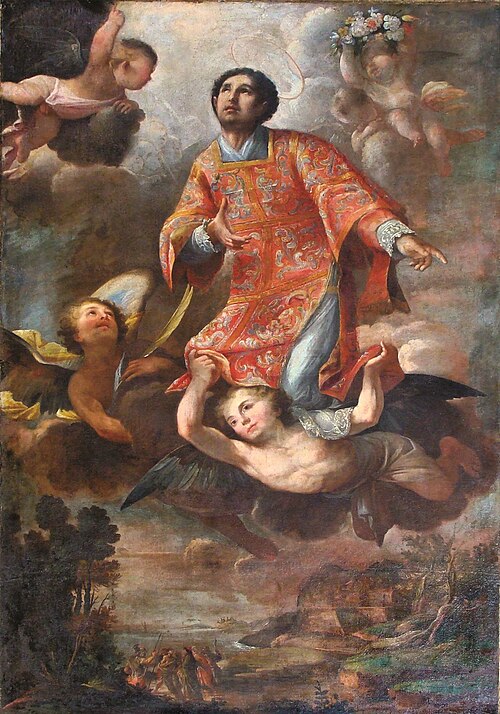
Hieromartyr
Caesarius of Terracina
Deacon of Terracina
Deacon and martyr of Terracina in Italy, venerated in both the East and the West.
Life
Saint Caesarius of Terracina, hieromartyr, was a deacon from Africa who suffered for Christ at Terracina in Italy and is venerated in both East and West. He is commemorated on 1 November, together with the priest Julian. The story of his martyrdom is preserved in his Passion, written late, and not all details are certain; historians place it in the third century, in the time of Diocletian, although tradition ties it to the time of Trajan.
Confession
According to the Passion, Caesarius, a deacon from Africa, was on his way to Rome when a mishap at sea stopped him and he came to Terracina. There, every year on 1 January, a young man named Lucian was offered to the god Apollo and thrown from a cliff. Caesarius opposed this sacrifice, saying that the state and the emperors who buy their well-being with blood are to be pitied. Apollo's servant, Firminus, seized him and brought him to the consul Leontius, who had ordered the sacrifice.
When he was brought to judgment, Caesarius would not sacrifice to the idol. It is told that his prayers caused the temple of Apollo to collapse, and Firminus died under the ruins. Caesarius was imprisoned, and after a time brought to trial. He asked to pray and a radiant light came down upon him; the consul Leontius believed and, having received communion from the priest Julian, departed to the Lord. His successor in office, Luxurius, condemned Caesarius and Julian to drowning: they were shut in a sack and thrown into the sea on 1 November. Caesarius had foretold that Luxurius would die bitten by a viper, and so it happened on the road to Rome.
After the martyrdom
The bodies of Caesarius and Julian were cast up on the shore and found by a monk named Eusebius. His prayers at the burial place brought many to repentance, and the priest Felix baptized them. Eusebius and Felix were seized by the son of the consul Leontius, beheaded and thrown into the river; their bodies were found and buried by the priest Quartus of Capua.
Veneration
In the fourth century, according to some sources the emperor Valentinian I and according to others his daughter, was healed at the saint's tomb at Terracina. The emperor decided to move the relics to Rome, where they were laid first in a church on the Palatine Hill, then in a newly built church by the Appian Way, called San Cesareo in Palatio. The cathedral of Terracina is dedicated to Saint Caesarius and the Holy Apostle Peter. In the Western tradition he is invoked against floods and drowning, lightning and earthquakes. He is commemorated on 1 November.
Commemorated the same day October 7
 Mark of RomeSaint · Bishop of RomeOct 7
 Sergius and BacchusHoly MartyrsOct 7
 Jonah of HankouSaint · Bishop of HankouOct 7
 OsythVenerable · Mercian prioressOct 7
 Sergius of NuromVenerable · Founder of Nurom MonasteryOct 7
- Dubthach of ArmaghSaint · Bishop of ArmaghOct 7
 Bacchus of RomeMartyrOct 7
- Sergius the ObedientVenerableOct 7
- Adalgis of NovaraSaint · Bishop of NovaraOct 7
- Aetherius of LyonSaint · Bishop of LyonOct 7
 Aleksiy Mogilnitsky of LelchitsyHieromartyrOct 7
- AndechiusMartyrOct 7