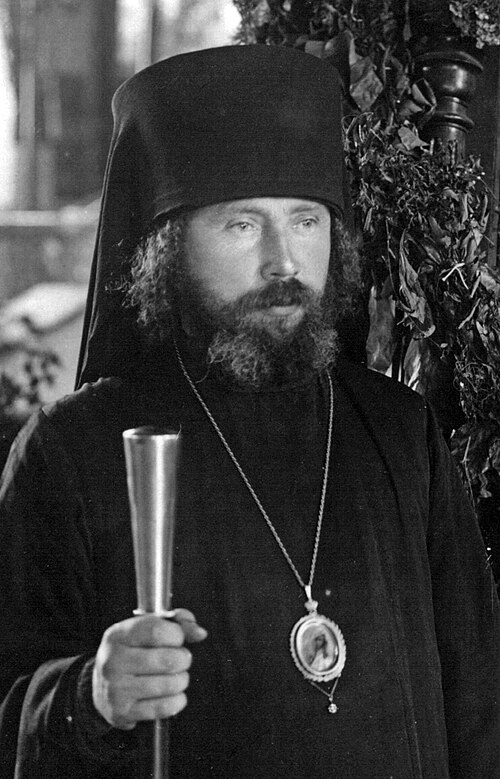
Saint
Jonah of Hankou
Bishop of Hankou
Bishop of the Russian Church Outside Russia, born Vladimir Pokrovsky in 1888, who died in 1925.
Life
Saint Jonah of Hankou, Hierarch, in the world Vladimir Ilyich Pokrovsky, was a bishop of the Russian Church Outside Russia, vicar of the diocese of Beijing, who laboured in the town of Manzhouli on China's border. He fell asleep on 20 October 1925 (7 October on the old calendar), at only thirty-six. The Russian Church Outside Russia glorified him on 20 October 1996, and the Council of Bishops of the Russian Church canonized him, as Enlightener and wonderworker, on 3 February 2016.
Youth
He was born on 17 April 1888, in the family of a priest of the village of Rogachevo in the province of Moscow (in other sources, at Kaluga). He lost his mother at three and his father at eight and was taken in by a deacon, who saw to it that he was educated. He attended the church school, the seminary at Kaluga and, from 1909, the Kazan Theological Academy. In his third year he was tonsured a monk with the name Jonah and sent for a time to the Optina Hermitage; on the counsel of Elder Gabriel of Optina he also accepted a teaching post at the academy, out of obedience. He finished the academy in 1914, as a professorial fellow, and taught as a lecturer.
Army chaplain and exile
After the First World War began he became, by his own wish, a military priest, and in 1917 was appointed preacher of the 2nd army; he took part in the Brusilov offensive. In 1918 the Revolution forced him to leave Kazan. He was arrested by the Bolsheviks as a “counter-revolutionary,” escaped from prison but was caught again at Perm, beaten until he lost consciousness and thrown into prison in his shirt. He was sent in a cattle car, then by steamer on the river Tavda toward Tyumen, to be tried by a military tribunal, but on the way was freed by the troops of the Siberian government. Reaching Omsk, he again joined the military clergy, as the initiator of the “companies of the Holy Cross.” In 1919 he was raised to abbot and named dean of the 11th army corps, part of the Southern Army. Retreating through Northern Turkestan, he joined the army of Ataman Dutov, as senior priest. Remaining with Dutov's detachment, in early 1920 he crossed the Kara-Sarik pass, through Lepsinsk, without food or fodder, gripping the sparse shrubs and icy ledges with wounded hands. The remnants of Dutov's men descended into Xinjiang, in Chinese Turkestan. He came to Kulja, where he helped to bring together the scattered Russian forces. In the spring of 1921 he reached Shanghai with a detachment of Cossacks, where his pastoral work among Russian and Chinese refugees began, and in the seminary founded on his initiative he taught the Law of God; among the seminarians were many young Chinese. He was raised to archimandrite and assigned to the Russian mission in Beijing.
Bishop at Manzhouli
On 20 June (3 July) 1922 he was chosen second vicar of the diocese of Beijing, and in September 1922 he was consecrated at Beijing bishop of Tianjin, with the charge of rector of the missionary cathedral of Saint Innocent in the town of Manzhouli; the title of bishop of Hankou he bore from 1925. He arrived at Manzhouli on 19 October 1922. His services were marked by solemnity and depth. He did much more than church service: he founded a ten-class school with a craft emphasis, in which by his death 497 children of both sexes were educated, without distinction of nationality or religion, the poorest free of charge; he opened a pharmacy giving medicine free to the poor, a shelter for orphans, a free clinic and a dining hall for two hundred people. The breadth of his interests and learning, his varied useful work and his love for all made him popular and deeply venerated among the Orthodox and the non-Orthodox of north-east China.
Repose and veneration
While caring for a priest who died of typhoid fever, he contracted chronic tonsillitis, and from gargling with kerosene blood poisoning followed. As he lay dying he wrote a final epistle to his flock, reminding them of the need to love one another, confessed one last time to Archbishop Methodius of Beijing, received Holy Communion, blessed those in his room, then put on the epitrachelion and cuffs that had belonged to Elder Ambrose of Optina and began, “loudly and with prostrations,” to read the canon for the departure of the soul. At last “overcome with weakness,” he lay down on his bed and said: “God's will be done. Now I shall die,” and he died within minutes. That same evening a ten-year-old boy, Nicholas Dergachev, who suffered from an inflammation of the knee joints and could not walk, had a dream of a hierarch in white vestments, who said to him: “Here, take my legs. I don't need them anymore. And give me yours.” The boy woke up and “was miraculously healed”; from a photograph he later identified the hierarch in the dream as Bishop Jonah, who had died that very night.
The funeral was led by Archbishop Methodius with many clergy, before eight thousand worshippers, and he was buried behind the altar of the church. A few years after his death a volume appeared describing cases of blessed help through his prayers. Saint John Maximovitch said: “Already here in the diaspora we have righteous ones in our time. Although they are not yet glorified, people receive wondrous signs from them. For example Bishop Jonah of Manchuria.” In July 1994 an attempt was made to excavate the relics, which did not find the site of his grave; in 1997 new information was provided, but a second attempt has not yet been made.
Commemorated the same day October 7
 Mark of RomeSaint · Bishop of RomeOct 7
 Sergius and BacchusHoly MartyrsOct 7
 Caesarius of TerracinaHieromartyr · Deacon of TerracinaOct 7
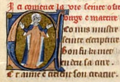 OsythVenerable · Mercian prioressOct 7
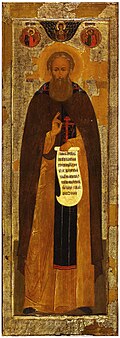 Sergius of NuromVenerable · Founder of Nurom MonasteryOct 7
- Dubthach of ArmaghSaint · Bishop of ArmaghOct 7
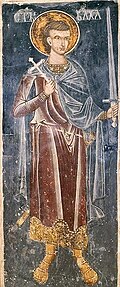 Bacchus of RomeMartyrOct 7
- Sergius the ObedientVenerableOct 7
- Adalgis of NovaraSaint · Bishop of NovaraOct 7
- Aetherius of LyonSaint · Bishop of LyonOct 7
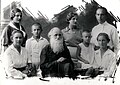 Aleksiy Mogilnitsky of LelchitsyHieromartyrOct 7
- AndechiusMartyrOct 7