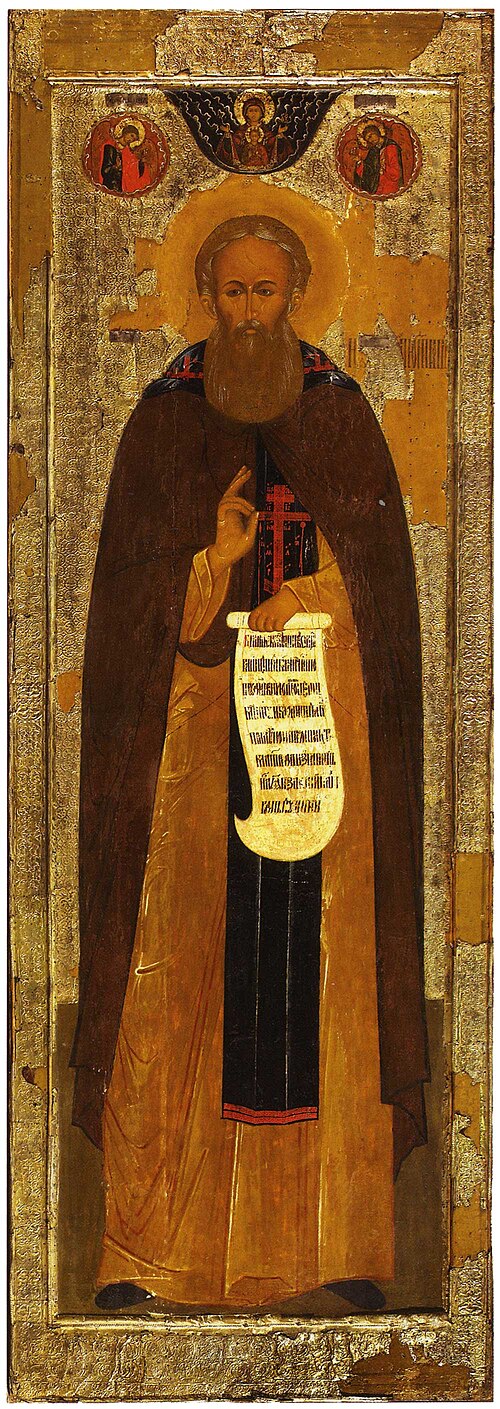
Venerable
Sergius of Nurom
Founder of Nurom Monastery
Monk of Greek origin, disciple of Sergius of Radonezh, founder of the Nurom monastery; died in 1412.
- Feast
- October 7old style October 20
- Reposed
- 141215th century
- Place
- Athos (tonsure, priesthood), Mount Athos
- Order
- Venerables
Life
Venerable Sergius of Nurom (also called Sergius of Vologda or of Obnora) was a Russian monk of Greek origin, a disciple of Saint Sergius of Radonezh and founder of the Spaso-Nurom monastery, in the Vologda region. He was born about the middle of the fourteenth century and died in 1412. He is remembered on 7 October, on the old calendar, in the synaxis of the Athonite saints and in that of the venerable ones of Radonezh.
Life
He received monastic tonsure on Mount Athos. In the second half of the fourteenth century he moved to Russia, to the monastery of Saint Sergius of Radonezh, to follow monastic life there under his guidance. He stayed there some years, in obedience to the abbot of the Trinity monastery. Then he wished to withdraw to a deserted place, to spend more time in prayer and spiritual perfecting. He asked the abbot's blessing and went into the forests of Vologda, on the river Nurma, where he built a chapel. Several times he was attacked by robbers in his solitude, but each time he saved his life.
Later about forty people gathered around him, to lead the life of hermits. Together they raised the church of the Procession of the Honourable Trees of the Life-giving Cross of the Lord and several cells. Not far from the monastery Saint Paul of Obnora struggled, who often spoke with Sergius and came to his monastery for counsel. A few years after the repose of Saint Sergius his relics were found. Church veneration of Sergius of Nurom began in 1546. About eighty miracles worked by the saint have been described.
The Spaso-Nurom monastery
The monastery was founded in 1387. Its buildings, among them two churches, that of the Procession of the Honourable Trees of the Cross and that of the Nativity of Christ, were entirely of wood. In the fifteenth to seventeenth centuries it had lively economic activity and was counted second in the diocese after the cathedral monasteries. In 1714 it held fourteen villages, and at its closing, in 1764, it had three hundred and eighty peasants. After the closing it was turned into a parish church. By 1890 the church had two floors, four altars and venerated icons of the seventeenth century. In 1933 the church was closed by the authorities. Today restoration work is under way.
Commemorated the same day October 7
 Mark of RomeSaint · Bishop of RomeOct 7
 Sergius and BacchusHoly MartyrsOct 7
 Caesarius of TerracinaHieromartyr · Deacon of TerracinaOct 7
 Jonah of HankouSaint · Bishop of HankouOct 7
 OsythVenerable · Mercian prioressOct 7
- Dubthach of ArmaghSaint · Bishop of ArmaghOct 7
 Bacchus of RomeMartyrOct 7
- Sergius the ObedientVenerableOct 7
- Adalgis of NovaraSaint · Bishop of NovaraOct 7
- Aetherius of LyonSaint · Bishop of LyonOct 7
 Aleksiy Mogilnitsky of LelchitsyHieromartyrOct 7
- AndechiusMartyrOct 7