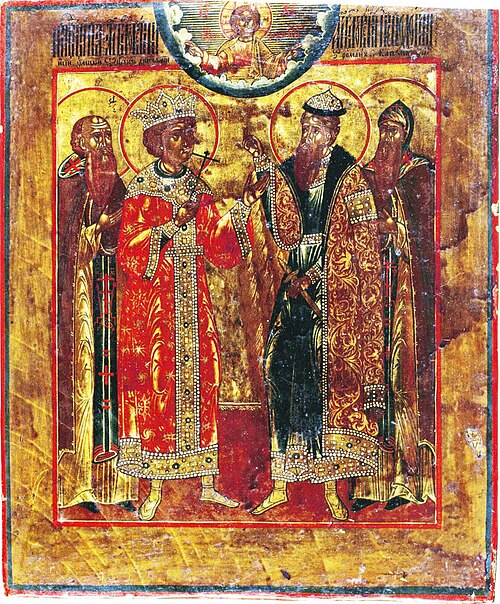
Venerable
Cassian of Uglich
Founder of Cassian Monastery at Uchma
Monk of Greek descent from the ruling house of Theodoro, founder of a monastery at Uchma; died in 1504.
- Feast
- May 21old style June 3
- Reposed
- 150416th century
- Order
- Venerables
Life
Saint Cassian the Greek (Cassian of Uglich, Cassian of Uchma, in the world Constantine Gavras) the venerable was a monk of Greek stock in the Russian Church, the founder of the monastery of Cassian on the river Uchma near Uglich. He died in October 1504 (on 2 or 4 October, according to the sources) at about eighty. He is commemorated on 21 May and 2 October (in some calendars also on 23 May).
From Constantinople to Moscow
Constantine came of a Greek line of rulers of the principality of Theodoro, of a lateral branch of the Komnenoi. He took part in the defence of Constantinople against the Turks and on 29 May 1453 was among the survivors. He entered the circle of Thomas Palaiologos, moved to the Morea and from there, in 1460, to Corfu, where he lived five years. In autumn 1465 he came to Rome in the entourage of the children of Thomas Palaiologos. On 12 November 1472 he arrived in Russia in the suite of Sophia Palaiologina, bride of Grand Prince Ivan III. He lived ten years at the grand prince's court, and in 1482 left Moscow and drew close to Archbishop Joasaph of Rostov, who had fallen into disgrace. After a year he withdrew to the Ferapontov monastery, where he was tonsured a monk with the name Cassian, in honour of Cassian the Roman (the choice of name being determined by the Roman period of Constantine's life).
At the Ferapontov monastery
Exile in the north gave Cassian much. At Ferapontov he met well-known people of the time, such as Nil Sorsky, Spyridon of Kyiv and the icon painter Dionysius. There too he returned to his old passion, writing books. Here there is a mismatch in the sources: they say that in 1477 (which does not fit with a tonsure in 1483) Cassian left the monastery with several monks.
The monastery on the Uchma
After meeting the prince of Uglich Andrei Vasilievich, Cassian began the building of a monastery on the river Uchma, twenty kilometres north of Uglich. In 1479 Andrei Vasilievich gave funds for a new stone church of the Dormition of the Mother of God and endowed the monastery with lands, whose boundaries reached the village of Zolotoruchye, that is, almost to Uglich. After 1491, when the support of the prince of Uglich ceased, the monastery declined. Cassian himself never, in all the years of the monastery, sought ways to power and did not wish to be abbot. His holy relics were buried in the same monastery. The monastery was abolished in 1764 and its churches became parish churches. In the Uglich chronicle many miracles are recorded that happened through the prayers of the venerable one, among them the defence of his monastery from Polish soldiers in 1609-1611.
Veneration
In the eighteenth and nineteenth centuries two stone churches, of the Dormition and of the Nativity of John the Baptist, and a bell tower were built on the peninsula where the monastery had stood. In the first church was the grave of Saint Cassian. At the end of the 1930s the monastery was blown up by the communists. Today only three hills rise above the Volga, and a cross and chapel put up by local historians of Myshkin recall one of the lost centres of medieval culture. In 1993-1994, not far from the ruins of the monastery, a church was built and consecrated in the name of the venerable Cassian of Uchma and of Saint Anastasia the Deliverer from Potions. In 1999 the Museum of the Uchma Land was opened beside the church, a museum of wooden architecture created by the local forester and local historian Vasily Gurievich Smirnov, who also set up in 1989 the cross on the monastery's site and was the museum's first director.
Commemorated the same day May 21
 Constantine the GreatEqual-to-the-Apostles · Roman EmperorMay 21
 HelenaEqual-to-the-Apostles · Empress, mother of ConstantineMay 21
 Anna-NedaRight-Believing · Empress of BulgariaMay 21
 HospitiusVenerable · Recluse of GaulMay 21
 Constantine of MuromRight-Believing · Prince of MuromMay 21
 Serapion the SindoniteVenerable · Egyptian monkMay 21
 Victor of CaesareaMartyr · Soldier of Caesarea in CappadociaMay 21
- Abraham of MinufVenerableMay 21
 Andrew of SimbirskFool-for-Christ · Fool for ChristMay 21
 Alexei KantserovHieromartyr · PriestMay 21
- Moses of UfaVenerable · ArchimandriteMay 21
 Pachomius of KenaVenerable · Disciple of St. Alexander of OshevenskMay 21