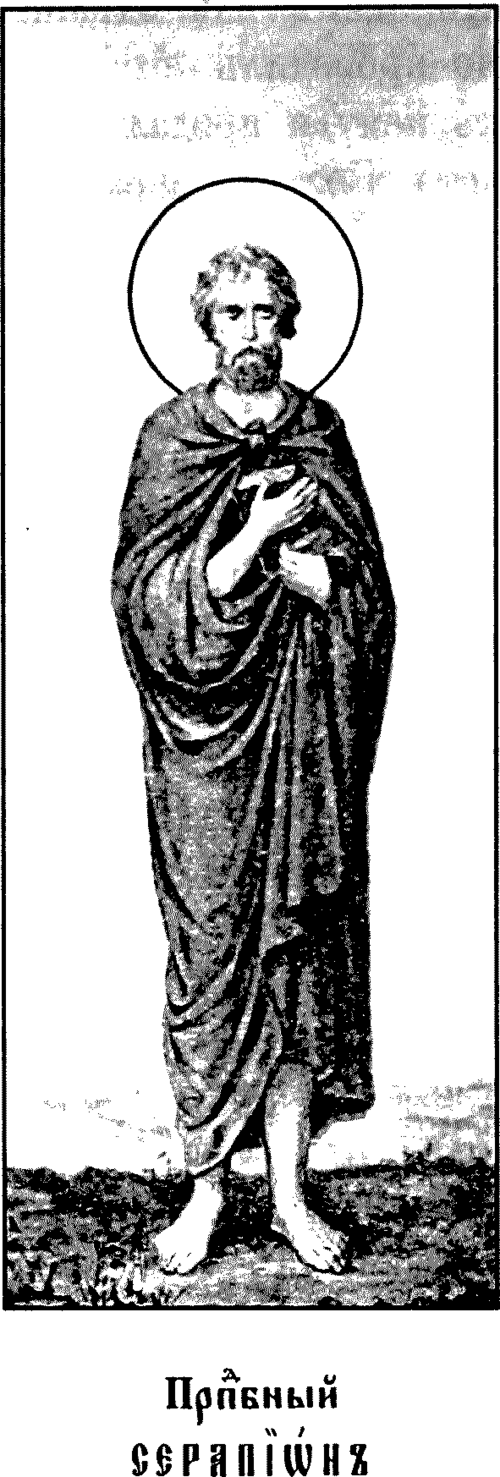
Venerable
Serapion the Sindonite
Egyptian monk
Egyptian monk who died in 356, called the Sindonite, venerated in the Orthodox and Catholic Churches.
- Feast
- May 21old style June 3
- Reposed
- 3564th century
- Place
- Egypt
- Order
- Venerables
Life
Venerable Serapion the Sindonite was an Egyptian monk and ascetic of the fourth or fifth century, called the Sindonite because from youth to death he wore a single white linen garment, the sindon. He is honoured by the Orthodox Church, by the Oriental Orthodox Churches and by the Roman Catholic Church. Our calendar gives him several days: 7 April and 14 May in the Orthodox Church and, in the Western Church, 21 March or 21 May. Our sources do not agree on the year of his death: 350, 356, 386, or, according to one source, the fifth century. He is not to be confused with Serapion of Thmuis, the confessor, who lived in the same Egypt.
His life
From youth he lived, it is said, like a bird of the air, without shelter, sometimes going whole days without food, since he had nothing to buy bread with. It is told that he once gave even his sindon, by which all knew him, to a poor man shivering with cold, and remained half-clothed. One source says he always carried the Gospel in his hand. Asked by someone who had stripped him, he is said to have pointed to the Gospel and answered that it had. Then he gave the Gospel too, to ransom a debtor whom his creditor wished to throw into prison.
A philosopher, wishing to test whether the holy man was truly without possessions, gave him a gold coin to buy bread and stayed to watch. Serapion took a single loaf from the baker, paid, and left without waiting for the change. According to one source this happened in Athens: after four days without food he began to cry out from hunger. The philosophers asked why he cried out, and he answered that he owed three debts, had paid two, and the third still tormented him: the first was the lust of the flesh, the second the love of silver, and the third the belly. Two had left him alone; the third still troubled him.
The actor and the journey to Rome
Serapion was himself a Christian and called others to the way of salvation, by ways of his own. Wishing to bring a Greek actor to Christ, he sold himself to him as a slave and came to live in his house. The actor, struck by the example of the righteous man's holy life, believed and was baptized with his whole family. Then he asked Serapion to remain with him, no longer as a slave but as teacher and friend. The holy man, however, departed and again refused the money offered him.
Near the end of his life he decided to visit Rome. He boarded a ship without paying the sailors anything. They noticed that the old man had eaten nothing for five days and fed him for God's sake, thus fulfilling the Lord's commandment. In Rome he continued to wander, going from house to house with nothing, gathering only spiritual wealth for himself and his neighbour. A Greek source relates that on this pilgrimage he was told of a famous recluse woman, who lived in a small room and never went out. Doubtful, since he was himself a great wanderer, Serapion visited her and asked why she sat there. She answered that she did not sit, but journeyed. Returning from Rome, Serapion settled again in his place. He fell asleep in peace, in deep old age.
Commemorated the same day May 21
 Constantine the GreatEqual-to-the-Apostles · Roman EmperorMay 21
 HelenaEqual-to-the-Apostles · Empress, mother of ConstantineMay 21
 Anna-NedaRight-Believing · Empress of BulgariaMay 21
 HospitiusVenerable · Recluse of GaulMay 21
 Constantine of MuromRight-Believing · Prince of MuromMay 21
 Victor of CaesareaMartyr · Soldier of Caesarea in CappadociaMay 21
 Cassian of UglichVenerable · Founder of Cassian Monastery at UchmaMay 21
- Abraham of MinufVenerableMay 21
 Andrew of SimbirskFool-for-Christ · Fool for ChristMay 21
 Alexei KantserovHieromartyr · PriestMay 21
- Moses of UfaVenerable · ArchimandriteMay 21
 Pachomius of KenaVenerable · Disciple of St. Alexander of OshevenskMay 21