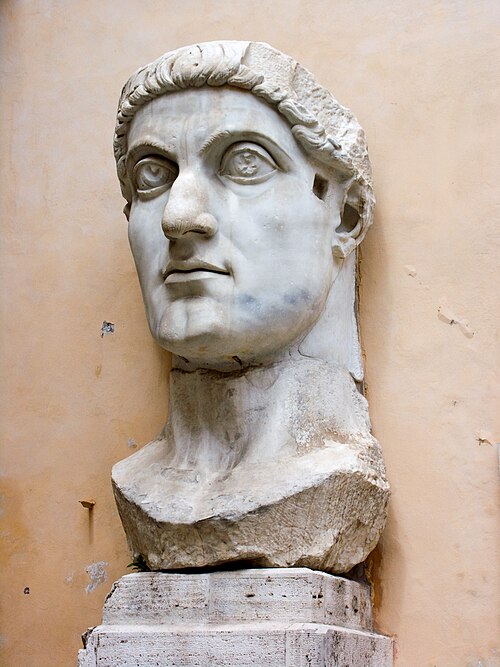
Equal-to-the-Apostles
Constantine the Great
Roman Emperor
First Christian Roman emperor, who granted the Church freedom and convened the First Ecumenical Council.
- Feast
- May 21old style June 3
- Reposed
- 3374th century
- Place
- Nicomedia
Life
The holy Emperor Constantine the Great, equal to the Apostles, was the first Roman emperor to embrace the Christian faith. He reigned in the first half of the fourth century, gave the Church freedom after centuries of persecution, and convened the First Ecumenical Council at Nicaea. The Church commemorates him every year on 21 May, together with his mother, Saint Helena.
The road to the throne
He is believed to have been born at Naissus in Upper Moesia (modern Niš in Serbia) between 272 and 288, with 272 the year most often accepted. His father was Constantius Chlorus and his mother Helena, the daughter of an innkeeper from Bithynia. In 305 he was at Diocletian's court at Nicomedia as a tribune. Constantius died at Eboracum in Britain on 25 July 306, and the army proclaimed Constantine emperor. Years of war with the other rulers of the empire followed.
In the autumn of 312, marching against Maxentius, whose army was four times larger, Constantine wished to pray but did not know to which god. According to the historian Eusebius of Caesarea, he began to pray to the true God, and toward evening he saw in the sky the sign of the Cross with the words "By this conquer". At night the Lord appeared to him in a dream with the same sign and told him to make a standard in its likeness. Thus the labarum, with the monogram of Christ, was born. He defeated Maxentius at the Milvian Bridge on 28 October 312 and entered Rome. The Greek synaxarion adds that he at once took care of the Christians of the city and helped the Church of Africa from the public treasury.
Freedom for the Church
In February 313 at Milan, Constantine and Licinius, ruler of the East, agreed on freedom of religion for all, Christians included (the Edict of Milan). When Licinius again began to persecute Christians, Constantine defeated him in 324 and became sole ruler of the empire. Among the churches associated with his reign are the Church of the Holy Sepulchre in Jerusalem, Old Saint Peter's in Rome and the Church of the Holy Apostles in Constantinople. History also remembers grave moments, such as the deaths of his son Crispus and his wife Fausta in 326.
The Council of Nicaea
When the teaching of the Alexandrian priest Arius, which denied the full divinity of the Son, disturbed the unity of the Church, Constantine first sent a letter by Bishop Hosius of Cordoba, and when this failed, decided to gather the First Ecumenical Council at Nicaea in Bithynia in 325. Eusebius relates that the emperor entered the hall with humility and gentleness and called quarrels within the Church a greater evil than wars. The Council condemned Arius and composed the first part of the Creed. Afterwards the emperor ordered Arius's teaching condemned throughout the empire.
Later, between 327 and 335, under the influence of Eusebius of Nicomedia, he allowed the partisans of Arius to return from exile. In 335 the Council of Tyre condemned Saint Athanasius the Great, and the emperor exiled him to Trier. In 330 he dedicated the new capital, Constantinople, on the shores of the Bosphorus.
Constantine on the Lower Danube
The emperor also campaigned along the Danube. In 328 a bridge over the river was inaugurated between Sucidava (modern Celei) and Oescus, a sign of the importance that the lands north of the Danube had acquired. Through his campaigns he recovered part of the territory of Dacia.
His mother, Helena
Saint Helena built churches in Rome, in Constantinople, at Bethlehem (the basilica of the Nativity) and on the Mount of Olives. The synaxarion says that in 326 she went to Jerusalem, where she found the Holy Cross and the crosses of the two thieves.
Repose and veneration
In April 337 Constantine fell ill, sought healing in hot springs, and then withdrew to Helenopolis in Bithynia, where he prayed in the church of the Martyrs. Feeling the end near, he received baptism in a suburb of Nicomedia from the Arian bishop Eusebius of Nicomedia, and from then on wore no imperial purple, only the white robe of baptism. The synaxarion also records another tradition, according to which he was baptized by Pope Sylvester. He fell asleep on the day of Pentecost in 337. His body was carried to Constantinople and laid in the Church of the Holy Apostles, which he had built.
The Orthodox Church calls him holy emperor, equal to the Apostles, and commemorates him on 21 May together with Saint Helena.
Commemorated the same day May 21
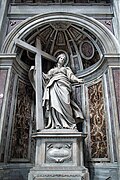 HelenaEqual-to-the-Apostles · Empress, mother of ConstantineMay 21
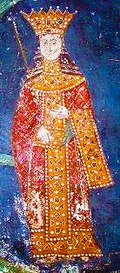 Anna-NedaRight-Believing · Empress of BulgariaMay 21
 HospitiusVenerable · Recluse of GaulMay 21
 Constantine of MuromRight-Believing · Prince of MuromMay 21
 Serapion the SindoniteVenerable · Egyptian monkMay 21
 Victor of CaesareaMartyr · Soldier of Caesarea in CappadociaMay 21
 Cassian of UglichVenerable · Founder of Cassian Monastery at UchmaMay 21
- Abraham of MinufVenerableMay 21
 Andrew of SimbirskFool-for-Christ · Fool for ChristMay 21
 Alexei KantserovHieromartyr · PriestMay 21
- Moses of UfaVenerable · ArchimandriteMay 21
 Pachomius of KenaVenerable · Disciple of St. Alexander of OshevenskMay 21