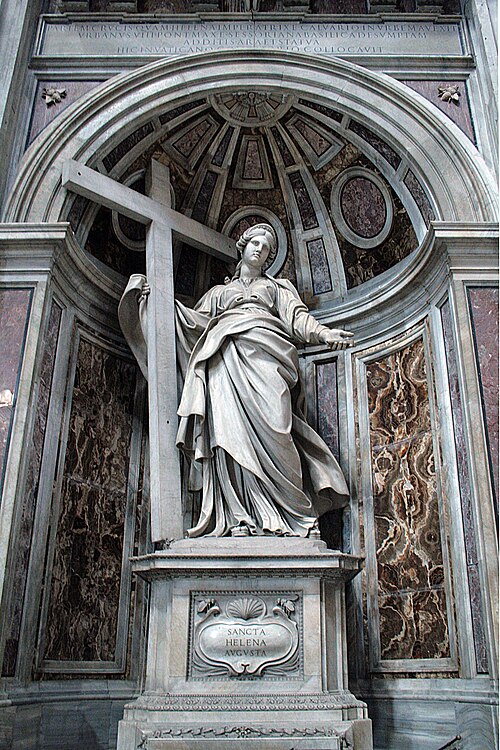
Equal-to-the-Apostles
Helena
Empress, mother of Constantine
Mother of Emperor Constantine, who found the Holy Cross at Jerusalem and built churches in the Holy Land.
- Feast
- May 21old style June 3
- Reposed
- 3304th century
- Place
- Constantinople
Life
The Holy Empress Helena, Equal to the Apostles, was the mother of Emperor Constantine the Great. The Church honours her for her faith, for her care for the holy places and because, according to tradition, she found the Holy Cross of the Lord at Jerusalem. She fell asleep around 330 (some sources say earlier), at about eighty years of age, and is commemorated on 21 May (old style) together with her son, on the day of the Holy Emperors Equal to the Apostles.
Early life
Her place of birth is uncertain. Most sources, beginning with Procopius, point to Drepanon in Bithynia, in north-western Asia Minor, which Constantine later renamed Helenopolis. Her date of birth is worked out from Eusebius of Caesarea, who writes that she was about eighty on her return from Palestine, which places it around 246 to 249. The sources say she was of humble birth: the Greek synaxarion calls her the daughter of an innkeeper, and Saint Ambrose of Milan calls her a stabularia, a servant at an inn, and makes it a praise.
She met Constantius Chlorus, an officer who would become Caesar. Ancient writers call her either his wife or his concubine, and historians disagree about the nature of the union. Around 272 she bore her son Constantine at Naissus (Niš). Before 289 Constantius, rising in rank, left her to marry Theodora, Maximian's daughter. Helena never remarried. She lived for a time in obscurity, though close to her son, who kept a deep regard for her, and she came to the court of Diocletian at Nicomedia.
The empress
After Constantine was proclaimed emperor by his father's troops in 306, Helena was brought back to the court in 312. In 324, after the victory over Licinius, her son gave her the title of Augusta. According to Eusebius, Constantine brought Helena to the faith; the Russian lives of the Holy Emperors say instead that she was already a Christian and instilled in her son respect for the Christian faith. The synaxaria stress her almsgiving, and Eusebius adds that she had unlimited access to the imperial treasury.
Pilgrimage to the Holy Land
Between 326 and 328, at nearly eighty years of age, Helena set out for the Holy Land with wide powers and funds from her son. According to Eusebius and Socrates Scholasticus, she built or adorned the church of the Nativity at Bethlehem and the church of Eleona on the Mount of Olives, the places of the Lord's birth and ascension. She had the places linked with the earthly life of the Saviour and of the Mother of God cleared of the traces of paganism. According to local tradition, a chapel at Mount Sinai is also linked with her, and in Cyprus the monastery of Stavrovouni, where a piece of the rope with which the Saviour was bound is kept.
During this time, the synaxaria testify, she gave great alms and prepared meals for the poor, whom she served with her own hands.
The finding of the Holy Cross
Emperor Hadrian had built in the 130s a temple of Venus over the supposed site of the Tomb of Christ. According to the tradition told by Saint Ambrose and Rufinus, Helena had it torn down and, with Patriarch Macarius of Jerusalem, began excavations that brought three crosses to light. To tell which was the Lord's, a woman near death was touched by each in turn, and at the touch of the third she was healed at once. Sozomen and Theodoret add that she also found the nails of the crucifixion, one of which was set in Constantine's helmet and another in the bridle of his horse.
Eusebius does not mention the finding of the Cross, but describes the pilgrimage at length. From Constantine's letter to Macarius we know that the emperor himself ordered the church of the Holy Sepulchre to be raised over the place of the Tomb. According to the Russian synaxarion, Helena left the Holy Cross with the Patriarch at Jerusalem and took only a part for the emperor.
Repose and relics
Helena fell asleep around 330, with her son at her side; the Russian synaxarion gives 327, and other sources give 18 August 330, at Nicomedia. She was buried in the mausoleum on the Via Labicana near Rome, where her sarcophagus is, now in the Vatican Museum. Other historians, such as Socrates and Nikephoros Kallistos, say her body was moved two years later to the church of the Holy Apostles at Constantinople. Her relics are venerated in Rome, in the church of Santa Croce in Gerusalemme, where she is said to have brought parts of the Cross, and in other places; Doxologia records their coming from Italy to Athens.
Veneration
The Orthodox Church celebrates her on 21 May together with Saint Constantine, as the Holy Great Emperors Equal to the Apostles; the Roman Catholic Church remembers her on 18 August. She is venerated by the Orthodox and the Oriental Orthodox, and by Catholics, Anglicans and Lutherans. She is the patroness of the island of Kastellorizo. A popular legend of the Middle Ages in Britain makes her the daughter of King Cole of Colchester, but it has no basis in the early sources.
Commemorated the same day May 21
 Constantine the GreatEqual-to-the-Apostles · Roman EmperorMay 21
 Anna-NedaRight-Believing · Empress of BulgariaMay 21
 HospitiusVenerable · Recluse of GaulMay 21
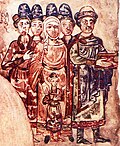 Constantine of MuromRight-Believing · Prince of MuromMay 21
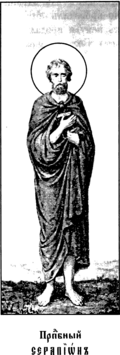 Serapion the SindoniteVenerable · Egyptian monkMay 21
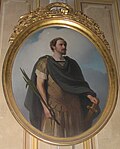 Victor of CaesareaMartyr · Soldier of Caesarea in CappadociaMay 21
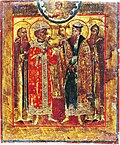 Cassian of UglichVenerable · Founder of Cassian Monastery at UchmaMay 21
- Abraham of MinufVenerableMay 21
 Andrew of SimbirskFool-for-Christ · Fool for ChristMay 21
 Alexei KantserovHieromartyr · PriestMay 21
- Moses of UfaVenerable · ArchimandriteMay 21
 Pachomius of KenaVenerable · Disciple of St. Alexander of OshevenskMay 21