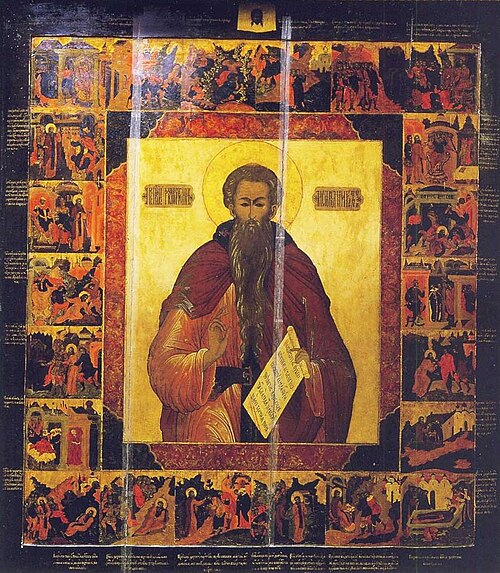
Venerable
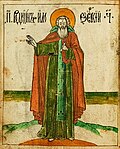
Chariton the Confessor
Monk in the Judean desert
Monk born at Iconium in Asia Minor, who died in the Judean desert around 350.
- Feast
- September 28old style October 11
- Reposed
- 3504th century
- Place
- Bethlehem
- Order
- Venerables
Life
The Venerable Chariton the Confessor was a monk born at Iconium in Asia Minor, who died in the Judean desert around 350, the founder of lavra-type monasticism in Palestine. He is venerated by the Eastern and the Western Church. His feast is on 28 September.
Confession and abduction
He came from Iconium, in the province of Lycaonia, and was a pious Christian, perfect in virtue. In the persecution of the emperor Aurelian (270-275), according to some later sources, under other emperors, he was seized at Iconium, confessed Christ and condemned the pagan gods as demons cast down from heaven. His life says he was beaten so harshly that his entrails showed, and flesh fell from the bones; in his struggle he was strengthened by the example of Saint Thecla the Protomartyr, born in the same city, whom he honoured especially. He remained alive, however, by God's providence. After Aurelian's death, his successor Tacitus ordered the release of imprisoned Christians and Chariton was freed; he was grieved that he had not suffered to the end, for it would have been sweeter to him to die for Christ than be let go free.
The lavras of the Judean desert
He then set out on pilgrimage to Jerusalem and the other holy places, but in the neighbourhood of Jerusalem he was seized by robbers and taken to a cave in the Pharan valley (the upper course of Wadi Qelt). Expecting death, he prayed fervently and thanked God. A snake then entered the cave and, drinking from the vessel of wine left by the robbers, poisoned it with its venom; the robbers, returning, drank the poisoned wine and all died. Chariton thanked God and stayed to struggle in that place; the robbers' gold he gave to the poor, and in their cave he built a church. Disciples soon came and the lavra of Pharan was born, the first lavra-type monastery in the Judean desert. Wishing stillness, he went farther: he founded the lavra of Douka, near Jericho, on the Mount of Temptation, on the ruins of the Hasmonean and Herodian fortress, and, around 345, a third lavra, Souka (the Old Lavra), in the valley of Tekoa. His fame drew Christians to learn from him, but, wanting solitude, he kept moving on. At Souka he settled in a cave in the cliff, the Hanging Cave of Chariton, where the archaeologist Yizhar Hirschfeld found his remains. Returning, toward the end, to Pharan, he died there in deep old age and was buried in the church raised on the site of the robbers' cave. After the Muslim conquest his relics were moved to the Old Lavra, today called the Monastery of Chariton, a name preserved in the Arabic name of the valley, Wadi Khureitun.
His importance
His importance lies chiefly in having established by his own example the rules of monastic life in the Judean desert, in the form of lavras: silence, only one meal a day, after sunset, of bread, salt and water, manual work, the night divided between sleep and psalmody, prayer at fixed hours, staying in the cell, guarding the thoughts, hospitality. Leaving Pharan, he left these rules to his disciples. Tradition counts him among the originators of the Typikon of Jerusalem: its oldest manuscripts (thirteenth century) urge the abbot to keep the order as it was left by the holy fathers Euthymius the Great, Sabbas the Sanctified, Theodosius the Cenobiarch, Gerasimus of the Jordan, Chariton the Confessor and Cyriacus the Anchorite; Saint Symeon of Thessalonica says that Sabbas received it from Euthymius and Theoctistus, and they from those before them and from the confessor Chariton. The Typikon provides for him a service with polyeleos, which is rare for saints of the early Church. Tradition also credits him with composing the Office of the Monastic Tonsure.
Commemorated the same day September 28
 Wenceslaus of BohemiaPassion-Bearer · Duke of BohemiaSep 28
 Hilarion of KievSaint · Metropolitan of KievSep 28
 Faustus of RiezSaint · Bishop of RiezSep 28
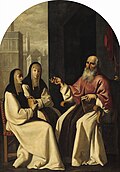 EustochiumVenerable · Consecrated virginSep 28
 Salonius of GenevaSaint · Bishop of GenevaSep 28
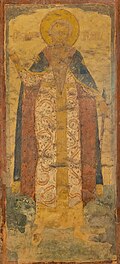 Nicholas SvyatoshaVenerable · Prince and monk of the Caves LavraSep 28
 Abraham the Recluse of the Kiev CavesVenerable · Recluse of the Kiev Caves LavraSep 28
 Arethas the RecluseVenerable · Recluse of the Kiev CavesSep 28
 Athanasius the RecluseVenerable · Recluse of the Kiev CavesSep 28
 Damian the HealerVenerable · Priest and healer of the CavesSep 28
 Matthew the ClairvoyantVenerable · Monk of the Kiev CavesSep 28
 Herodion of Ilo-OzeroVenerableSep 28