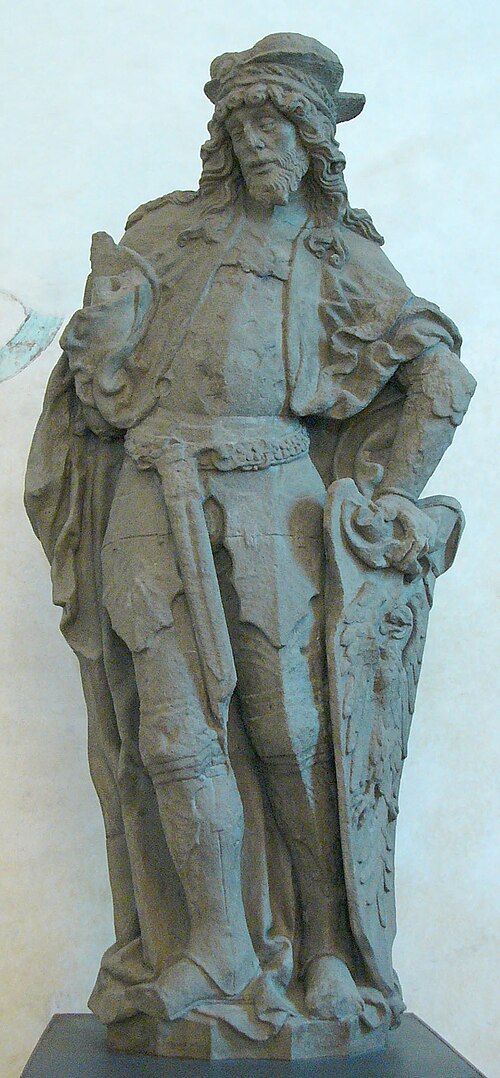
Passion-Bearer
Wenceslaus of Bohemia
Duke of Bohemia
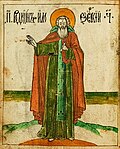
Duke of Bohemia from 921 to 935, pious and merciful, killed on the orders of his brother Boleslav.
- Feast
- September 28old style October 11
- Reposed
- 93510th century
- Place
- Stará Boleslav
- Order
- Martyrs
Life
Wenceslaus of Bohemia was duke of Bohemia from 921 to 935, a pious ruler, merciful to the poor, killed on the order of his brother Boleslaus. The Church remembers him as a holy martyr and passion-bearer, and the Czech people honour him as the patron of the land and of the state. He is remembered on 28 September (11 October on the new style), and the translation of his relics on 4 March. The Russian Orthodox Church has honoured him from of old, and the Church in the Czech lands keeps his memory on the day of his martyrdom. He lived before the great schism, and so is a saint of the undivided Church.
Family and childhood
He was born around 907, the son of Duke Vratislaus I of the Přemyslid dynasty and of Drahomíra. His grandfather Bořivoj and his grandmother Ludmila had been baptized by Saints Cyril and Methodius into the Byzantine faith, before the schism. His mother, the daughter of a chief of the Havelli, was baptized at her marriage. His grandmother, Saint Ludmila (16 September), saw to it that he was raised in the faith and taught the Church Slavonic liturgical language, and the Orthodox sources say he also learned Latin and Greek. He was sent early to the school at Budeč.
His father died in 921 (Russian sources give 920) when Wenceslaus was a child, and Ludmila became regent. Drahomíra, jealous of Ludmila's influence, had her killed: on 15 September 921, at Tetín castle, assassins strangled her, according to tradition with her own veil. Drahomíra took the regency and began measures against the Christians. When Wenceslaus was eighteen the Christian nobles rose, were victorious, and Drahomíra was sent into exile at Budeč.
His reign
With the support of the nobles Wenceslaus took the government around 925. He moved the relics of Saint Ludmila to the church of Saint George in Prague, built by his father. He was peace loving, honoured the clergy, built and adorned churches, and at Prague raised the rotunda of Saint Vitus, the foundation of the cathedral of today. The Orthodox sources say he bought the freedom of pagan children sold into slavery and had them raised as Christians.
The chronicler Cosmas of Prague tells, after the Passion of the saint, that he rose at night from his bed and went barefoot, with one chamberlain, to the churches of God and gave alms to widows, orphans and prisoners, so that he seemed not a prince but the father of all the wretched. A legend adds that when Count Radislas rebelled, Wenceslaus called him to single combat, to avoid shedding innocent blood, and Radislas saw two angels at his side and repented.
His reign was burdened by raids of the Magyars and by the pressure of the Saxon king Henry the Fowler and Duke Arnulf of Bavaria, who reached Prague in early 929 and forced him to resume paying tribute. Western historians also note that he brought German priests into the land and favoured the Latin rite, while the Orthodox sources see him as a defender of the Eastern and Slavonic tradition, and the two views do not fit easily together.
Martyrdom
Some nobles joined the duke's younger brother, Boleslaus, to kill him. Boleslaus invited him to the feast of Saints Cosmas and Damian at Stará Boleslav and after a night asked him to stay another day. His servants warned him, but Wenceslaus would not believe in a plot and gave his life into the will of God. In the morning, on 28 September 935, as he went to Matins, he was attacked at the church doors by Boleslaus's men. According to the Western sources several companions stabbed him and then Boleslaus ran him through with a lance. Some sources give the year 929, but most historians think 935 more probable.
His body was left without burial. His mother, hearing of her son's murder, found it and laid it in a recently consecrated church at the princely court. The blood splashed on the church doors could not be washed off, but after three days it vanished of itself. Later, after repenting, Boleslaus moved the saint's relics in 938 to Prague, to the church of Saint Vitus, which Wenceslaus himself had built.
Veneration
Wenceslaus was counted a martyr and a saint at once after his death, and within a few decades four lives of him were in circulation. They had a strong influence on the idea of the righteous king, whose power springs from piety. Emperor Otto I gave him the royal title after his death, which is why he is called king in legend and song. The hymn "Svatý Václave" is one of the oldest Czech songs, and since 2000 the day of 28 September has been a public holiday in the Czech Republic, Statehood Day. The English carol "Good King Wenceslas", published in 1853 by John Mason Neale, sings of him. A legend says that an army of knights sleeps in the mountain Blaník, ready to wake under his command if the land is in danger.
In the troparion the Orthodox Church calls him a defender of the Eastern Church in the Czech lands and a warm refuge of the poor and the orphans, who like a second Abel took death without malice, at the hand of his brother, before the doors of the church. His shrine is in Saint Vitus Cathedral in Prague.
Commemorated the same day September 28
 Hilarion of KievSaint · Metropolitan of KievSep 28
 Faustus of RiezSaint · Bishop of RiezSep 28
 EustochiumVenerable · Consecrated virginSep 28
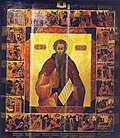 Chariton the ConfessorVenerable · Monk in the Judean desertSep 28
 Salonius of GenevaSaint · Bishop of GenevaSep 28
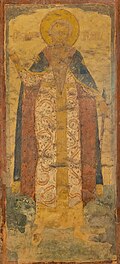 Nicholas SvyatoshaVenerable · Prince and monk of the Caves LavraSep 28
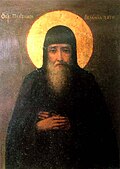 Abraham the Recluse of the Kiev CavesVenerable · Recluse of the Kiev Caves LavraSep 28
 Arethas the RecluseVenerable · Recluse of the Kiev CavesSep 28
 Athanasius the RecluseVenerable · Recluse of the Kiev CavesSep 28
 Damian the HealerVenerable · Priest and healer of the CavesSep 28
 Matthew the ClairvoyantVenerable · Monk of the Kiev CavesSep 28
 Herodion of Ilo-OzeroVenerableSep 28