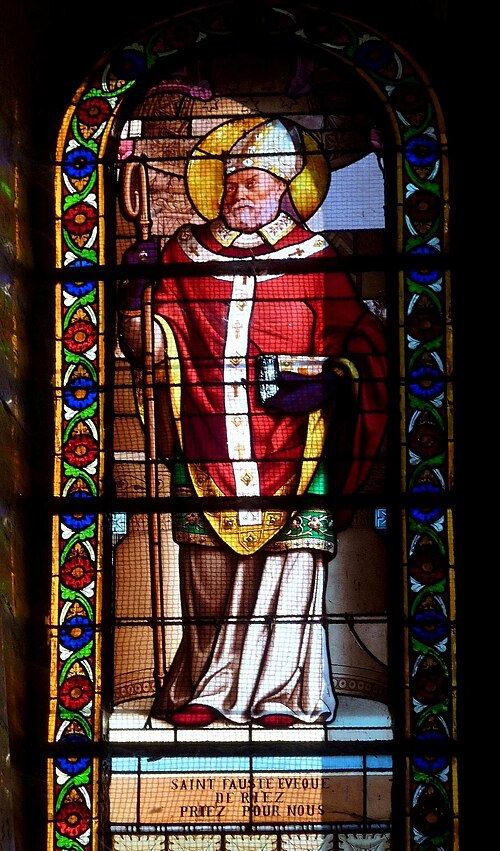
Saint
Faustus of Riez
Bishop of Riez
Bishop of Riez in Provence in southern Gaul, who died around 495.
- Feast
- September 28old style October 11
- Reposed
- 4955th century
- Place
- Riez
- Order
- Hierarchs
Life
Saint Faustus was bishop of Riez in Provence, in southern Gaul, and one of the best-known defenders of the faith in the fifth century. The Church remembers him as a monk, abbot and bishop who stood against Arianism and against the teaching of strict predestination, and who paid for it with exile.
He was born between 405 and 410 into a wealthy Gallo-Roman family; his contemporaries Avitus of Vienne and Sidonius Apollinaris say that he came from Britain. He received a fine education in rhetoric and Christian philosophy, and some think he practised as a lawyer. Under the influence of his mother, known for her holiness, he gave up the world and entered the monastery of Lérins, on the island of Saint Honoratus. There he was ordained priest, and in 432, because of his piety, he was chosen abbot in place of Maximus, who had become bishop of Riez. He led the monastery for about twenty-five years, founded a school of theology there, and became known as a gifted extempore preacher and a stern ascetic.
After Maximus he himself became bishop of Riez, in 461 according to some sources. The new office changed nothing in his way of life: he kept his fasts, returned often to Lérins to renew his zeal, and founded many monasteries in his diocese. He took part in the council held at Rome in 462 under Pope Hilarus, and in 471 he travelled with Bishops Leontius of Arles and Basil of Aix to the Gothic king Euric for peace negotiations.
He fought firmly against Arianism and Pelagianism, and also against the doctrine of absolute predestination taught by the priest Lucidus and condemned at the synods of Arles and Lyons (475). At the request of the bishops, above all Leontius of Arles, he wrote two books on the grace of God and the freedom of the human will; his own position was later sharply criticised, and semi-Pelagianism was condemned at the Second Council of Orange in 529. He also wrote two books on the Holy Spirit and left twelve surviving letters; a work against the Arians and Macedonians has been lost. He held that the human soul is in a certain sense corporeal, God alone being pure spirit.
Because he opposed Arianism, King Euric, who ruled much of southern Gaul, drove him from his see, and his exile lasted eight years. He returned after the king's death in 484 and shepherded his flock until he fell asleep between 490 and 495. His people considered him a saint and built a basilica in his honour at Riez. His memory is kept on 28 September.
Commemorated the same day September 28
 Wenceslaus of BohemiaPassion-Bearer · Duke of BohemiaSep 28
 Hilarion of KievSaint · Metropolitan of KievSep 28
 EustochiumVenerable · Consecrated virginSep 28
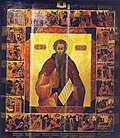 Chariton the ConfessorVenerable · Monk in the Judean desertSep 28
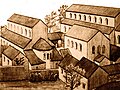 Salonius of GenevaSaint · Bishop of GenevaSep 28
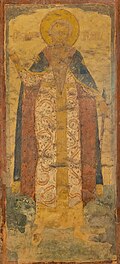 Nicholas SvyatoshaVenerable · Prince and monk of the Caves LavraSep 28
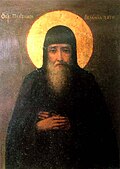 Abraham the Recluse of the Kiev CavesVenerable · Recluse of the Kiev Caves LavraSep 28
 Arethas the RecluseVenerable · Recluse of the Kiev CavesSep 28
 Athanasius the RecluseVenerable · Recluse of the Kiev CavesSep 28
 Damian the HealerVenerable · Priest and healer of the CavesSep 28
 Matthew the ClairvoyantVenerable · Monk of the Kiev CavesSep 28
 Herodion of Ilo-OzeroVenerableSep 28