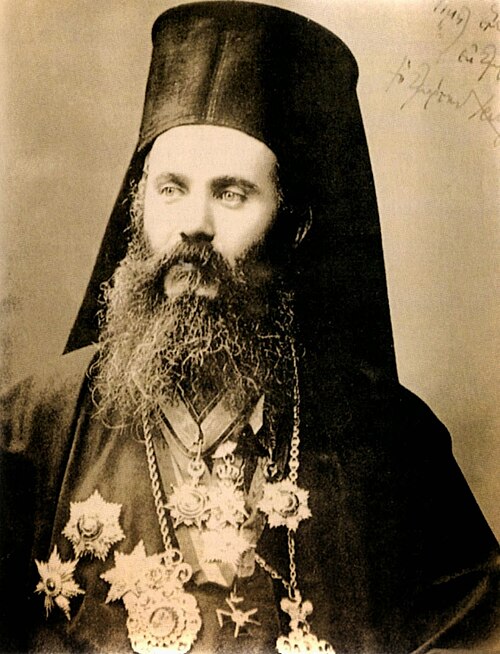
Hieromartyr
Chrysostomos of Smyrna
Metropolitan of Smyrna
Greek Metropolitan of Smyrna, who died a martyr in September 1922 at the fall of the city.
Life
Saint Chrysostomos of Smyrna, Hieromartyr, in the world Chrysostomos Kalafatis, was metropolitan of Smyrna, killed by a mob at the fall of the city, in September 1922. The Church of Greece numbered him among the saints on 4 November 1992. He is remembered on the Sunday before the Exaltation of the Holy Cross.
He was born on 8 January 1867 in Triglia, in Bithynia (today Tirilye, in Turkey), one of eight children (four boys and four girls) of Nikolaos Kalafatis and Kalliopi Lemonidou. His father, a learned man, represented his fellow townsmen before the Turkish courts and had been elected village elder. His mother, a pious woman, had dedicated him to the Mother of God. From a young age he showed his wish to become a priest, and his parents, selling part of their property, sent him at 17 to the theological school at Halki. There he met the metropolitan of Mytilene, Constantine Valiadis, who, valuing his diligence, bore the expense of his studies. He graduated with distinction. Metropolitan Constantine ordained him deacon, made him archdeacon in Mytilene and then in Ephesus, where he was transferred in 1896. On 2 April 1897 Constantine was elected Ecumenical Patriarch, and on 18 May he ordained Chrysostomos priest and named him Great Protosyncellus of the Patriarchate. As such he was also president of the mixed Orthodox-Anglican commission and preached much, becoming an unusually eloquent preacher. His “Oration at the burial” of the Patriarch of Alexandria, Sophronius IV, and “Oration to the Crucified,” delivered on Good Friday of 1901, are regarded as monumental.
On the day of his election as metropolitan of Drama he said to Patriarch Joachim III words that remained prophetic: “With all my heart and all my mind I will serve the Church and the nation, and the mitre which your holy hands have set on my head, if it is ever to lose the brilliance of its jewels, will be the crown of thorns of a martyr hierarch.” On 23 May 1902 he was consecrated bishop, and on 22 July he arrived at his see. He was metropolitan of Drama until 1910, in the time of the struggle for Macedonia, in which he supported the Greek national cause and opposed the Bulgarian Exarchate. In Drama he built a new building for the metropolis, schools for boys and girls, a hospital, a gymnasium, houses for tobacco workers, orphanages and homes for the aged. Because of his activity, the Turkish authorities demanded his recall in 1907 and again in 1909, but after the proclamation of the constitution in 1908 he returned to Drama.
In 1910 he was elected metropolitan of Smyrna, where he cared for sport, education and the social welfare of the city. In 1914 he was removed from his see by the Ottoman authorities and, after the landing of the Greek army at Smyrna on 2 (15) May 1919, he was restored. He was a fervent supporter of the Greek national cause. When the Greek army lost the war and withdrew in August 1922, the metropolitan declined the offer of the Great Powers to leave the city safely and decided to stay with his flock. On 27 August (10 September) 1922, after the Turkish army entered Smyrna, a Turkish officer and two soldiers took him from the office of the cathedral and led him to the Turkish commander-in-chief, Nureddin Pasha. He told him that he was no longer recognized as metropolitan of Smyrna, that Mustafa Kemal would not receive him, and that he should appoint a deputy and withdraw. As the metropolitan went down the stairs, outside, in front of the Government House, the crowd seized him, tore at his beard and killed him cruelly. It is said that Nureddin Pasha decided to hand him over to the crowd, but witnesses do not agree on the evidence. His death is certain, however. He was, at that moment, the last metropolitan of Smyrna until 2016. The Church of Greece numbered him among the saints in 1992, and in 1993 entered in the synaxarion all the martyrs of the Asia Minor Catastrophe.
Commemorated the same day August 27
 Liberius of RomeSaint · Bishop of RomeAug 27
 Hosius of CordubaSaint · Bishop of CordubaAug 27
 Caesarius of ArlesSaint · Archbishop of ArlesAug 27
 Poemen the GreatVenerable · Desert FatherAug 27
 PhanouriosMartyr · the Newly RevealedAug 27
 Lycerius of CouseransSaint · Bishop of CouseransAug 27
 Gebhard of ConstanceSaint · Bishop of ConstanceAug 27
 NarnusSaint · First bishop of BergamoAug 27
 Kuksha of the Kiev CavesHieromartyr · Monk of the Kiev Caves LavraAug 27
 Rufus of CapuaMartyrAug 27
 John SmirnovHieromartyr · Archpriest at ZarayskAug 27
- Alexander TsitserovHieromartyr · PriestAug 27