Martyr
Phanourios
the Newly Revealed
Called the Newly Revealed, honored as a martyr in the Orthodox and Catholic Churches; remembered on 27 August.
Life
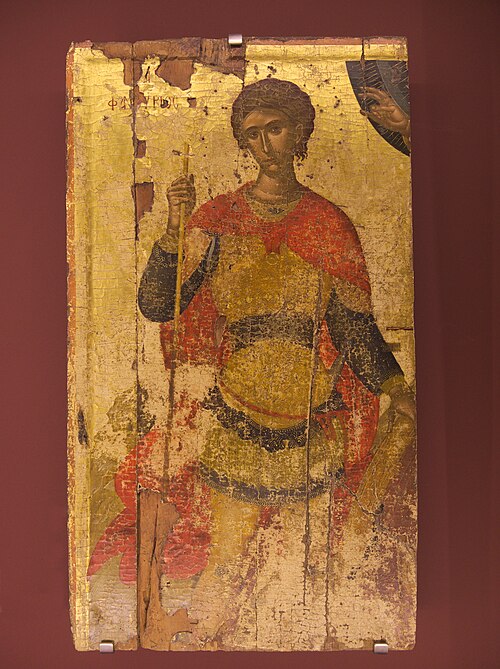
Saint Phanourios the Martyr, called “the Newly Revealed,” is venerated in the Orthodox and the Catholic Church and is remembered on 27 August. He is known only from the icon found on the island of Rhodes and from the tradition after its discovery. His name means “the one who reveals.”
No written life of him survives, the place and time of his martyrdom are not known, nor his parents, and no relics are preserved. From the image on the icon, he was a Christian soldier, perhaps an officer, who lived on the island of Rhodes and was severely tortured and killed by pagans or Romans because he would not renounce the Christian faith. According to a tradition widespread in Crete, he had a sinful mother, for whose amendment he prayed unceasingly. In the moment of his torments he is said to have asked God to help those who would pray for the salvation of his mother.
The icon was found in the ruins of an old church on Rhodes, according to one source in the sixteenth century, according to others in the fourteenth. When the Ottoman Turks conquered the island, they rebuilt the walls of the city, using stones from ruined buildings nearby. In clearing the rubble they came upon a small church and many icons, whose colours were so damaged that neither faces nor inscriptions could be seen. Among them the workmen found an icon in perfect condition, which the faithful took as a sign that the discovery was not by chance but by God's will. The Metropolitan of Rhodes, Nilus, read the inscription “Saint Phanourios” and understood that the image had been found of a martyr of the early centuries, forgotten until then. The saint is shown in a soldier's armour, with a cross in his hand, and above the cross a burning candle. Around the icon are twelve scenes of his torments: he answers before the judge, is beaten with stones on face and head, scourged, torn with iron nails, beaten lying on the ground, in prison, again made to sacrifice to the gods, bound to the wheel and burned with candles, left unharmed among beasts, crushed under a great stone, standing before idols with burning coals in his hands, and finally in the blazing furnace, with hands raised to heaven.
His veneration spread quickly from Rhodes to the Dodecanese, Cyprus, Crete, Chios, Lesbos, Patras and the whole Greek world. He is the patron of Rhodes. Because his name sounds like the verb meaning “to reveal,” he is called on in prayer to help find lost things. On the eve of his feast a lenten pie, the fanouropita, is baked, for the forgiveness of his mother. A small chapel of the saint near the village of Agios Georgios on the north coast of Cyprus stands close to fossil bones of pygmy hippopotamuses; locals took them for the saint's bones and powdered them for a healing drink, and the species was given in 1972 the name Phanourios minutus. Angelos Akotantos of Crete painted a number of icons of the saint, many of them showing him slaying a dragon; Cretan tradition says that in the fifteenth century the saint saved many Cretans from death at the hands of the Ottomans. In Greece he is the patron of shadow-theatre puppeteers, because he reveals jobs to them.
Commemorated the same day August 27
 Liberius of RomeSaint · Bishop of RomeAug 27
 Hosius of CordubaSaint · Bishop of CordubaAug 27
 Caesarius of ArlesSaint · Archbishop of ArlesAug 27
 Poemen the GreatVenerable · Desert FatherAug 27
 Chrysostomos of SmyrnaHieromartyr · Metropolitan of SmyrnaAug 27
 Lycerius of CouseransSaint · Bishop of CouseransAug 27
 Gebhard of ConstanceSaint · Bishop of ConstanceAug 27
 NarnusSaint · First bishop of BergamoAug 27
 Kuksha of the Kiev CavesHieromartyr · Monk of the Kiev Caves LavraAug 27
 Rufus of CapuaMartyrAug 27
 John SmirnovHieromartyr · Archpriest at ZarayskAug 27
- Alexander TsitserovHieromartyr · PriestAug 27